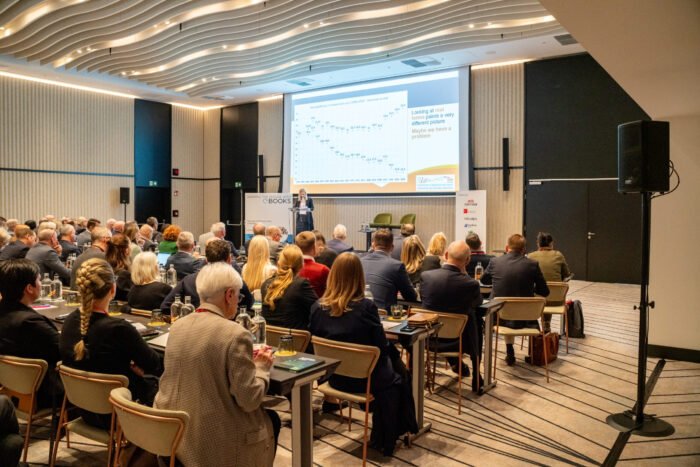
On 19 February 2026, Intergraf brought together over 100 leaders from across the European book printing, and publishing value chain at the Shaping the Future with Books conference in Brussels. The full-day event convened publishers, policymakers, printing industry experts, academics, and influencers from 22 countries to address the key trends shaping the book sector’s future from sustainability and digital engagement to reading behaviour and supply-chain cooperation.
A diverse and insightful speaker line-up
The event featured contributions from a range of high-profile figures whose presentations offered valuable insights into current challenges and opportunities in the book ecosystem:
Sonia Draga, president of the European Book Publishers Federation (FEP) outlined the evolving dynamics of the European publishing and printing sectors, emphasizing their shared ecosystem and mutual dependence. Both play a vital role in sustaining Europe’s cultural foundations, and their continued cooperation is essential.
Gina Lyons, business systems director at Clays, spoke about the critical importance of sustainability in print products and services, outlining how Clays has integrated sustainability into its core business strategy. Lyons shared practical approaches to setting science-based emission targets, managing supplier engagement, and translating sustainability into measurable actions across the print value chain.
Jasmine Darban, book influencer and co-founder of a Publishing Imprint – presented on the impact of BookTok on the publishing industry, exploring how social media platforms are reshaping reader engagement, expanding access to literature, and inspiring younger audiences to discover and interact with books. Her talk pointed to the growing influence of digital culture on traditional publishing practices.
Marte Pupe Støyva, PhD student and senior librarian at Stavanger University Library, examined how students read and interact with different media for academic purposes, explaining research into reading mediums, the bodily involvement in reading, attention, and how physical print contributes to deeper engagement and learning outcomes. Her presentation was complemented by the speech of Andrea Cangini from the Italian Osservatorio Carta, Penna & Digitale who underscored the vital role of physical interaction in the cognitive and emotional experience of reading and writing by hand.
Adam Page, managing director at Smithers,shared latest market data and trends during his overview of the European book market. His presentation drew on Smithers’ extensive research to outline current market dynamics and offer a data-driven outlook on future sector developments.
European book printing is valued at Euros 7.8 billion in 2025, growing at an average 1.5% since 2020. Digital printing is forecast to grow at 7.3% to 2030 while analog printing will decline at 5.0% up to 2030.
From the policy perspective, Normunds Popens, deputy director-general at the European Commission’s Directorate-General for Education, Youth, Sport and Culture (DG EAC), stressed that literacy and engagement with books are fundamental to the development of critical thinking. He highlighted the EU programmes in place to support culture and reading, and invited ongoing dialog with stakeholders.
Hermann Eckel, product manager from pagina showcased BOOXITE, a software programme that allows for a better communication of data in the course of book production from author to publisher, printer, distributor and consumer.
Jonathan Huddart, head of Sales from CPI presented the advantages of delocalised printing to reduce transport and warehousing costs.
Tobias Kaase, CEO of mediaprint solutions presented how the Digital Product Passport for Books can provide more transparent communication along the value chain and increase efficiency.
Panel discussion: value chain cooperation
One of the highlights of the program was the panel discussion on ‘Value Chain Cooperation to Enhance Supply Chain Resilience and New Supply Chain Models.’ Moderated by Håvard Grjotheim, Chairman of ScandBook AB, the session brought together industry voices with deep expertise in publishing, paper production, and printing:
Peter Kraus vom Cleff, managing director of the Börsenverein des Deutschen Buchhandels, discussed the need for strengthened cooperation across publishers, printers, and stakeholders to ensure a resilient and sustainable book value chain. Matt Baehr, executive director of the US Book Manufacturer’s Institute, highlighted the importance of strategic collaboration in manufacturing, adapting to evolving market conditions and he made the point that self-publishing is not a major threat to the market.
Dr.-Ing. Oliver Kranert, representing Druckerei C.H.Beck, shared perspectives from a major European printing house on operational resilience and process innovation, stating that AI might be the biggest challenge yet for publishing.
Antti Makkonen, sales director for Graphic Papers at Sappi Europe, underlined the necessity of transparency and deeper collaboration between paper producers, publishers, and printers to navigate market pressures and build sustainable supply models.
Reinforcing the strategic role of books
Across the conference sessions, speakers consistently emphasised the strategic importance of printed books in education, culture, and reading habits, insisting on the importance of a resilient, innovative, and sustainable European book value chain.
Participants will also receive an exclusive European Book Market Report prepared by Smithers and Intergraf, offering comprehensive analysis of market data and key trends affecting the books segment of the printing industry, as well as the outcomes of the conference in Brussels
The event concluded with robust networking opportunities, strengthening connections across the industry and supporting future collaboration. Intergraf reaffirmed its commitment to driving a meaningful dialogue to support the book sector’s evolution in the years to come.