At Minosha’s stand at Pamex Mumbai, Koji Miyao, president of Ricoh’s graphic communications BU and corporate officer, spoke about developments in the print production market, noting that current industry trends are shaping Ricoh’s product portfolio and strategic focus. He identified sustainability and automation as the primary growth engines and highlighted Ricoh’s latest upgrades.
Miyao noted that the industry is undergoing rapid transformation, driven by margin pressure, tighter environmental regulations, and labor shortages linked to an aging, retiring workforce. “As a result, print service providers are looking for more agile, cost-effective, and sustainable printing solutions. Over the past five years, digital media has accelerated the move from long offset runs to shorter runs, significantly expanding the digital printing business.”

Although toner-based technology continues to expand because of its quality and user-friendly operation, Ricoh is seeing strong momentum in inkjet—both sheet-fed and web—across applications such as direct mail, book publishing, and transactional printing. Miyao said that within the next five years, he expects digital technology to truly enter the “mass market,” integrated with AI-driven workflows that reduce human error and maximize uptime.
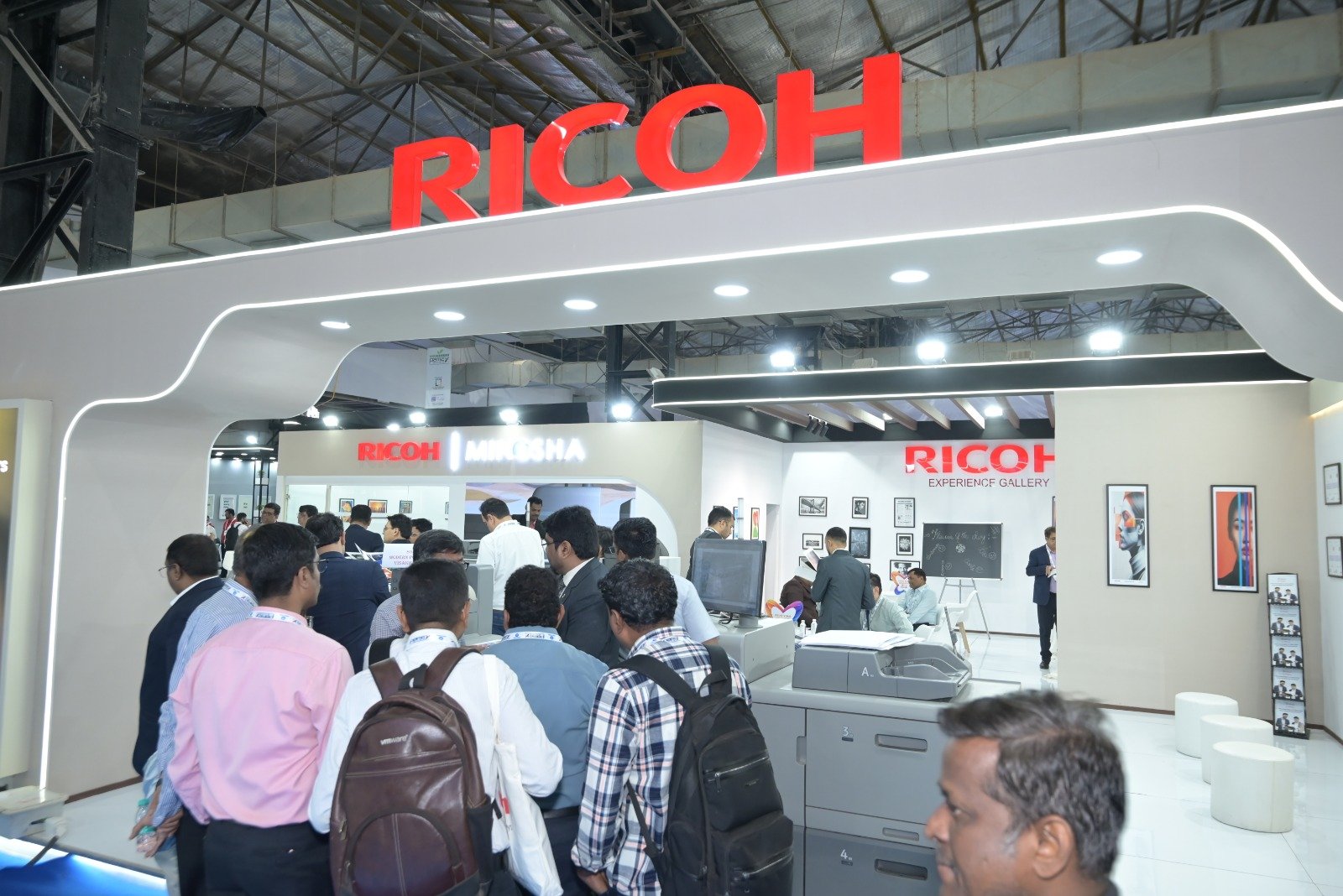
For Miyao, Pamex 2026 served as an important platform, as Ricoh views India as one of its most strategic global markets. “We used this opportunity to gather practical insights into future business growth by understanding local trends and customer requirements, opening up new avenues for sustainable expansion. Through our participation with Minosha, our long-standing strategic partner, we seek to connect global innovation with local execution.”
According to Miyao, Ricoh’s market contribution stems from its ownership of core technologies, particularly its in-house designed and manufactured printheads.
“We focus on the productivity of the entire workflow—from pre-press through post-press—not just engine speed. In India, we advance innovation through automation and intelligence, deploying AI-driven tools such as Auto Color Diagnosis and predictive maintenance to maximize uptime. This approach helps customers stay profitable and competitive despite rising labor and production costs.”
The ongoing shift from offset to digital has prompted Ricoh to significantly broaden its media capabilities. Its latest models, the Pro C9500 and C7500, now handle substrates ranging from 40 gsm to 470 gsm and feature elastic transfer belts that maintain high quality even on textured stocks.
To help printers secure higher-value assignments, Ricoh offers seven types of special toners—gold, silver, white, among others—enabling them to deliver value-added applications that conventional printers struggle to replicate.
Automation and workflow efficiency, he said, are essential to managing labor shortages and mounting cost pressures.
Meanwhile, the transition toward digital printing continues to accelerate, as digital technologies support short-run, on-demand, and variable data printing. This allows printers to react quickly to market demands, cut inventory, and boost profitability. Demand is rising for premium print applications that offer superior quality and clear differentiation.
“In this context,” he says, “Ricoh is driving digital transformation in printing by delivering reliable and adaptable solutions that use AI to automate workflows, reduce manual tasks, enhance process visibility, and enable smarter, data-driven production. These trends directly influence our product portfolio, steering us to provide flexible, sustainable, and high-value printing solutions that ensure long-term customer success.”
Sustainability, Miyao added, remains a priority, as demand grows for waste reduction, energy-efficient production, and environmentally responsible consumables. This momentum is fueling the expansion of digital printing solutions that combine efficient production with consistent, high image quality.
The company is laying the groundwork for its high-speed inkjet portfolio. Miyao said, “Our roadmap includes a phased rollout of these technologies to ensure that as Indian customers scale up their volumes, we have the right inkjet solutions in place to support their next stage of business growth.”
Geographically, while Ricoh maintains a solid presence in major cities such as Delhi and Mumbai, its key focus is expanding into tier 2 and 3 cities, where the scope for digital adoption is significant. “From a segment perspective, we are concentrating on commercial and photo printing, as well as the fast-growing labels and packaging sectors. By leveraging Minosha’s extensive service network, we aim to deliver dependable support to customers across pan India,” he concluded.