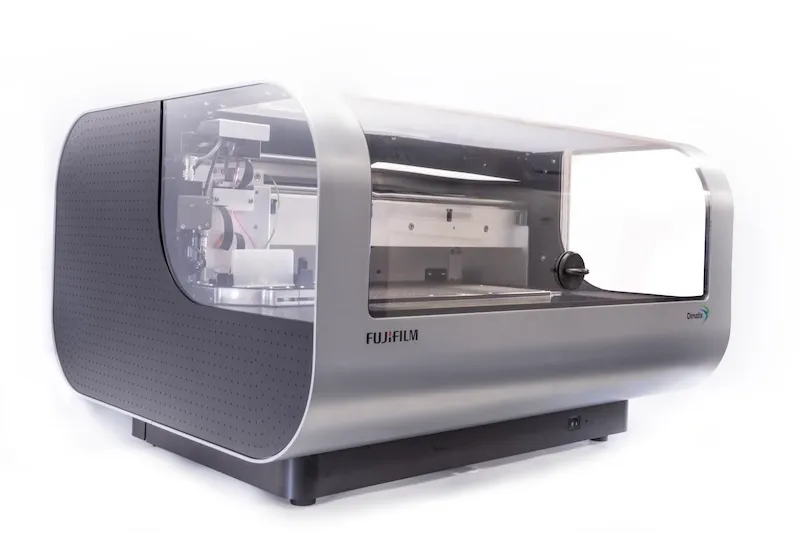
Fujifilm Dimatix has released a new version of its Dimatix Material Printer, a benchtop test system widely used by OEMs developing new fluids and inkjet systems.
The DMP is essentially a print system in a box, complete with an 8x11ins substrate bed that allows R&D engineers to test new inks and other fluids to understand their jetting characteristics.

Steve Billow, president and chief executive officer for Fujifilm Dimatix, explains, “Universities and R&D teams greatly benefit from a complete platform that can offer precision printing of materials, jetting analysis, and fluid development, as it allows users to rapidly produce new prototype designs, reduce costs and lead times, and accelerate the innovation process.”
The new DMP 2850 S builds on this with improvements in the existing software, including new drop analysis software. This can be used with the integrated drop watcher to evaluate the drop formation from each nozzle and develop waveforms to optimize jetting for a given fluid.
The new S model also gains a Print Job feature that allows users to save all settings associated with a particular job and allows for batching multiple jobs within a run, so the user can walk away. It supports multiple file types, including BMP, JPEG, TIF, and PNG.
There have been some improvements to the built-in computer, including a more powerful CPU, dual USB ports for data transfer, and more storage for print jobs and data needed during the printing process.
This integrated computer runs on Microsoft Windows 10 IoT Enterprise LTSC. There have also been improvements to the encoders and thermal platen, which takes materials up to 25mm in height and with the temperature adjustable up to 60°C.
According to Dimatix, the system supports precision jetting for a wide range of functional fluids, including UV, aqueous, solvent, acidic, and basic fluids. Instead of printheads, it uses cartridges to jet the fluids. Since 2021, with the introduction of the current DMP 2850, these cartridges have built with Silicon MEMs technology, similar to that used in the Dimatix Samba printhead.
This gives researchers a good understanding of how the fluid will work, but without the cost and complexity of having to set up a system with actual heads, Samba or otherwise. The cartridges are easily replaceable, which is exactly what you want in a test system. They have a reservoir of just 1.5ml, which should limit the potential for waste of expensive fluids.
However, it is worth noting that as with the Samba, these cartridges work best with relatively low viscosity fluids in the 4-8cPs range. With many inkjet developers now shifting their focus to high viscosity applications, there may be a case for Fujifilm to offer a choice of cartridges, though that’s pure speculation on my part.
In any case, you can find more information on the new DMP 2850 S from fujifilm.com.