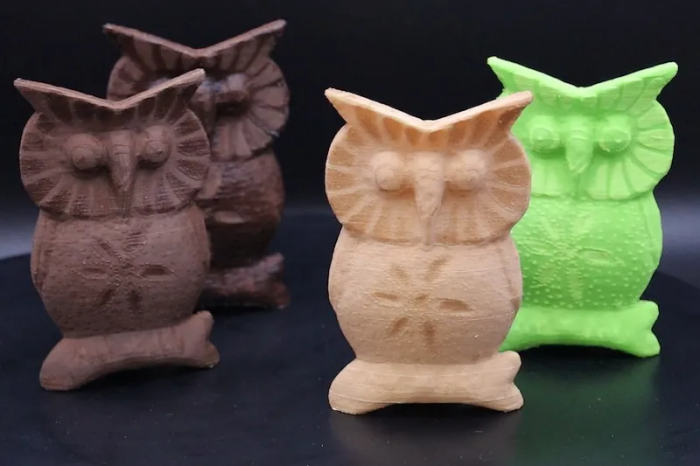
Researchers from MIT and Delft University of Technology have demonstrated a new approach to 3D printing that should make it easier to produce parts with multiple textures and colors from a single material.
The process, which is called speed-modulated ironing, works by using heat to modify the texture or even the color of a material. It will only work on a dual-nozzle 3D printer, which generally means a mid-sized FFF machine but there’s no need to modify the hardware in any way. This approach will only work with filaments that respond to heat, including most available filaments.

Normally each nozzle would be heated to apply the material. But in this case the first nozzle simply deposits the filament and the second nozzle passes over the printed material to activate certain responses, such as changes in opacity or coarseness, using heat.
The heat output from the second nozzle remains constant but the researchers found that by controlling the speed of the second nozzle, and therefore the dwell time over the material, it’s possible to heat the material to specific temperatures to achieve a specific color, shade, or roughness from the heat-responsive filaments. The advantage of varying the dwell time rather than the amount of heat is that there’s a need to wait for the nozzle to heat up or cool down to the desired temperature.
The MIT team worked with the TU Delft researchers to develop the theoretical model that predicts how fast the second nozzle must move to heat the material to a specific temperature. The model correlates a material’s output temperature with its heat-responsive properties to determine the exact nozzle speed which will achieve certain colours, shades, or textures in the printed object.
Marwa AlAlawi, a mechanical engineering graduate student at MIT, explains, “As we modulate the speed, that allows the printed layer we are ironing to reach different temperatures. It is similar to what happens if you move your finger over a flame. If you move it quickly, you might not be burned, but if you drag it across the flame slowly, your finger will reach a higher temperature.”
She adds, “There are a lot of inputs that can affect the results we get. We are modeling something that is very complicated, but we also want to make sure the results are fine-grained.”
The team tested this approach with three off-the-shelf heat-responsive filaments. The first was a foaming polymer called LW-PLA, which has particles that expand when heated, allowing for different shades, translucencies and textures. They were able to produce objects such as water bottles that are partially translucent. To make the water bottles, they ironed the foaming polymer at low speeds to create opaque regions and higher speeds to create translucent ones. They also utilized the foaming polymer to fabricate a bike handle with varied roughness to improve a rider’s grip.
They also experimented with two PLA filaments, one filled with wood fibres and the other with cork fibers, both of which can be charred to produce increasingly darker shades.
The main advantage of using this method is that it’s quicker than using multi-material printers because there is no need to change between different filaments. But it also allows for graduated transitions from one state to the next that cannot be achieved otherwise. In addition, there is less waste because the material is not heated in the nozzle, and this approach uses less energy.
You can find further details on this research from this link.