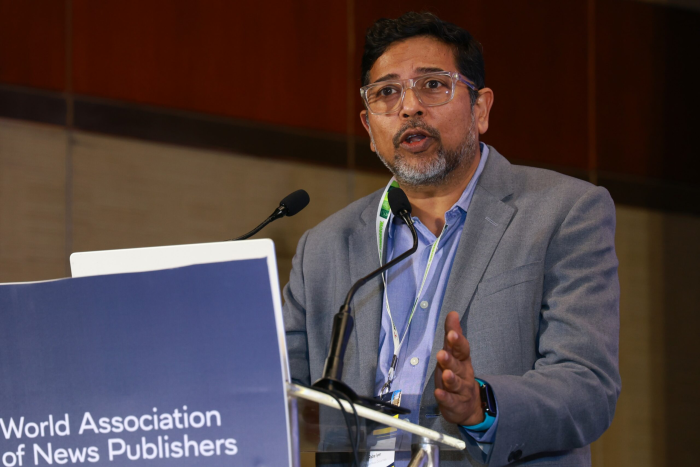
“The future of print will depend on its ability to engage a new audience that is increasingly digital-first,” Rabe Iyer, chief media officer of Omnicom Media Group, India, told participants of Wan-Ifra’s Indian Printers Summit last week in Hyderabad, reports Aultrin Vijay.
Iyer also discussed the challenges and opportunities facing print in India due to changing consumer behaviors and digital disruptions, and considered potential paths forward during the conference’s closing keynote address.

In his presentation, Iyer outlined the importance of understanding younger generations’ preferences and how digital platforms are reshaping the media landscape.
By recognizing these trends, the print industry can identify opportunities for growth and innovation, ensuring it evolves alongside the rapidly changing media environment, he said.
Print media struggles to engage social media users
Iyer outlined several challenges India’s print industry faces:
Changing consumption habits: He highlighted the shift in reading habits among younger generations, particularly Generation Alpha and Generation Z. “These audiences are increasingly consuming content through social media and short-form digital platforms, making it difficult for traditional print media to engage them,” he said.
Digital disruption: The advent of smartphones has altered news consumption. “Before the smartphone era, changes in habits occurred more slowly, but now technology disrupts patterns at an unprecedented pace,” Iyer said. He compared this shift to the transformative effects of streaming services on cable TV, emphasizing that print must adapt quickly.
Print’s shrinking influence: Despite retaining a substantial advertising revenue share of ₹20,000 crores [US$2.4 billion, 2.2 billion Euros] in India, the reach of print media has been diminishing. “Daily readership has dropped from 31% to 17% post-Covid, with most remaining readers being older generations,” Iyer stated.
Competition with digital platforms: Iyer underscored the competition posed by digital entertainment platforms, asserting that news media is often deprioritized by consumers who prefer spending on entertainment and convenience.
Create a seamless flow between print and digital
Despite these challenges, Iyer identified several opportunities for the print sector:
Regional and local print: The growth of regional publications, particularly in Tier 2 and Tier 3 cities, presents an opportunity for newspapers to adopt a more localized approach. “Hyperlocal news can cater to community-specific needs,” he said.
Market mix modeling: Iyer highlighted the importance of measuring print’s contribution to business outcomes, stating that studies show print can account for 7 percent to 33 percent of client business success. He suggested that the print industry should partner with agencies to bring data-backed insights to the forefront.
Subscription revenue: Historically, print revenue was split equally between advertising and subscriptions. Now, with only 10 percent of revenue coming from subscriptions, Iyer urged the industry to appeal to loyal readers willing to pay for credible news, even suggesting slight increases in cover prices.
First-party data: Iyer emphasized the need for sophisticated models to collect first-party data, allowing print publishers to offer personalized content. “By tracking customer preferences and reading habits, print can deliver targeted marketing akin to digital platforms,” he added.
Seamless news consumption: Proposing a shift toward more digestible news formats, Iyer said, “We need to create a seamless flow between print and digital, allowing readers to easily transition from brief print summaries to deeper online engagement.”
Print could benefit from collaborations
Looking ahead, Iyer suggested that print could benefit from collaborations with digital platforms and journalists. “Traditional media has opportunities to reach wider audiences by partnering with digital entities,” he said.
Iyer said that print should focus on delivering highly localized content. This approach could involve citizen journalists to engage communities more effectively.
He highlighted the potential of artificial intelligence to transform the print industry. “By leveraging AI to understand reader preferences, we can offer more targeted content and enhance the digital experience,” he said.
While print’s influence may be declining, there is a pathway forward through innovation, strategic partnerships, and a focus on local content, Iyer said. “By leveraging data and exploring new revenue models, print can remain a relevant and valuable medium in India’s media landscape,” Iyer concluded.
aultrin.vijay@wan-ifra.org (This article was initially transcribed and summarized using artificial intelligence, with final edits and refinements by the Wan-Ifra team.