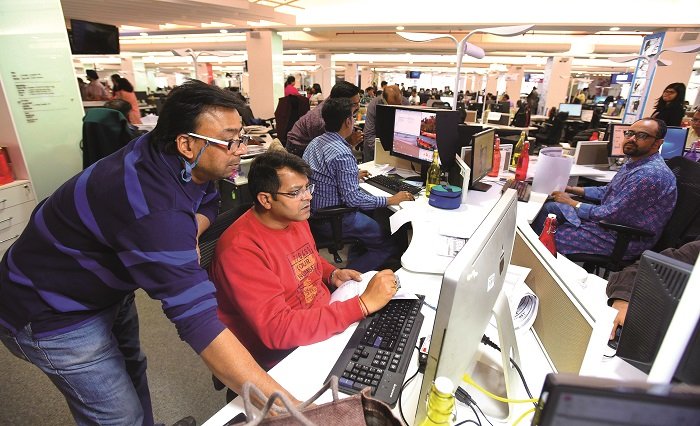
Recent reports of Hindustan Times drastically downsizing staff across several locations in the country have stirred up a controversy that perhaps coincides with talks about demonetization although it seems to have been planned much earlier. Over 1000 employees of HT across several locations in the country have been laid off.
The first paragraph of a circular signed by Sharad Saxena, executive director of operations and HR at HT Media states: ‘Post our major investments into a Digital Future and creation of an ultra modern and hi-tech newsroom in Delhi, backed by an enormous effort to culturally transform our ways of meeting the changing consumption trends, we are now shifting gears to move towards an accelerated digital trajectory’ The circular goes on to say that the intention is to strengthen the group’s ‘prime’ editions in Delhi, Mumbai, Chandigarh, Lucknow and Patna while doing away with the editions in Kolkata, Bhopal, Indore and Ranchi. Also discontinued were bureaus in Allahabad, Varanasi and Kanpur. All the changes were to take effect on 9 January 2017, according to the circular and reports from major online sites that confirm the move.

In addition, the HT business bureaus in Delhi and Mumbai have been closed down and the work of these bureaus has been handed over to the group’s financial daily, Mint, “as part of the effort to integrate newsrooms.” Although HT is trying to pass off the huge retrenchment as a blowback of the demonetization undertaken by the Modi government, it sounds hardly credible as the deadline for the exercise was already decided as the second week of January. Demonetization may have come as a convenient excuse for the HT management because of its overlap with the retrenchment exercise. Reports also suggest that HT’s staff retrenchment is based on the advice of the Boston Consulting Group.
According to an online media website, Sandeep Jain, chief strategy officer of HT Media, told participants in a conference call on 3 November 2016, five days before Modi’s announcement of demonetization, “We are working on a cost optimization project and it was kicked off about three months ago. The diagnostics of that project is going to be completed in a couple of months. We are looking at the entire organization and both the operating companies, both in Hindi and English business. We see that growth expectations have to be set right for this business and for us to maintain profitability, probably the only right option is to look internally at our costs, so we have embarked on this exercise which is pan organization. We are hoping that by the end of this financial year we should be taking action on some of the recommendations.”
The Brihanmumbai Union of Journalists, says that the HT management has closed down the operations at several centers to work around the Supreme Court’s order to implement the Majithia Wage Board Award, which was upheld by the Supreme Court on 7 February 2014. A press statement from the Brihanmumbai Union of Journalists said, ‘HT Media Ltd, a BSE listed entity, with a yearly turnover of over Rs 2,000 crore has not implemented the Award in any of its units and has forced employees to submit undertakings under Clause 20(j) of the Award to renounce the benefits under it.’
According to online news reports, ABP, the biggest media house in eastern India is also planning a major retrenchment and has identified over 500 members of its staff that it wants to lay off. Even the country’s largest and most profitable media house, Bennett Coleman & Co. publisher of the world’s largest selling English daily, The Times of India, is not beyond the current attempts at print media right-sizing. Sources in TOI said that the company has stopped recruiting, not even to replace staff who retire or resign, and is even planning to slash wages, which it had done earlier in 2009 citing the global financial crisis as the reason.