“The real economies for the brand owner lie within the walls of the printer … a couple of hours in prepress is a lot cheaper than 15 minutes of press time” – Marc Levine of Schawk
The KIPES exhibition featured several Korean manufacturers of label presses and global vendors of a host of technologies. Digital technologies at the show included live demonstrations of web-fed digital color presses from Screen and Domino. Wide format output devices for both signage and proofing were in abundance along with ancillary measuring and color management software and hardware. Esko and Chilli Publish were among the active packaging solution providers at the show.

The World Print and Communication Forum held a one-day conference on the first day of the exhibition. Dr Sean Smyth of Smithers Pira indicated that the US$ 775 billion print industry would reach US$ 1 trillion by 2020–2021 although the total number of A4 pages would remain flat if not shrink marginally. Smyth indicated that the only print segment that is growing globally is packaging.
Peter Burger of Heidelberg spoke about the concept of Industry 4.0 and how it would lead to the Smart Printshop. He echoed many of the themes that the company has been talking about. For instance the company plans to link 15,000 print systems to the cloud. Huge amounts of data are collected by as many as 3,000 sensors in a printing press. Burger said that these machines could also be described as “interactive automated devices or cyber physical systems”. He essentially held out the possibility that with this amount of data flowing downstream and upstream, it would be possible to anticipate and resolve 70% of the maintenance problems of such a press remotely and before breakdowns occur. When needed, the system will tell the operator when to ‘Push to Stop’ the press with an instructive diagnosis of what to do. This is integral to Heidelberg’s concept of trying to achieve 24/7 uptime and higher production efficiency.
Spectrum Asia focuses on packaging and color standardization
The annual Idealliance Spectrum Asia conference, organized by Idealliance Korea and supported by the Korean Printers Association, took place on 1 September 2016 alongside the KIPES exhibition in Seoul. The conference was initiated and moderated by David Steinhardt, chief executive officer of IdeallianceEpicomm and brought together Idealliance associates from India, China and Korea with their Asian, American and Canadian colleagues around presentations focused on packaging. Steinhardt spoke about the pioneering role played by Idealliance in content, data exchange and print standards such as Standard Graphics Markup Language or SGML in the 1980s and the launch of XML at an Idealliance conference. Steinhardt also pointed out that while print is actually shrinking in many parts of the world, too often there is a hyper competition for very small gains.
Spectrum Asia addressed the various touch points in the packaging supply chain from the brand owner to the consumer. Presentations discussed innovation and branding, quality assessment and color standardization from the point of view of brand owners, printers and end users.
Marc Levine, director of print quality at Schawk, who is also an Idealliance Print Properties coach and a G7 process control expert, spoke of how brand owners are now going beyond shelf audits and analysis of their packaging. Levine discussed at length how brands and retailers are using web-based platforms to track the quality scores of their packaging suppliers on a 12-month trend line.
Packaging print optmization
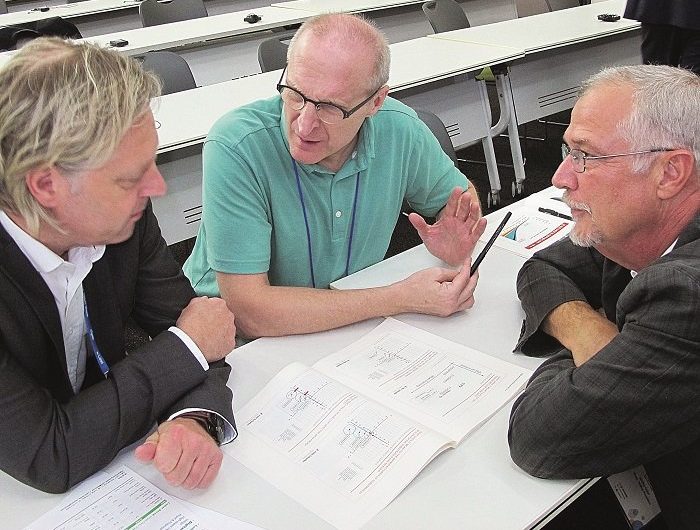
Steve Smiley of SmileyColor, who is part of several work groups of the ISO TC130 committee, spoke about the standard communication formats and standards for precise communication of color between brand owners and packaging printers. The latest PDF-X format contains all the information for blind transfers of files including fonts while the CXF format contains all information related to color. CXF-4, for instance, contains information regarding special or spot colors including the spectral data essential for ink formulation. Smiley emphasized, “It’s important for brands that you give spectral data for the brand and spot colors to the ink formulation software or to the ink makers.”
An advocate of using G7 calibration and curves instead of color management, Smiley says, “Many of the printers I work with save 30% of cost using G7 in terms of waste and time saving.” Smiley also mentioned the new ISO CDI 16761-2 standard being developed for packaging supply chain responsibility for adoption by consumer product companies. On his way to the TC 130 meeting in San Jose, California in midSeptember, he was also quite optimistic about the agreement on the ISO DIS 20654 within the year.