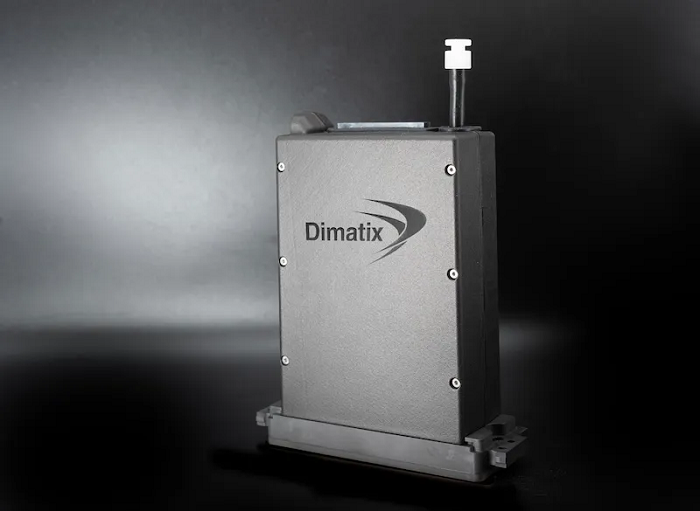
Fujifilm Dimatix has introduced a new printhead in its Starfire range, the PhaseMaster, which is designed for solid or hot melt inks. Up to now, Dimatix has mainly offered the Galaxy HotMelt printhead for those inks, and this new head builds on some of that capability but combined with features from the Starfire family.
As such, it is suitable for graphic arts applications such as coding and marking as well as printing direct-to-screens for screen printing. It can also work across industrial uses such as additive manufacturing and printed electronics for etch-masking applications such as photovoltaic cells, where Fujifilm is already seeing some demand for this head. Dimatix says that it can be used in either single- or multi-pass systems

The StarFire PhaseMaster is a bulk piezo head with a metal nozzle plate. At the heart of it are four jetting modules, each having 256 nozzles or 1024 in total. Since the head has a print width of 65 mm, or 2.56 ins, this adds up to 400 dpi resolution in total. These heads have a single fluid channel. Mike Wozny, senior product manager at Dimatix, says there is no need to add further channels.
Dimatix has integrated its Redijet recirculation system into the printhead collar, meaning that OEMs can choose whether or not to implement recirculation. The recirculation is useful for those ink types that are prone to sedimentation, but leaving out the recirculation makes for a simpler system that is easier and cheaper to make. The ink itself would normally be supplied from a heated reservoir.
A typical implementation might see this heated ink reservoir located next to the heads and able to supply up to two heads. In order to handle this ink, Dimatix has had to change the ink supply to the heads, which comes through a print collar at the base of the head rather than the usual tubing system.
The PhaseMaster has a built-in heater and thermistor, and operates at up to 125ºC to reduce the viscosity of the ink. Dimatix is quoting a viscosity range of 8-20cP at this temperature, but this is limited to 10-14cP for faster throughput. To protect the electronics from this heat, clean, dry air is circulated through the top part of the head.
There are currently two variants, starting with the PM1024M, which has a firing frequency of 30 kHz. It produces a 30pL native drop, but multiple drops can be combined together in a greyscale model to produce up to 80pl droplets. This leads to productivity of 900 ng-kHz (nanograms of ink per kilohertz or the amount of ink that can be laid down within a given time period). For those applications that require larger drops, there is the PM1024L, which has a native drop size of 80pL, but can go up to 200pL, with a 20kHz firing frequency. This translates to 1500 ng-kHz. Throughput will depend on the application, but Dimatix is quoting 60mpm at 400 x 200 dpi as an achievable production speed.
Wozny says the throw distance depends on the application but that it is adequate for most coding and marking use – where throw distances tend to be longer than other graphic arts applications – and that customers appreciate the higher resolution for the new 2D barcodes. The head does appear to be a little larger than most heads designed for coding and marking, where space is often at a premium. But Dimatix is also aiming for some packaging applications, where multiple PhaseMasters could be combined together for a full color solution using hot melt inks.
Shane O’Neill, director of business development at Fujifilm Dimatix, commented, “Building on more than 20 years of proven success with the Galaxy HotMelt printhead and leveraging the well-established reputation of the Starfire platform for durability and serviceability, we have combined the strengths of both technologies to create a unique solution for jetting phase-change solid inks at high-resolution with outstanding reliability and consistency.”
The PhaseMaster has a modular design that makes it easier to replace major components, such as the printhead collar or the jetting modules, which should help ensure a long service life. As with other Dimatix heads, customers will be able to design and edit their own waveforms, and Dimatix offers a training program to OEM customers to help them do this. There are as yet no third-party drive electronics, but my understanding is that several vendors, including both GIS and Meteor Inkjet, have already looked at this printhead.
Dimatix will continue to sell the Galaxy HotMelt printhead, with Wozny noting, “The Galaxy has been a good product for us for more than 20 years and continues to grow, so one isn’t replacing the other.” Instead, he says that the new head is giving customers higher resolution and more productivity and a smaller drop size, adding: “So some of our customers will use the PhaseMaster as a growth engine.”
He says that the main take up so far is coming from Europe and North America for applications such as additive manufacturing and coding and marking, as well as from China where the interest is mainly in industrial applications such as solar panels.
O’Neill concludes, “As the newest addition to the Starfire product family, PhaseMaster is engineered to deliver high performance, productivity, and long-term value across a wide range of current and emerging applications.” You can find further details from Dimatix at fujifilm.com