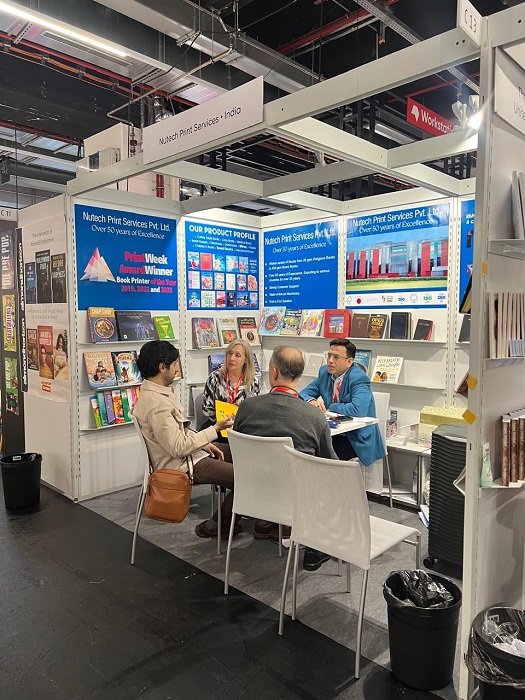
Indian Printer & Publisher recently met Ravi Shroff of the 50 plus year old commercial and book printing company, Nutech Print Services. Since our visit to the modern purpose-built book production plant in Faridabad, Nutech has considerably extended its floor area and added several automated presses and binding machines for domestic and export book production.
According to Shroff, as energy and labor costs have increased, he has been adding automated machinery for inline processing. For example 2-3 years ago, Nutech invested in a new binding line for the simultaneous gathering and sewing of printed signatures. The integrated machine saves energy, time and labor.

Shroff says the publishers are globally reducing initial order and reprint quantities. “Publishers no longer want to speculatively stock large inventories that have to be pulped later as they are unsure of market demands and the performance of various titles.”
He explains that the machines added in the last several years are fully automated. Nutech has been using CIP prepress data to effectively speed up their press make-readies since 2004. The new machines all have closed-loop color monitoring and correction for even faster make-readies and color consistency is viably achieved in short runs.
In the binding department, Nutech has installed additional capacity because short runs increase the set-up times. “We have more make-readies in every shift leading to less number of books being produced on the binding machines,” Shroff said. For the added short run load, Nutech recently added another Bindwel machine, alongside its Kolbus and Wohlenberg binding lines it has for larger runs.
“Since majority of Nutech’s production is for book exports, all our consumables from ink, chemicals or adhesives, meet all the global standards,” Shroff shares. “Typically, we take the certification data from the suppliers, check it ourselves and get it checked by our customers as well. Only then the item is added to our ecosystem. It doesn’t matter whether the books are being made for the local market or the export market, we use the same standard of approved chemicals, inks, adhesives, etc since it’s impossible to segregate products on the shop floor.”
Software-driven, automated printing & binding equipment
The automation of printing and binding equipment requires frequent upskilling of press and bindery operations and resources. “From time to time, we have to re-train our operators so that they’re able to use the facilities, and sophisticated features of a machine effectively. We conduct internal workshops and also invite industry expert trainers and our vendors as well to help train and upskill our existing operators.”
Printing speeds have gone up substantially as Nutech added more multicolor perfectors to print both sides of the sheet in a single pass. “To make sure that we’re able to keep pace with the increase in print volumes, we’ve had to add more machines in folding, gathering and sewing specifically, binding and trimming. The recent machines we have added give a much higher output per hour”
“When we evaluate any machine for printing or binding, all the factors are taken into account – the speed of the machine, the changeover time, whether it reduces the energy consumption and manpower,” Shroff said. “The most important aspect is the throughput. All these factors put together should lead to a better throughput. A faster rated speed is only of value if you are getting more output from the machine and adding to overall efficiencies.”
Support from the machine manufacturer and their distributors is crucial for maintenance and spare parts. “It has always been a big challenge especially for the imported machines. We have to ensure that whatever we buy, there is sufficient support for us to keep the machines running properly,” Shroff concluded.