Fujifilm has announced plans to partially sell off its Business Innovation division, which includes Office Solutions and Graphic Communications – essentially everything to do with office and professional printing.
As such, this marks a significant restructuring for Fujifilm and potentially also for the wider printing industry. Fujifilm chose to make this announcement alongside the release of its first quarter financial results. Those results simply confirm the picture revealed in the last full year financial results from April this year; the Business Innovation division generates the largest revenue for the group, but the lowest profit, and this situation is unlikely to improve.

Fujifilm is split across four divisions: Healthcare, which includes the Medical System business as well as the Bio Contract Development and Manufacturing Organization; Electronics, made up of Electronic Materials and Advanced Functional Materials; Imaging, mainly cameras, lenses and related consumables, both Consumer and Professional; and Business Innovation.
The Business Innovation division is sometimes characterized as the renamed Fuji Xerox venture, but there’s more to it than that. The Fuji Xerox joint venture itself dates back to 1962 but came to an end somewhat acrimoniously when Fujifilm acquired the complete business and then renamed it Fujifilm Business Innovation in 2020. It’s now made up of three parts, with the largest being Office Solutions, which includes all the office printing and dry toner technology such as the current Revoria range of production presses. There’s also a Business Solutions unit that includes Enterprise Resource Planning and Business Process Outsourcing.
The third part is the existing Graphic Communications business, which was then folded into the Business Innovation division and includes Dimatix inkjet printheads and various ink technologies, plates and prepress. The company has since shut down its European plate manufacturing, and rumors are suggesting that it might sell its remaining plate manufacturing to a Chinese company. Since the start of this year, Fujifilm has been gradually running down its Graphic Communications business, discontinuing most of the Acuity range of wide format printers, abandoning sales of the B2 Sheetfed Jet Press and roll-fed Jet Press 1160 CF in Europe, and selling its flexo inks business in the US and Canada to Nazdar.

Business Innovation is also home to a joint venture with Konica Minolta that was set up in 2025 and covers procurement for raw materials and parts for office and production printers. Fujifilm Business Innovation holds 75% of this, with Konica Minolta having the remaining 25%. Far from being a minor detail, this joint venture is part of the restructuring of the Japanese office printer market that is already underway. As the office printer market continues to shrink, the manufacturers are partnering to cut their costs. This is mirrored by Ricoh, Toshiba Tec and Oki, who have formed a similar Etria joint venture for their office printers. So this spin-off could offer the opportunity for a more radical restructuring of the office printer market.
Fujifilm’s press release is very light on any reasons behind spinning off Business Innovation, apart from some corporate drivel about “giving our world more smiles” and a vague statement about increasing stakeholder value. But a separate presentation accompanying the Q1 figures explains that the spin-off is to allow Fujifilm to concentrate on growing the Healthcare and Electronics divisions, which offer high growth and high profitability, while retaining the cash-generating Imaging business.
The financial results for Fujifilm’s first quarter, ended 30 June 2026, ostensibly showed a 10.3% increase in revenue, year on year, to ¥826.5 billion (roughly US$5.19 billion) (1 Japanese Yen equals 0.0063 United States Dollar according to present exchange rates), mainly due to sales of semiconductor materials and data tapes in the Electronic segment. The figures themselves are distorted by a number of factors. Firstly, there is the weak value of the Yen, which the Bank of Japan has historically been willing to tolerate and counters by having a very low interest rate. But that interest rate is ticking up – currently at 1.0%, and the Yen has been weaker than normal over the last year. So currency fluctuations are one reason why Japanese companies have been posting higher than average revenues, though many of them, including Fujifilm, have also been hit by rises in raw material costs and in semiconductor memory prices.
While companies trumpet their revenues in press releases, a far more accurate measurement is the operating margin, which is the ratio of operating income to net sales and the ability to cover operating costs. This reveals a far less rosy picture, with operating revenue for Q1 falling 32% to ¥51.2 billion (US$321.4 million), though Fujifilm says this was “broadly in line with the internal plan.” This was due to increased costs in the Bio CDMO business, one-time expenses related to strengthening the operational foundation of the Business Innovation division, and higher raw material prices. The net income fell 30.4% year on year to ¥37.4 billion (US$234.8 million).
A more accurate portrait emerges from looking at the four individual divisions. Business Innovation saw revenue fall 0.1% year on year to ¥273.2 billion (US$1.715 billion), while operating income fell by ¥17 billion (US$106.73 million) from ¥15.6 billion (US$97.94 million) to a loss of ¥1.4 billion (US$8,789,802). (This is better than Fujifilm’s own English-language press release, which states the loss as ¥17 billion (US$106.73 million).
To break this down further, Business solutions rose 2.7% to ¥77.8 billion (US$488.42 million), mainly due to overseas sales. Graphic communications saw higher revenue for inkjet printheads but lower demand for printing plates and related products, particularly in Europe. This is reflected in revenues of ¥81 billion (US$508.5 million), up 4.1% year on year. However, Office Solutions saw revenues fall 4.6% to ¥114.5 billion (US$718.8 million) mainly due to lower exports to Europe and North America and reduced demand for equipment replacements in China for the office solutions, mainly copiers and production presses.
However, the operating margin fell from 5.7% to a negative 0.5%. Fujifilm cites several reasons for this, including rising aluminum costs and initial costs in renewing its ERP system, restructuring around expenses and some disputed costs, as well as lower revenue affecting gross margins.

At first glance, the numbers aren’t much better in the Healthcare division, which reported revenues of ¥256.8 billion (US$1.61 billion), up 12.4% year on year, but an operating income loss of ¥12.7 billion (US$79.7 million). The Healthcare division is made up of several parts. Fujifilm has bet on potential growth in Bio CDMO, but this has so far been limited while Fujifilm is building new facilities. Nonetheless, Fujifilm is expecting to see decent returns on its investment once these facilities are completed.
Meanwhile, the Medical Systems part of this business has maintained strong growth, supported by increased sales in Japan and China in addition to major markets such as the United States and Europe. Higher sales of Healthcare IT solutions also contributed to revenue growth. In the Life Sciences Solutions business, revenues rose due to greater use of cell culture media from major pharmaceutical companies.
The Electronics division was the only division where the operating margin rose, up 2.3 points, mainly because of increased sales of semiconductor materials and data tape. Here, revenue increased 25% to ¥127.7 billion (US$801.5 million) with operating income up 38.2% to ¥31.1 billion (US$195.2 million).
For the Imaging division, revenues increased by 16.2% year on year to ¥168.8 billion (US$1.06 billion), while operating income rose 3.9% to ¥43.4 billion (US$272.4 million). This is due in part to continuing sales of professional cameras but mostly down to increased demand for consumer products, notably around the Instax film.
An even starker picture emerges if we look back three months to the full year figures for the previous financial year. These show that Business Innovation generated the highest revenues for the group – accounting for 35% of revenue on its own – but, crucially, the lowest operating margin. This suggests that Business Innovation, or at least the core copier part, is a mature business with high overheads and low profit margins and little room for further growth.
In contrast, the Healthcare division might have similar numbers but only because Fujifilm is in the process of constructing new facilities. Once those are up and running, it has the potential to generate higher profits. The Electronics division is already generating high margins, largely benefiting from the AI boom and demand for chips. And the Imaging division is coasting along and bringing in decent profit margins. So in this context, the Business Innovation division is the weakest performer, and spinning it off makes more sense.
Another factor is a recent change in Japanese tax law that makes a partial spin-off more attractive than a complete divestment. Fujifilm itself has specifically said that it will consider the tax implications of this spin-off. This is the reason behind Fujifilm’s statement that it is “considering retaining a minority stake…of less than 20%.” Selling off a majority stake would allow Fujifilm to generate more cash to fund the growth in the Healthcare and Electronics divisions, but whilst still keeping some control over the printer business, which itself would keep the Fujifilm brand and be able to take advantage of any synergies with companies in the Fujifilm Group.
Fujifilm has said that the process of spinning off the Business Innovation division is likely to take place over the next two to three years. But a lot could happen in that time, including other companies seeking to acquire specific high-value parts such as the Dimatix inkjet printhead business.

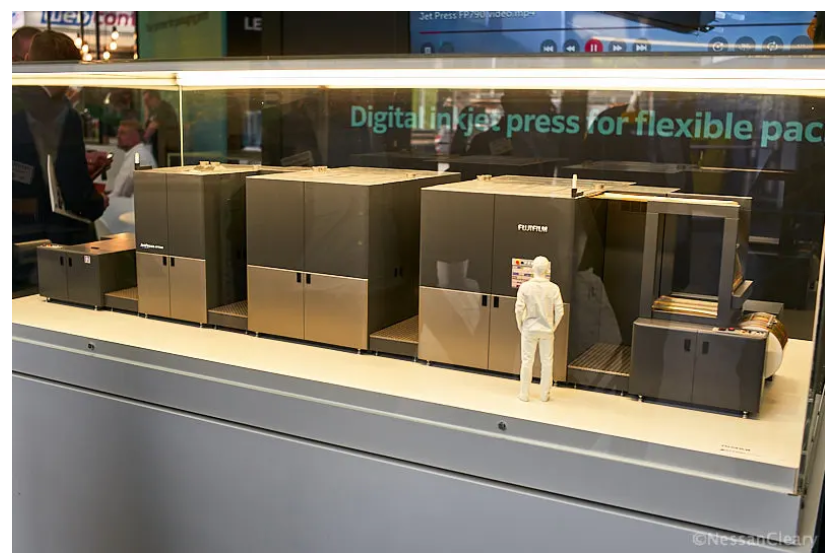
In my view, part of the reason that Fujifilm’s Business Innovation has appeared sluggish is that there has not been much innovation, particularly on the inkjet side. Too many products were reliant on technology from other companies. Fujifilm may have dropped several product lines, but this is still the case with flagship products such as the FP790 flexible film press, itself a rebadged Miyakoshi press, and the Acuity HS, which is a rebadged Barberán machine. Instead, Fujifilm’s strengths lie less in building machines, and more in supplying components – namely the printheads and inks – together with the bespoke integration services of those components.
I think it’s reasonable to assume that other manufacturers and venture capital companies will now be considering if Fujifilm would be open to offers on those higher-value parts of the Business Innovation business. Fujifilm itself will have to consider the impact from selling off parts of the division against the tax implications of the partial spin-off and the potential income generated. For me, the different parts that make up the Business Innovation division do not appear to be very tightly integrated so some sort of restructuring might not be a bad thing. And no doubt Naoki Hama, president and CEO of Business Innovation, will also have to consider the possibility that Fujifilm might opt for a full spin-off at some point.
It’s also worth noting that Fujifilm is now forecasting higher revenue of ¥3.56 trillion ($22.35 billion) for the end of the year in March 2027, which is up ¥90 billion on the previous forecast, supposedly due to strong sales in the Electronics segment and improvements in foreign currency fluctuations. However, the forecast for the full year operating income remains at ¥365 billion (US$2.29 billion) even though the company is expecting further delays in the ramp-up of its Bio CDMO facilities and increased costs in semiconductor memory prices. Net income for the year is still forecast at ¥280 billion (US$1.76 billion).
Teiichi Goto, president, chief executive officer and representative director for Fujifilm Holdings, commented on the first quarter financial results, “While reported operating income was affected by higher costs and one-time expenses, underlying performance remained broadly in line with our expectations. Supported by the strength of our growth businesses and continued expansion of demand, we have revised our revenue forecast upward and remain confident in our long-term growth trajectory.”
The question is, to what extent will print feature in that long-term growth, if at all? You can find further information on Fujifilm and its business from fujifilm.com.
(First published in the Printing and Manufacturing Journal. Republished with permission)