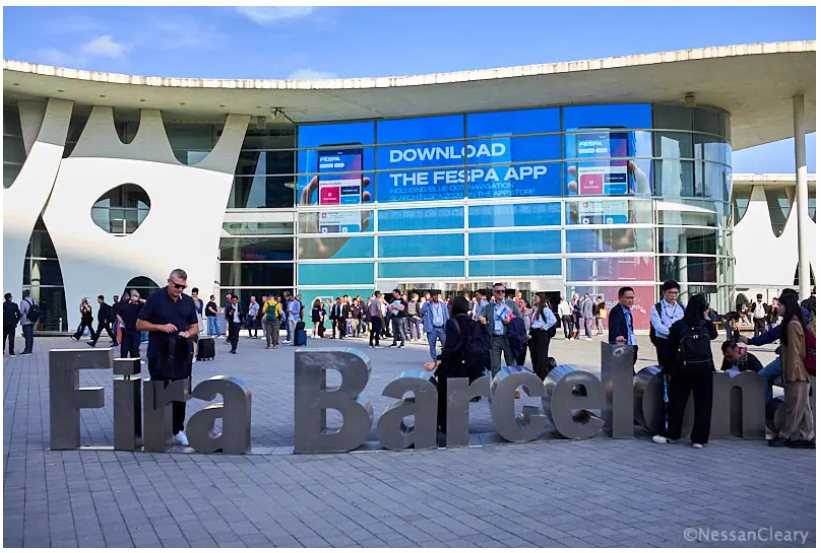
It seems hard to remember that the Fespa organization’s roots lie in screen printing, as the show has enjoyed rapid growth over the last 15 years or so, largely driven by its embrace of various aspects of inkjet printing. The result is that this year’s Fespa show was made up of six different shows, each covering a different market sector, including textiles and corrugated printing as well as sign making and display graphics.
This serves to highlight just how diverse the wide format print market has become, with both the equipment vendors and the print service providers striving to serve multiple markets. This is to be expected as the technology has moved beyond the original wide format market – sign making – and branched into new areas, and suggests there is still plenty of scope for new business opportunities.

However, this also means that it is more difficult to tease out a simple narrative. At the same time, it’s not so easy to just write multiple stories covering the different aspects of the show. That’s because although there were quite a few new products announced, most of them are relatively minor incremental upgrades; useful to have but not the kind of groundbreaking advances that immediately grab attention.
Nonetheless, there were a couple of trends that are worth mentioning. One of these is the sheer number of direct-to-shape printers that are now starting to appear. There have been a number of small flatbeds for decorating flat-ish objects for a few years now. But recently there have been a number of new printers aimed at cylindrical objects, typically drink flasks, mugs, bottles, or even candles.
Most of the vendors describe these as a move into industrial printing, but in reality, this is just a form of short-run decorating. As such, it’s mostly sold as an add-on to an existing business. To be truly industrial, these printers would have to be running at the sort of volumes necessary to enable either a print service provider to concentrate on just this type of decorating or a manufacturer to add as part of their process for making the objects in the first place.
Roland DG has clearly understood this, developing not just its own direct-to-cylinder printer in the RC300, but signing a global distribution deal with Lsinc so that it can reach that more industrial, higher volume part of the market. I’ve already covered this in more detail.
Inkcups showed off its existing Helix One tabletop direct-to-cylinder printer, which is mainly about providing a compact entry-level option for prototyping and very short runs. Inkcups also highlighted the X5-T High throw that it first showed at last year’s Fespa. This aims to get around the problem of printing to contours and curves by increasing the throw distance between the printhead and the surface of the object.
There were numerous other direct-to-shape cylindrical printers, though some of them appeared to be rebadged versions of others. In among them there were several Chinese companies, including AC Color, which has developed a DtS cylindrical printer that it is selling through its European partner, SmartColor.
This machine uses five Toshiba Tec CFS printheads, which are arranged such that the first lays down white ink, followed by one head for cyan and magenta, another for yellow and black, a fourth for light cyan and light magenta and the fifth head for varnish. It takes cylindrical objects up to 150mm in diameter and 300mm in length, though it will only print up to 280mm long. The printer can handle a difference in height of up to 2cm.
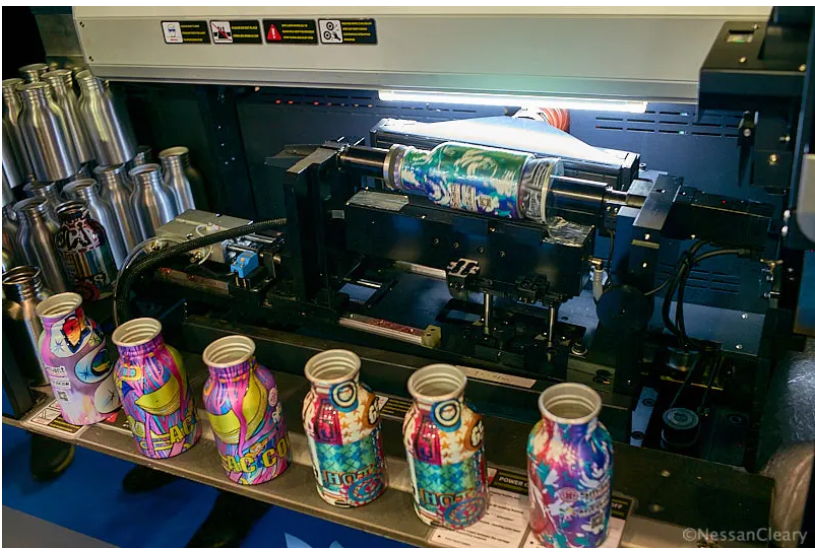
It uses a UV LED ink from Sakata INX. It can print to metal, glass, plastic, ceramic or even wood. Edmond Fu, director of international business for AC Color, says that it can print to clear glass because of the angle of the LED array. Productivity is relatively slow at around one object per minute. It’s priced at around €43,000 and mainly aimed at European customers.
Display graphics
There was also a noticeable emphasis on mid-volume 3.2m wide hybrids as the dominant workhorse for most sign and display graphics printing. That’s not a new thing, but most vendors also offer smaller 2.5m-wide entry-level roll-feds as well as large flatbeds, though there was little evidence in Barcelona, with most exhibitors choosing to highlight just their larger hybrid printers. Of these, the most interesting was Canon’s 3.4m wide Colorado XL, which marks a change in strategy for Canon and which I’ve already covered. Previously, the company has relied on its Arizona flatbeds, supplemented by the developing M-series 1.6m-wide rollfed Colorados. But now Canon has opted to push its UVgel ink technology into the large hybrid market space, where it will directly compete against HP Latex as well as the many UV hybrids.
HP showed off the Latex FS70W at Fespa, which was first introduced last October. It’s a mid-volume 3.2m-wide hybrid that replaces the older 3000-series machines. It prints CMYK plus light cyan and light magenta as well as white. It includes an embedded spectrophotometer for automated colour calibration. This printer can produce up to 162 square meters an hour in 2-pass mode, though HP is quoting the 3-pass 117 square meters an hour for outdoor work and the 4-pass 91 square meters an hour for indoor applications. Naturally, the white ink slows the productivity down. Thus, 60% white spot is 57 square meters an hour, while a 100% white overflood or underflood is 17 square meters an hour. For a three-layer backlit, the speed drops to 10 square meters an hour, or 3.7 square meters an hour for five layers.
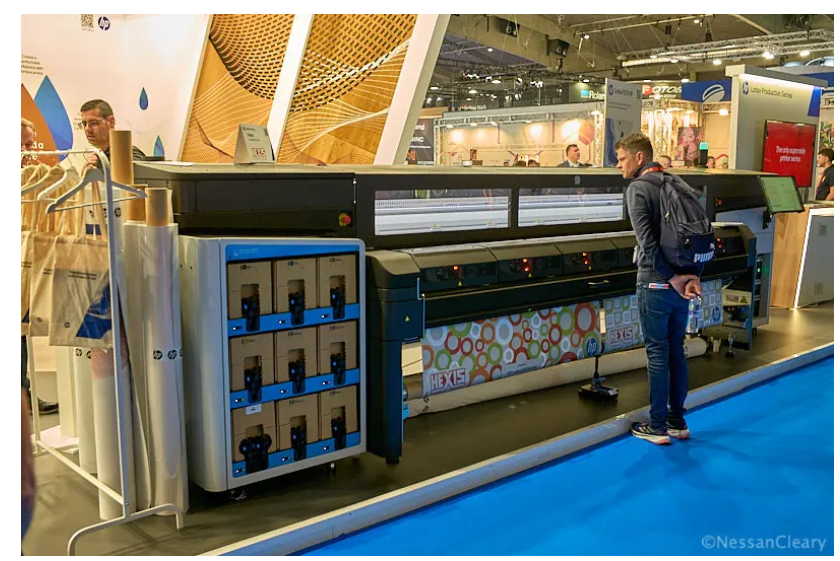
The HP stand featured a selection of the company’s smaller latex printers, with the most interesting being the R2000 Plus hybrid, which was shown with an automated handling system for rigid media. HP also discussed its cloud-based PrintOS Production Hub, which centralizes order and production management. It also includes analytics and job queue tracking, as well as automatic preflight file checks.
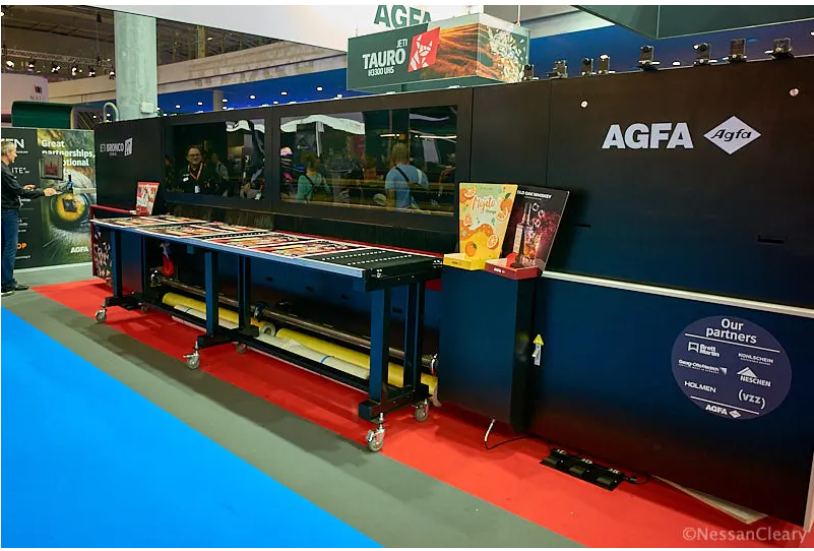
Agfa introduced its Jeti Bronco H3300 HS, a mid-range 3.3m hybrid with LED curing. It can produce up to 450 square meters an hour. It prints CMYK plus light cyan, light magenta and light black as well as white. It also features media feeding guides to handle warp-prone media such as corrugated cardboard.
Within Agfa’s portfolio, it sits between the entry-level Anapurna Ciervo H2500 2.5m-wide hybrid and the heavy-duty hybrid Jeti Tauro H3300 UHS, both of which were also demonstrated in Barcelona. To complete the stand, Agfa also brought along its Onset Panthera flatbed.
Otherwise, Agfa’s main news was the release of its Asanti 8 workflow software. This gains improved layout automation with new Hot Ticket tools such as auto-placement and auto-snapping. These enhancements embed logic directly into the workflow to minimize media waste, reduce errors, and accelerate job preparation. Agfa has also improved its Pantone rendering for better matching of out-of-gamut colors and better hue preservation.
Asanti 8 also gains a new StackFlow feature that organizes high volume, multi-destination print jobs by automatically arranging printed items according to delivery location. This is said to reduce manual collation, cut labour costs, and lead to faster fulfillment for large campaigns or multi-site rollouts. Michael Dupré, head of software digital printing solutions at Agfa, explained, “The new StackFlow feature is designed to help print service providers dealing with high-demand campaigns, seasonal rollouts, and high-mix folding carton work by making it easier to fulfil multiple different printed items to hundreds or even thousands of locations accurately and on time.” StackFlow is currently available for the Speedset Orca folding carton press, and future updates will extend this functionality to the Onset Panthera flatbed and presumably down to the rest of Agfa’s portfolio.
The release also adds broader hardware and systems integration with extended connectivity with the Fotoba XL cutter series, including automatic custom barcode generation via Fotoba Cloud for hands-off cutting setup.
EFI also brought along a new 3.2m wide hybrid printer, the Vutek M3H X, and announced several other printers, including two new variants on its Nozomi single-pass inkjet machines. But perhaps more interesting was the way that EFI is using artificial intelligence to analyze data from its machines. This can be seen in both the Insight analytics platform and the InSpec quality control system, but I’ve already covered all of this in a separate story on EFI.
Over on the Durst stand at Fespa, I came across another new 3.2m-wide hybrid, the P5 Core, which is really more of a restatement of the existing P5 platform that Durst has been selling for some years now, and which I’ve written about in a previous story.
Durst also showed off new software, demonstrating its Kyveris Sandbox concept, which is an AI-based workflow designed for more factory automation. Christoph Gamper, CEO and co-owner of Durst, told me, “I think our industry will go lights-out and autonomous and we need to think about this, so that’s what we are showing here.”
Kyveris appears to offer some of the features that the Job Definition Format promised to the commercial print sector. It includes an OSI Open Software Initiative, with open APIs and documented interfaces to allow for integration with MIS, workflow and finishing systems. It also incorporates a robotic automation layer, with Durst showing a Kyveris Sandbox area complete with robotic arms.
It’s becoming increasingly common to see such robotic arms operating at print trade shows, mostly for loading and unloading substrates for wide-format use or plate/ sleeve cylinders for flexo and gravure presses. But fully integrating robotic solutions into print workflows is complex, mainly because of the degree of programming needed to control the movements of any robotic system and how those systems respond when something unexpected happens. This requires a particular expertise, beyond what most printing companies are capable of, which means that any integration project is going to be prohibitively expensive.
Durst is exploiting AI to reduce some of that complexity and is building that integration into its Kyveris system. This should make it easier for its customers to combine their printing devices into a wider, more automated manufacturing workflow. That might enable large format print service providers to more closely align their printing and converting, and in the labeling and packaging markets, it might bring the printing closer to the manufacturing. But it’s really going to come into its own in the industrial segment, where printing can be part of the manufacturing process itself.
Inevitably, other vendors will also look into this, and indeed Zund and Koenig and Bauer already have their own robotics subsidiaries, so this is something we are going to see more of in the future, and not just at Fespa shows. In the meantime, I’ll complete this report from the Fespa 2026 show with a second part later this week.