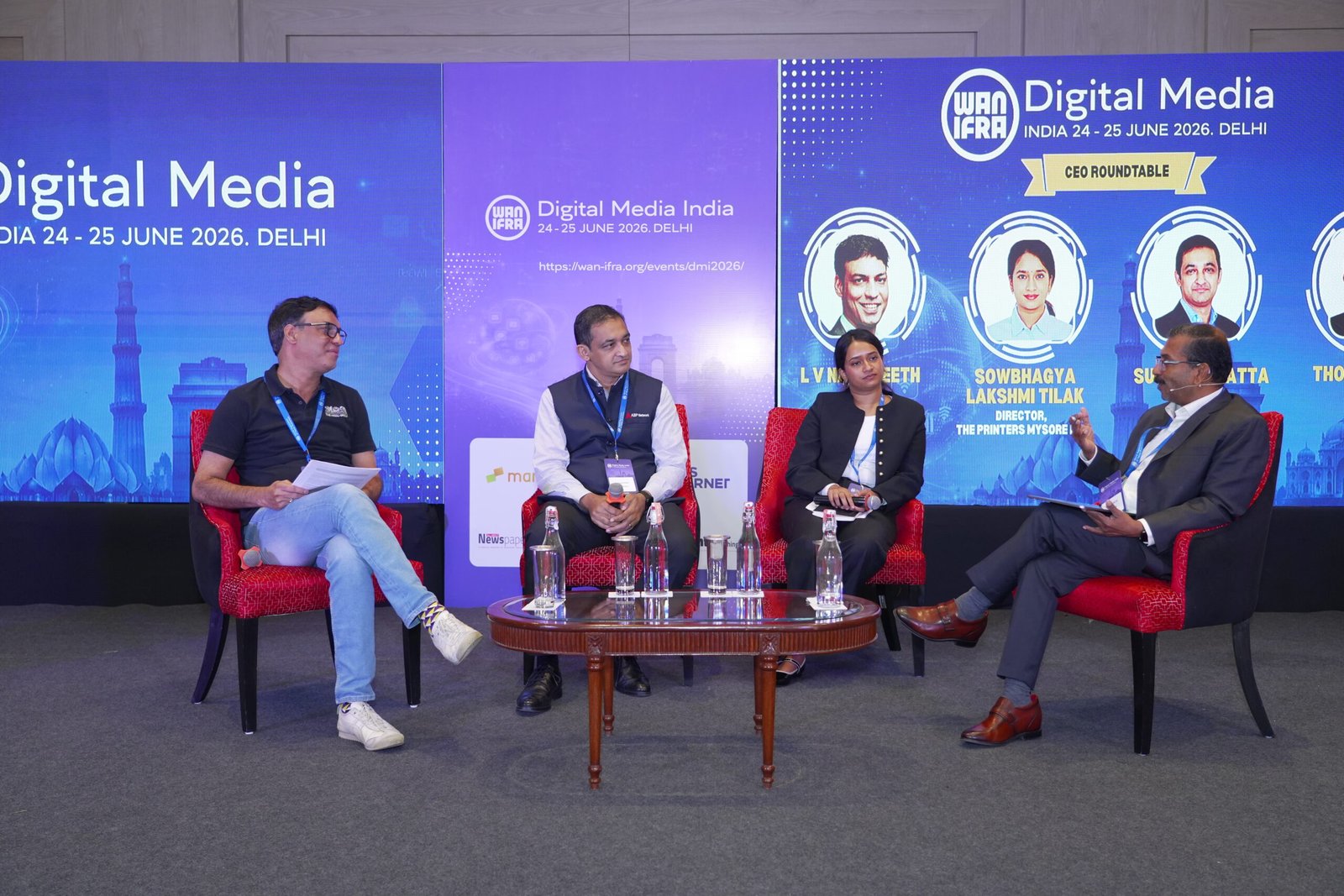
At the Wan-Ifra Digital Media India (DMI) 2026 conference in Delhi, a CEO roundtable discussed the challenges in the digital news business, relationships with platforms, the advent of AI, and their plans.
The four key issues that were central to the discussions featuring LV Navaneeth, CEO of The Hindu Group, Sowbhagyalakshmi Tilak, director, The Printers Mysore, and Sumanta Datta, CEO ABP Network, and moderated by Thomas Jacob, chief operating officer at Wan-ifra, were digital transformation, digital revenue, the AI disruption and Big Tech.

As far as digital transformation goes, progress has been made, but then, it’s been a mixed bag. There’s a need for a mindset change as there’s still too much reliance on print in legacy media houses. Digital revenue is still in the high single digits, but it’s unlikely that 50% of revenue in traditional print houses will come solely from digital soon. “There’s a need for media houses to add value and have faith in their own content,” was the general consensus.
Speaking on the use of AI, Navaneeth said a few media houses are toying with the idea, some are trying, and others are even using it, but they are all working in silos. There is a need to use AI for differentiation and efficiency, he said, adding that AI needs journalism for its future.
Touching upon the media’s relationship with Big Tech, he said all stakeholders need to come on the same page for a fair share of revenue and get a fair value for their content.
Sowbhagyalakshmi outlined her company’s ideas and vision of the media house that publishes Deccan Herald and Prajavani. The Karnataka-focused media house, which has an ad-based revenue model, was not fully successful in its paywall implementation on digital.
She spoke about owning the audience, the importance of diversified revenue, and leaning into what AI cannot replace, such as on-ground and original reporting, etc. As far as AI is concerned, she admitted that they are still a small player in the space.
News consumption
Contrary to the perception that people are shying away from news, Sumanta Datta felt news consumption is rising, but monetization is a problem. The focus, he said, should also be on selling good storytelling to the readers.
Pointing to the rise of third-party platforms, he said the balance of power has shifted to external digital intermediaries (for example, Facebook or Google). There is a need for content formats that fit any text or video platform, he said, and spoke about the focus on CTV.
The power of newsrooms lies in trust, and media houses just need to know how to make money from it, Datta said, stressing the correlation between war news and an increase in viewership, the need for an integrated content architecture, focus on monetization, building a connection with audiences, etc.
“Those who adapt will survive,” he cautioned, stressing the need to innovate.
The discussions then shifted to managing print and digital revenue and the gradual shift from the old format to the new one.
No new investments in print
Navaneeth said that, as far as print is concerned, the segment has seen no new major tech investments in recent times. Whatever money has been put into print goes into hiring journalists, who fit both models.
Elaborating on print, he said the segment has still steam left as far as advertising is concerned, with some legroom to grow. At the same time, he felt print is expected to reach a saturation point in the next two to three years.
Digital, he said, is rising fast but needs 25-30% growth in the next 2-3 years for the segment to contribute 50% of the revenue of the overall news media pie.
“85-90% of revenues and most profits for legacy publishers come from physical products. It is neither print nor digital… There is a need to protect and grow physical while doubling down on digital efforts,” Navaneeth said.’
He spoke on the need to learn from the downside of print’s over-dependence on ads, which are linked to geopolitical changes and events. Digital should be careful enough not to replicate the same model.
Explaining the difference between eyeballs and subscriptions, Navaneeth said that clicks on digital channels may not necessarily translate into revenue.
According to Sowbhagyalakshmi, there has to be an efficient strategy for the transition from the old to the new, which leverages both print and digital.
Different models
The discussions then shifted to monetization, with the panel exploring different business models such as YouTube videos, branded content, podcast interviews, events, and membership.
Dutta narrated his company’s learning experiences with concerts and events, recalling the example of the 10-city ‘I Am Home’ India tour of singer Sunidhi Chauhan. “It’s a cautious approach, and we are learning from failures or setbacks,” he said.
Going back to CTV, Dutta spoke on the need for an integrated approach to using the current content to fit all formats across mediums and, if needed, take the help of AI.
Navaneeth stressed the importance of audience activation as well as a common India subscription package spanning media houses and questioned if there was too much piggy-backing on legacy print brands to pull off events. “We need individual identity for all verticals,” he said.
One of the keys to staying relevant for readers is disseminating hyper-localized and need-based original information, Sowbhagyalakshmi said, taking the example of curated information for farmers such as commodity pricing as well as highlighting day-to-day issues affecting the public.
On the disruption of change brought about by AI and loss of referral traffic due to AI overviews, the general consensus was that it is a work in progress. More registered users and subscriptions could help tackle the AI disruption and help build loyalty among digital readers, who are known to shift bases fast.