So, the end of June brings the first half of this year to a close. A summary of H1 2026 reads much like the weather forecast: lots of high pressure, with some lows expected and the risk of thunderstorms.

The American president Donald Trump has finally managed to put the lid back on his disastrous campaign against Iran as both sides have committed to talks to try and restore the status quo established by the Obama-era Joint comprehensive plan of action. In his desperation, Trump has hung the Israeli leader Benjamin Netanyahu out to dry in the midst of yet another Lebanese operation.
As a result, oil prices have dropped rapidly, with pump prices now back to pre-war levels in the US and most of Europe. However, it appears that a genie may have escaped and offered Iran several wishes, including a commitment not to interfere in the continuing oppression of the Iranian people, the end of sanctions and the establishment of a $300 billion fund to help rebuild the infrastructure the Americans destroyed. Trump now has a delicate balancing act to persuade extremists in his own movement that this is really a kind of victory; if he fails, then a return to hostilities remains a distinct possibility.
Nonetheless, the economic tsunami that rippled around the world following the US attack on Iran will continue to be felt for many months, particularly around food prices because of the earlier disruption to the supply of fertilizer.
The US inflation rate has hit 4.2%, prompting Trump to declare “I love the inflation,” though American voters may feel differently. For now, the US Federal Reserve opted to hold its interest rates steady between 3.5 and 3.75%, though half of the bankers who advised on this have said they expect US rates to rise later this year.
Elsewhere, the Reserve Bank of Australia held rates at 4.35% this month but said it may have to raise rates later in the year to control inflation. And Japan has also seen a rise in inflation, though Japanese inflation is much lower than in other countries, at around 1.4%. Despite this, the country has seen a steep rise in prices as a direct result of the US action against Iran. Consequently, the Bank of Japan raised its main interest rate to 1 percent, up from 0.75 percent, the highest level since 1995.
Inflation in the Eurozone has risen from 3% to 3.2%, mainly due to rising energy costs. This has prompted the European Central Bank to raise its main deposit interest rate for the first time since 2023, from 2% to 2.25%.

The EU and China have begun three months of talks aimed at avoiding a trade war as the EU seeks to reduce the €360 billion annual trade deficit with China. Maroš Šefčovič, the EU’s trade commissioner, warned: “We simply cannot afford to continue in the unsustainable growth of the trade deficit from the European perspective.” The talks will cover four areas: the rebalancing of trade and investment; export controls, including those on rare earths; intellectual property rights and World Trade Organisation reforms.
In Britain, the Office for National Statistics reported that the economy shrank slightly by 0.1% in April due to rising costs and falling sales. Surprisingly, inflation in the UK has remained static at 2.8%, largely because food prices have fallen. A new report from the Bank of England suggests that Brexit knocked six percent out of the British economy, partly due to the Brexit settlement itself but also resulting from the years of uncertainty that surrounded the whole process. For context, an average economic depression would normally see a reduction in GDP of around four percent.
The British prime minister, Keir Starmer, is to stand down in the next few weeks, despite making it clear that he did not want to relinquish power, and there having been no actual challenge to his authority. Instead, the majority of Labour MPs have simply convinced themselves that their jobs will be safer with Andy Burnham, the former mayor of Greater Manchester, installed as leader. There have been no policies yet from Burnham other than a speech promising to move some government functions north of London and promoting his concept of Manchesterism, which basically means taking the same collaborative approach that most Labour leaders promise but rarely deliver. You can find a longer analysis of geo-economic trends filed under Letter from Lincoln, and of geopolitical events under Return to Sender.
In the meantime, the James Cropper paper mill has gone with the flow, working with Winter and Company to unveil The Colours of Manchester campaign at the inaugural Manchester edition of The Independent Paper Show. This is said to capture the tones that define the city for its Coloursource collection, which includes Vermillion, Azure, Bright Yellow, Grey, Chartreuse and Mandarin. Jordan Scott, head of marketing for James Cropper, explained: “Manchester has a visual language entirely its own, shaped by weather, music, architecture, sport and industry. This project was about observing those details closely and translating them into paper in a way that feels emotionally true to the city.”
The EU has scrapped its de minimis Customs duty exemption on business-to-consumer parcels valued at under €150. Instead, starting from 1 July, there will be a new flat-rate tariff of €3, which applies per item classification. That means that two t-shirts would be charged a total of €3 while a t-shirt and a pair of shoes would attract a €6 levy. This will directly affect Chinese web-to-print operators such as Temu and Shein but will also cause further headaches for British companies, except those based in Northern Ireland. To complicate matters further, the EU will introduce a separate €2 processing fee in November, though many European countries do already apply a customs administration fee. In any case, all of these schemes will be replaced in 2028 when the EU establishes both a new Customs Agency and a Customs Data Hub.
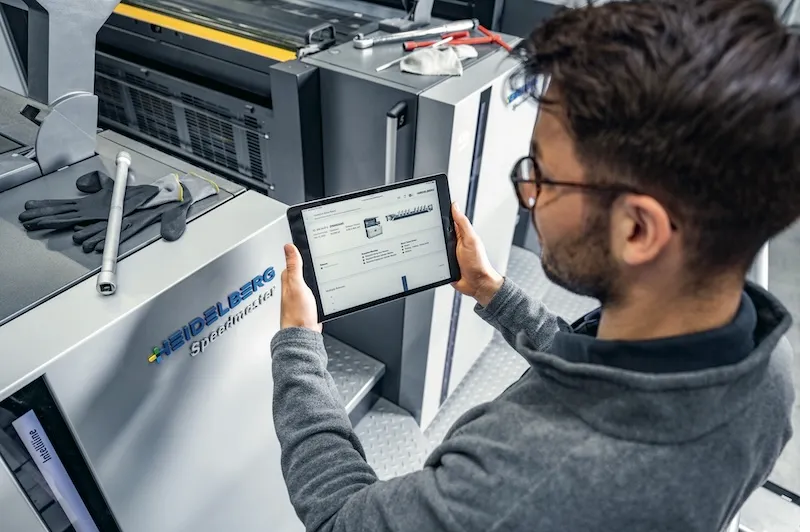
Heidelberg has acquired Manroland Sheetfed’s service and spare parts business, which includes roughly 35 country organizations with about 600 employees, and will strengthen Heidelberg’s own international service structure. Moreover, the deal also comes with the technology and intellectual property related to service and spare parts, as well as selected assets. This is good news for the roughly 3000 Manroland Sheetfed customers worldwide.
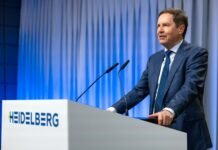
Jürgen Otto, Heidelberg’s CEO, explained, “With this transaction, we are ensuring that the acquired Manroland business can continue to operate reliably. The combination of Manroland Sheetfed’s service and spare parts business and its sales subsidiaries with Heidelberg strengthens our global role as a systems integrator and enables us to seamlessly ensure the supply to Manroland users worldwide. Together with our strong service and logistics network, we offer our customers a global range of services and spare parts.”
Interestingly, the deal also includes the IP for the Roland 900 / Cartonmaster that would allow Heidelberg to re-enter the large format sheetfed offset segment. The company has said that it is “currently evaluating options for the production and further development of this system”.
For DScoop’s recent Edge event in Slovenia, HP confirmed the commercial availability of its new Indigo 7K+, which builds on the existing SRA3+ 7K model that dates back to 2020. The 7K+ gains a new Eco Print Mode for reduced electroInk consumption with four colors. Feedback from beta customers suggests that around 40–60 percent of jobs would be suitable for Eco Mode. HP also launched an Indigo 18K value pack, that upgrades the Indigo 15K with support for media up to 600 microns.
Esko has announced a new Flexo Front End to help create and calibrate flexo screens. Robert Bruce, Flexo Product Manager with Esko, explains, “Flexo platemaking has traditionally required assembling multiple tools such as RIP software, screening technologies, calibration systems, and manual workflows, often resulting in inefficiencies, trial-and-error setups, and inconsistent output. By combining critical processes such as screening, calibration, and file preparation into a unified solution, the software empowers platemakers to streamline operations, reduce interventions and achieve predictable outcomes faster than ever before.”
Callas Software has introduced a new nesting module, pdfNest, for its OEM customers. This enables software developers and workflow vendors to build into their programs the ability to calculate optimized nesting layouts for multiple PDF files on a given sheet size. The nesting module is not included as part of the pdfToolbox but is designed for integration into automated production environments. It accepts XML and/or SVG for the description of the items to be nested, and delivers the same on output with the definition of the imposed sheets. An easy-to-use API makes for quick and easy integration.
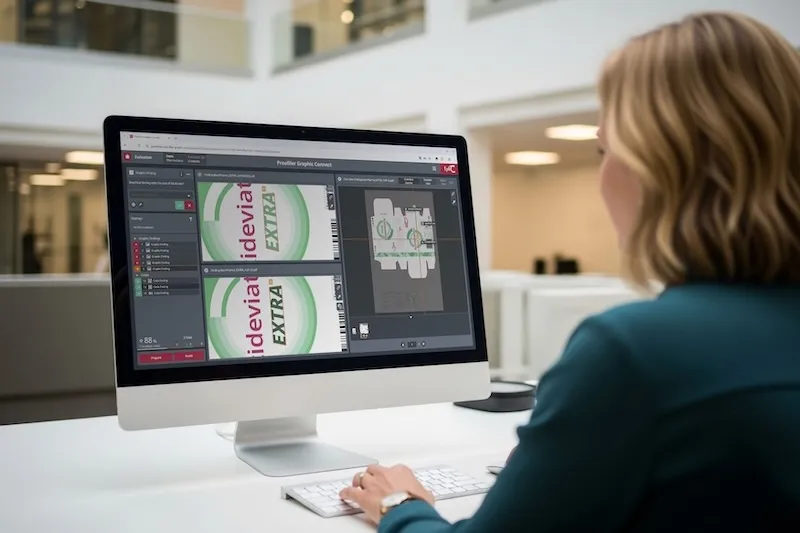
EyeC, which makes print inspection systems, has announced a new cloud-based prepress inspection software, Proofiler Graphic Connect for making PDF-to-PDF comparisons. That could include comparing print-ready and step-and-repeat files against approved reference files. It checks graphic content, barcodes, and Braille in client, print, and imposition PDFs, identifies deviations, all functioning in a browser and with real-time collaboration for faster approvals.
Xaar has held the official opening ceremony for its new Asia Pacific headquarters in China, located in the Songshan Lake Hi-Tech Industrial Development Zone in Dongguan. This brings together Sales and Technical Service functions and includes a dedicated Technology and Innovation Centre, manufacturing for ink delivery systems and printhead assembly, and advanced laboratories for ink and waveform development. The main market segments it will address are the ceramics, 3D printing, EV battery coating, and automotive glass printing sectors, which gives a good indication of where inkjet technology is heading.
Appointments
Fiery has promoted Micah Kornberg from Chief Financial and Operating Officer to CEO. Kornberg had been president of Entrac until that company was acquired by EFI. He became Vice President and executive sponsor for Fiery’s enterprise accounts division, where he helped modernize Fiery’s enterprise portfolio and was part of the leadership team when Fiery separated from EFI in 2023.
This follows a decision by the former CEO Toby Weiss, to take on a new job outside the print industry in cybersecurity. Weiss led Fiery through several milestones in his 17 years at the company, including the acquisition of direct-to-film software company CADlink in 2022, Fiery’s separation from EFI in 2023, Fiery’s acquisition by Seiko Epson Corporation in 2024, and the acquisition of textile software company Inèdit Software in 2026.
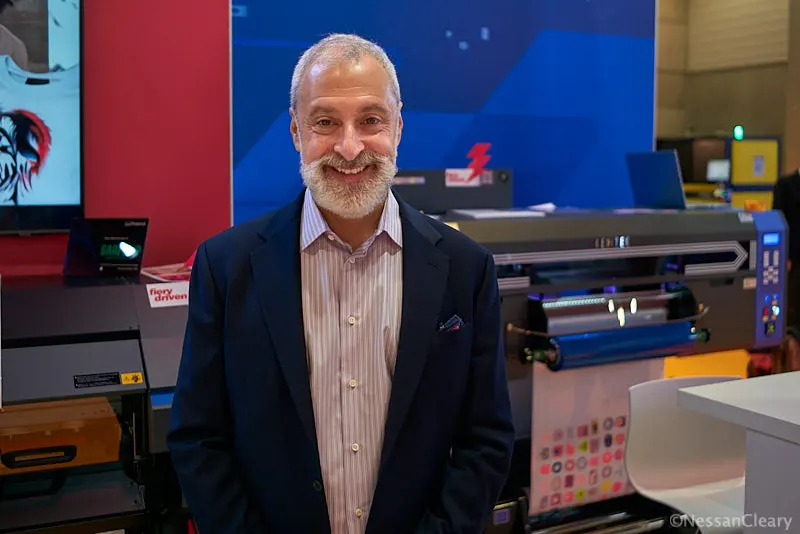
Weiss commented, “Leading the team at Fiery has been an honor for me. I love the print industry, but decided for personal reasons to take on the challenges of leading a company in the field of cybersecurity, which is where I spent my early career prior to joining Fiery. Micah has been an instrumental part of Fiery’s management team for over 15 years, and I have full confidence that he will continue to expand Fiery’s role as the leading DFE technology provider in digital print.”
Konica Minolta UK has hired James Pittick as Sales Director for its direct and indirect sales channels covering the company’s Digital Workplace and Professional Print business lines. He has over 20 years of experience across printing, technology, and managed services sectors. Rob Ferris, CEO of Konica Minolta Business Solutions UK, commented: “James’s extensive industry knowledge, multi-channel experience, and ability to lead successful high-performing teams make him an exceptional addition to our team.”
GEW, which is headquartered in the UK and makes UV curing systems, has appointed Jan Jonissek as sales manager for Germany. He is based near Hamburg, which will improve the company’s coverage in northern Germany as its existing team for the DACH region is near Stuttgart in southern Germany. He has spent the past ten years with Eltosch Grafix / Hoenle AG, where he specialised in project management and sales of LED curing systems. He will cover a number of applications, including label and web printing and converting, sheetfed and web offset printing, and all industrial and specialist UV projects.
Robert Rae, GEW’s Managing Director, complimented his breadth of knowledge, saying, “He has sound expertise in technical sales and negotiation, alongside his experience in customer-focused product development and in building strong client relationships.”