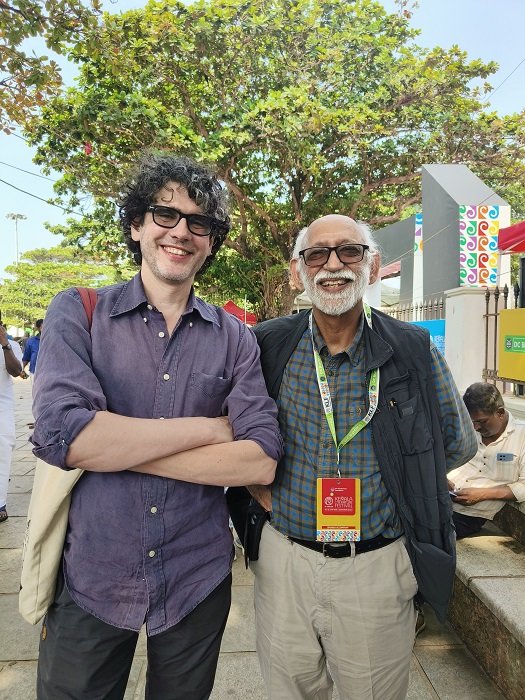
At the Kerala Literature Festival (KLF), correspondent Priyanka Tanwar spoke with Dan Morrison, author of the nonfiction book The Poisoner of Bengal, about his inspiration to write about crime in India, how his experience as a journalist shapes his writing, challenging aspects of writing the book, and his experience at the event.
Indian Printer & Publisher (IPP) – Tell us about your latest book, The Poisoner of Bengal.

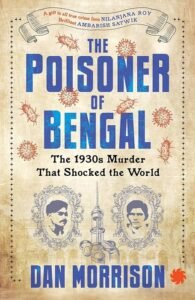
Dan Morrison – The Poisoner of Bengal, my new book from Juggernaut Books, is the story of a demented and cinematic murder in the 1930s in Kolkata, then Calcutta. It involves the murder of a young zamindar by his elder brother. The mode of murder was unique for the time. It was a pathogen, in this case, the plague virus – which caused the bubonic plague and some other pandemics of our time. It was used to eliminate this rival for the money and the status that came with the family’s holdings.
The story comprises the murder plot, the police investigation and the trial that brings justice. The cladding around the story is that of Calcutta in the 1930s.
IPP – What inspired you to write about crime in India?
Dan Morrison – This is a great and largely forgotten story of homicide, and it combines two of my great interests. I started my career as a crime reporter in New York City, and much later started writing about global health, medical science and the history of medicine.
This is a delicious collision of the two – A florid murder with an antagonist, with a killer straight out of the movies, at a time of great scientific discovery, and amid opportunities for the misuse of science
IPP – How does your experience as a journalist help you shape your writing?
Dan Morrison – Journalism is about the acquisition of facts, of getting as close as you can to the truth. In this case, the truth was almost better than fiction. The trial record, the documents from the home ministry, the letters and the diaries of people involved in the case revealed a story rich in motive, narrative, and in unique and interesting characters.
IPP – What were the most challenging aspects of writing the book?
Dan Morrison – I would say finding personal documents as well as letters and journals of people who were alive at that time. They were either closely or tangentially involved in the case or the time.
We are almost 100 years from the murder and that period. It’s almost impossible to find those people, and then for them to find the materials assembled by their grandparents or their great-grandparents.
IPP – Tell us about your experience of becoming a writer?
Dan Morrison – I became a writer by strong intent and pure accident. I grew up reading newspapers – a tabloid that my grandfather would bring home every night from work. But I fell into the business quite accidentally. I was young and in between jobs. I went to a temporary labor agency looking for data entry work, but they placed me at a newspaper, answering the phones at the city desk. I simply never left. My summer job turned into a career and seven years in that newspaper.
IPP – Writer’s block or creative shutdown is a familiar condition in the literary world. Have you suffered from it and how do you deal with it?
Dan Morrison – I put off, I delivered my manuscript late, I had many distractions. Some of them were legitimate. Some of them were maybe not legitimate and were avoidance. I wrote both this book and my previous book (The Black Nile: One Man’s Amazing Journey Through Peace and War on the World’s Longest River) in six months. But it took time to build the inward momentum to start and launch it. Once I begin, I don’t stop, but it takes me a while to get to that point.
IPP – Which authors have inspired you?
Dan Morrison – I come out of a newspaper tradition, and so a lot of my influences are from journalism. I grew up reading a man called Jimmy Breslin, who was sort of the archetypical city columnist, and another called Murray Kempton, who was sort of the yang to his yin.
One was this very forceful, aggressive, very public character who broke stories and was hated and loved. The other was an intellectual writer and columnist who would produce these enormously long and winding sentences full of literary references. They were my early influences.
Good, interesting, and forceful nonfiction writing has been happening in India for the past 15-20 years. In the 90s, when I first started visiting India, only the novelists known in my world and in the West. And now you’ve got both – strong narrative nonfiction and strong novel writing.
IPP – Would you like to talk about your experience at the Kerala Literature Festival?
Dan Morrison – It’s been terrific. Kerala is lovely. It’s great, similar to other cities, like Calcutta. It’s great to see the masses coming out to buy books, to see authors and to talk to authors. We have hope in the written word.
I’m meeting writers from India and from Europe. There’s a lot to talk about, see, and do. These literary festivals, and this one in particular, are great for just catching stories.
I saw an interesting session on a man named Chidambaram Pillai, who created in the early 20th century a shipping company meant to compete with British shipping companies at the height of the Raj (Swadeshi Steam: VO Chidambaram Pillai and the Battle Against the British Maritime Empire by A R Venkatachalapathy). It was such a threat that they crushed him and he ended up in prison for a time. But it’s a great story I didn’t know about. I think probably many people outside Tamil Nadu didn’t know about until this book was published.
IPP – You visited Calcutta for your research. How was your experience of the city?
Dan Morrison – I’ve lived in Bengal for three years. I love Cal (A short form of Calcutta mostly used by those born and brought up in the city). The history everywhere is involved and exciting. Calcutta has this history as a commercial, cultural, and imperial capital, and these layers give it extra depth. You could go and never come home. There’s so much to see there and so much to learn there. It’s also famous for its food.
IPP – What kind of research did you do before writing the book?
Dan Morrison – I spent years going through the thousand-plus pages of the trial record, including the depositions and exhibits used in the trial. I searched dozens of newspapers and archives on three continents, in the US, Europe, and in India. I spent fruitless time trying to track down descendants of people involved in various aspects of the case to see if their grandparents had left behind anything.
That included, say for example, former researchers at the Calcutta School of Tropical Medicine as it plays an important role in the book. I just had surnames of researchers at this institute and tried to track down their descendants. It involves a lot of digging, and there’s no guarantee you’re going to strike gold. I was, however, able to find a few descendants.
After the book was published, I’ve met the grandson of one of the lead investigators in the case, which is very rewarding. But it would have been tremendous to have met him before and get access to those papers. But you work with what you got, and in this case there was a lot to work with.
IPP – Which crime books would you recommend to our readers?
Dan Morrison – One of the best detective novels I’ve read is called The Tiger in the Smoke by Margery Allingham, written in the 1950s. Just give it a little time to get cooking, and once it starts, it really truly cooks. It beats any Agatha Christie to me. They were contemporaries, but Allingham hit it with this one. In non-fiction, the classics such as In Cold Blood (by American author Truman Capote) are worth reading.
There’s a lot of war reportage of the last 20 years since the US invasion of Iraq. These are war stories, but in some way crime stories. They’re just as rewarding in a similar way.
In pulp, you’ve got Dashiell Hammett. These classics are classics for a reason, and The Maltese Falcon can’t be beaten. Dashiell Hammett’s stories about the Continental Op, which are drawn from his early career as a private investigator, are thoroughly entertaining.