Roland DG used the Fespa show in Barcelona to reinvent itself following a management buyout that has allowed the company to delist. CEO and representative director Kohei Tanabe told me, “I don’t have to look to the shareholders. I can look at the market itself and what is needed and when, so we can make more decisions based on the market requirements and we can make quick decisions. That is the biggest difference.”
That’s led directly to a greater focus on industrial printing, which Tanabe defines as decoration either to flat or cylindrical objects such as bottles. He explains, “We are more focused on mass customization. In the past people talked about mass producing the same thing, but today people are looking for more customization so we are shifting towards that kind of demand. People need more productivity, more quantities, and with different objects.”

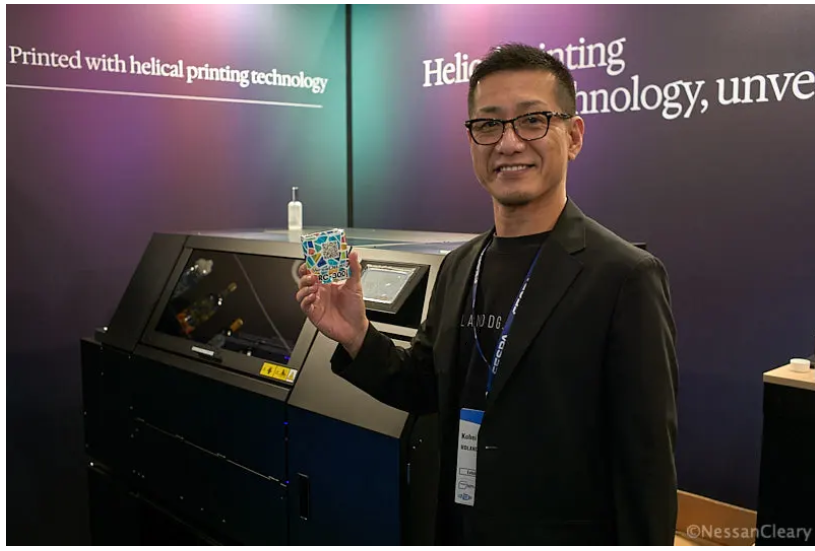
Thus Roland DG showed off both small-format flatbeds and direct-to-cylinder printers, all aimed at the decorating market. Perhaps the most interesting of these is a direct-to-cylinder printer, the RC300. This will handle cylindrical objects with a diameter from 45 to 127mm and up to 355mm in length, but with a maximum printable area of 300mm. It can handle some curvature, but Moe Kawami, product manager for the RC300, says that the profiles are still being developed for this.
It uses a new, harder UV LED ink which is said to be suitable for rigid objects and to cure into a tough scratch-resistant finish. The inkset includes CMYK plus two white channels, a primer and a gloss. The jettable primer can handle both glass and hard plastic.
The RC300 uses Ricoh Gen6 printheads, which is a new direction for Roland DG as the company has typically favored Epson heads. Each head in the RC300 uses four channels, with maximum resolution up to 1200 dpi. Roland is quoting a printing time of less than one minute to print a small bottle of 10mm diameter and 200mm length in CMYK plus white at 900 x 900 dpi.
Besides the standard model, there’s an RC300c variant that has been specifically designed for printing to transparent objects such as empty glasses. This is because it’s more difficult to control the curing process when the UV light can travel through transparent objects. The solution is to alter the angle of the LED array, which has required a very slight change in the array itself to accommodate this. The problem is further complicated by the need to work around patents held by other competitors, leading to the second variant. Kawami adds: “The idea is that you can buy one model and just swap the lamp array between them. But you would need training.”
Both models should be available this autumn with the standard RC300 priced at €65,000 and the RC300c variant at €70,000.

In addition to this, since January of this year, Roland DG has also taken on the worldwide distribution for the Peri series of direct-to-cylinder printers that have been developed by the American manufacturer Lsinc. This includes the PeriOne that was shown at Fespa, which is a single rotary printer, meaning that it can print 360º all around cylindrical objects with flat sides or a slight taper. It can produce up to 4.7 pieces per minute.
The range also includes the PeriVallo 360M, which is a contour printer so that it can also print to cylindrical objects with curves or contours but at a rate of up to 2.9 prints per minute. There’s also the PeriQ 360 that’s essentially a more productive version of the PeriOne and can take four objects at once and produce up to 19.1 pieces per minute.
The series uses Ricoh Gen4 printheads with resolution up to 1247 x 1200 dpi. There are five printheads for primer, white, CMYK and varnish. The same machine can handle both opaque and transparent objects, due to the patented configuration of the UV LED lamps.
Stanislav Golovchuk, head of sales for Roland DG’s industrial products, says that while the RC300 is a light industrial solution for short runs and prototyping, the Peri-series are real industrial products, adding, “So not only short runs but also industrial lots with customisation.” He continues: “So it could be premium packaging, drinkware, luxury products, customisation.” Golovchuk says the printed products are safe for up to 400 cycles in a dishwasher but that glass products should be heated over a flame before printing to improve adhesion, which is standard practice for printing to glass.
Tanabe says that this combination of the in-house developed RC300 and the Lsinc Peri-series allows Roland DG to cover all the demands from the market, noting, “If you are looking for 10 to 500 pieces then the RC300 is right so we have the option for customers to choose from.”
He explains, “If we can make it then we are going to make it” but adds: “We are looking for strategic alliances with outside partners for solutions where we don’t have the technology for.”

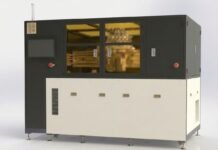
Roland also showed a new flatbed, the VersaObject IO300, though this is still a prototype and the staff on the stand were unsure what they could say about it. It uses a similar imaging system to the RC300, including the same ink, with LED UV curing. The printheads are also Ricoh Gen6, but with a two-channel version. Resolution is 1200 dpi.
There are four printheads, with two printing CMYK while the other two use white and clear. The standard production speed is 3.5 sqm/hr. However, there is also an option to load two sets of CMYK, which will result in faster printing, but Takefumi Kurahashi, who works inRoland DG’s digital print market development unit, says this won’t double the productivity, though Roland DG has yet to profile this to determine the speeds.
It has a print area of 770 x 550mm – equivalent to B2 – and will take media up to 204mm in height. The machine can print to objects with uneven surfaces and will handle up to 10mm curvature or variation in height. The target application is high quality decoration of small objects, with Kurahashi saying that it will comply with applicable standards for toy manufacturing. Typical applications are anticipated to include industrial parts decoration, nameplates, control panels, housings and functional components.
Roland DG also showed off several new wide format machines for the display graphics market. Tanabe explained, “We have to balance the sign making with the industrial. We are not going to leave the sign making area. We still have a chance to grow.”

Thus, Roland DG showed off a new latex printer, the TrueVis AG-640. It’s not the company’s first foray into latex, having previously collaborated with Brother whereby Roland DG supplied the chassis and Brother the ink. But Tanabe says that this time around the technology is all Roland DG’s, noting: “We had lots of feedback from the previous latex so we can put all that knowledge into our own technology.”
As with most latex printers, the inkset includes an optimizer to help the colors key to the media. The colours include CMYK plus red, orange and white. There’s no need for an overcoat with the inks containing the protective layer for good rub resistance. One obvious application is vehicle graphics, which still require lamination for longer lifespans but this can be done straight after printing without the hassle of having to wait for a solvent ink to de-gas.
As with other latex inks, there’s clearly a need to juggle the amount of heat used to dry the water-based inks without damaging the materials. This has led Roland to suggest a cut-then-print workflow to minimize the exposure to heat for some applications.
Jarno Provost, who owns a Belgian print bureaux, Grafical Racing Design, has been beta testing the new latex and told me: “We tested more than 108 different types of vinyl and there were only three that didn’t work.
Otherwise it’s a standard 1.6m wide printer/ cutter. The heads are Epson and arranged in a staggered configuration to allow the optimiser to be laid down first, followed immediately by the colours.
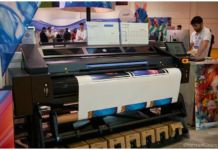
In addition to these prototypes, Roland DG also showed off several new display graphics printers that were first announced back in April of this year. There’s a new EU2-1000MF flatbed, which improves on the existing EU-1000MF that was launched in 2023, with Roland DG claiming the new version to be 1.5x more productive but with the same pricing. This takes media up to 2.44m wide and 1.12m in length, though there is an option to extend this length to 1.22m. It prints CMYK plus white and gloss. The new model gains updated printheads, with resolution up to 720 x 1200 dpi.

For the roll-fed market, there’s the new Truevis VG4 print and cut machine. Print resolution is up to 1800 dpi while the cutting speed goes up to 300 mm/s. It is available in both 1.3m and 1.6m versions.
The printer can be configured with up to eight colors, drawn from Roland DG’s TR3 eco-solvent inkset. This allows a choice of CMYK only, or CMYK with orange and red plus either Light Black and Green, or Light Cyan and Light magenta, or two whites. Roland DG also sells the VG4 Series with D-EA2 ink, though this is mostly in eastern Europe and emerging markets.
In truth, the new direction isn’t that different from the way that Roland DG has been operating for the last few years, with a mixture of graphics and small flatbeds. What is new is mainly a more determined push into more industrial markets that need higher volumes, along with the new direct-to-shape printers. Given that the company’s stand at Fespa appeared to be busy throughout the show, particularly around the new prototypes, it appeared that plenty of visitors were interested in this development.