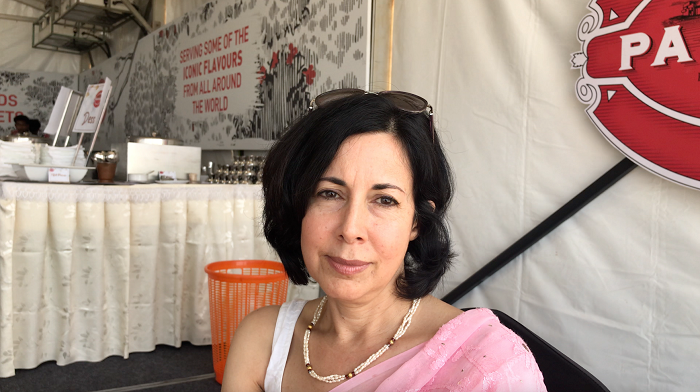
Correspondent Priyanka Tanwar spoke with historian Ira Mukhoty at the Kerala Literature Festival about her new book, The Lion and the Lily, the inspiration behind her writing, her perspectives on women protagonists, her transition from a scientist to a historian, and much more.
Edited excerpts:

Indian Printer & Publisher (IPP) – How was your experience at the Kerala Literature Festival?
Ira Mukhoty – It’s been marvelous. There were so many enthusiastic people – both young and old – interested in literature. They’d keep asking questions at the end of the sessions. It was a beautiful setting by the sea.
IPP – You have written about the history of Awadh in your latest book, The Lion and the Lily. What inspired you to write the book?
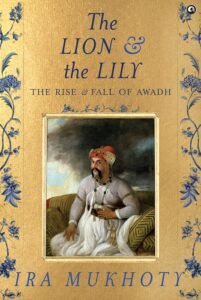
Ira Mukhoty – I have been interested in the history of 18th-century India because we have been told false narratives. The colonial narrative has driven our understanding of the 18th century. We have absorbed a lot of those stories written by the British. However, there has been a pushback against that.
My book is an attempt to unravel some of those myths – about the way the British takeover of India was somehow inevitable. India was waiting for this kind of assistance from the colonial powers. The Indian rulers did not put up any resistance and were almost willing to let the British take over.
There are many interesting aspects that can be unraveled about this narrative. I could also look at the French history in India because they had a presence in the 18th century. I read and write French and have been able to use some sources never used in India before. That aspect was very exciting for me. When I started digging into the French sources, I realized that after Bengal, Awadh was the most prosperous and most important.
There was an interesting history of the creation of Awadh. As the Mughal empire was crumbling, Awadh came up not only with the Nawabs but with the Begums. I have always been very interested in writing about Indian women, especially finding them their rightful place. Awadh provided me with this perfect space. I could discover both the anti-colonial narrative and the stories of Indian women through the Begums of Awadh.
IPP – Your writing offers unique perspectives on women protagonists. How did you get interested in the depiction of women in Indian history?
Ira Mukhoty – It began with the myths we are told as children and young girls. I was sensitive to stories told through popular media, Bollywood, cartoons, and TV advertisements. I began to have this sense that we were served this idea of Sita as a perfect woman whom Indian girls, children and women are expected to emulate. I found the way in which Sita is projected as problematic. They tend to emphasize her Brahmanical values – a chaste, well-behaved woman full of decorum who listens to her husband unquestioningly. Yet, doubt was cast on her sexual purity and chastity.
I thought it would be interesting to examine the way in which the myths have been twisted to serve a modern, nationalistic purpose. That brought me to the Mahabharata, which was far more interesting than the Ramayana. I started looking at Draupadi.
I felt the need to question the way in which such myths are presented to us as historical facts – as if these women have lived on this earth. In contrast, historical women have disappeared as myths. I was interested in this dual narrative and that took me on my journey of women in history.
IPP – Of all the women you have written about, which one is your favorite?
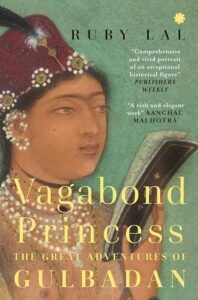
Ira Mukhoty – For a long time, my favorite was Gulbadan Begum, the daughter of Babur. She wrote her own biography in which she told stories of the zenana. She went on a 7-year pilgrimage at a time when Muslim women were not meant to be traveling alone. Ruby Lal wrote a fantastic book on Gulbadan (Vagabond Princess: The Great Adventures of Gulbadan). She is the first academic to pay close attention to Gulabadan’s biography and find it its place in the historiography of India. Her debut book (Domesticity and Power in the Early Mughal World), which studies the harem during the time of the early Mughals, was instrumental in getting me started on my journey.
Meera Bai has been another favorite. Recently, I discovered the Begums of Awadh. I like Bahu Begum because, despite being a woman who was strict with purdah (She was never meant to be seen by any outsider at all. Even her voice was not meant to be heard).
Despite these restrictions, she fought for her right to rule her lands in Awadh. She fought the British forces and was able to hold her own against Warren Hastings in such a determined manner that he was recalled to England, where he faced a trial for his behavior against Bahu Begum.
I thought the episode showed an extraordinary force of character and self-belief in the righteousness of her cause and refusing to be bowed down by the pressure of a man, no matter how powerful he was. I find her to be a great example for women today — that it doesn’t serve your purpose to be meek, obedient and quiet. Sometimes we need to learn to be feisty, loud and outspoken.
IPP – How has the status of women in India changed over the years?
Ira Mukhoty – I think we need to examine closely to understand what is happening in India. What is certain is that there was probably greater freedom in the distant past before brahmanical patriarchy came into the country and decided that a woman’s worth was in her womb, in her ability to produce sons for her husband as a chaste married woman.
We think the British brought in feminism and we gave them patriarchy, but in reality, they brought in patriarchy. The idea came through the ancient Greeks who started thinking about patriarchy in much more rigid terms. Their idea of a woman was one who should stay at home and produce sons for the Greek state. The men were supposed to be warriors and adventurous. This became a very powerful idea in Western European thought. From Greece, it went to Rome and then to Arabia. When the British came to India, they brought in those ideas.
IPP – You have written an authoritative biography of Akbar. What made you write it? What aspects of the Mughal emperor’s personality do you find most fascinating?
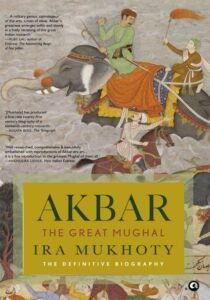
Ira Mukhoty – I had written a biography of the women in the Mughal Empire before this. During my research, some interesting facts came to light. Akbar married a number of Rajput princesses. I realized how much these Rajput women – especially his first Rajput wife from Amer – influenced his thinking vis-à-vis culture and food habits. He became a vegetarian on certain days. He removed the pilgrimage tax. We see how he opened up to the need to integrate Hindu kingdoms into his empire.
I thought a biography of Akbar would be a way to bring to light the stories of many such women who were confined to just one chapter. At the end of the book, you will find a chapter on the zenana. I didn’t want to remove women from the political stage. I wanted their lives to be intertwined with the main narrative, the political happenings, and the social and cultural changes.
There is Akbar, of course, but there are all the women – his mother, aunt, foster mothers, his milk mothers. I thread their lives into the narrative of Akbar’s life to bring them to the center stage, so that they find their own deserved space.
IPP – How did you become a historian?
Ira Mukhoty – I don’t call myself a historian. I am a writer of narrative history. I am a scientist by training. I came to writing accidentally, by beginning to write about myths. When I was offered the possibility to write about history, I thought, why not?
I am trained in understanding the concepts of research and how to carry it out. I thought if I applied it to history, I might be able to bring downplayed stories to light.
Sometimes we are not able to follow the paths that we dream of in our youth. Sometimes, we accidentally find our purpose a little later in life. That is my story.
IPP – Which author inspired you?
Ira Mukhoty – There are so many. Ruby Lal is a huge inspiration as a feminist historian. In historical fiction, I love the writing of Hilary Mantel, who has written the Wolf Hall trilogy. Her style of writing is just so vivid that it pulls you into the centuries and the times she’s writing about.
I like the way William Dalrymple has written his books, because he did it way before we realized that we could write about history in this way. He made history enter the public sphere, the sphere of the layperson.
Among the young crop, I admire Manu Pillai, Anirudh Kanisetti, Parvati Sharma. It is exciting to see these young writers enter the field.
IPP – There are allegations that the government is changing the course of Indian history. Would you like to comment on that?
Ira Mukhoty – Every empire fashions history according to its own idea of good and bad, of truth and lies. This is nothing very new. I think humankind and history is more resilient.
Martin Luther King once said, “The arc of the moral universe is long, but it bends toward justice.” I hope our writings will stay above and beyond the politics of today. These are more eternal, and people will have access to them even when things change.
IPP – Indian history has recently gained prominence in the literary scene. What are your thoughts on that?
Ira Mukhoty – Yes, I think it’s good. Western history has been written to such an extent that there’s in-depth knowledge about those figures. Dozens of books have been written about them.
I was questioned about the need to write a book on Akbar. But in the English language, the last book on Akbar was written 20 years before my book. We have to give the same attention to our historical figures because there are new developments and newer ways of looking at the past.
This is only the beginning. Indian history has a lot to tell us. It’s a far richer place than we can imagine, much richer than any Netflix offering.
IPP – Which books on Indian history would you recommend to our readers?
Ira Mukhoty – I love the works by Richard Eaton. He has written a lot about India. His book India in the Persianate Age: 1000-1765 is marvelous. I like Harbans Mukhia’s writings. He writes in a very accessible manner, despite being a professor.