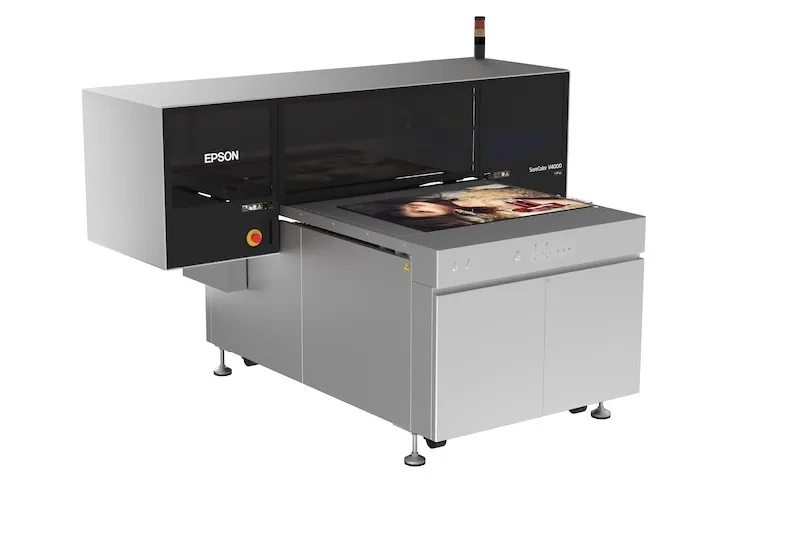
Epson has announced a new flatbed printer, the SC-V4000, which has an A1+ bed and is designed primarily for decorating small objects up to 200mm thick, including high-quality personalized items such as fine art, photography and signage.
Chris Davies, product manager for Epson Europe’s signage and textile printing, told this correspondent, “We believe for the applications that this printer will be used for, UV ink is the best choice for providing vibrant and long-lasting results.” It has a 10-colour UV inkset based on Epson’s existing Ultrachrome inks, which includes CMYK plus light cyan, light magenta, grey, red, white and varnish.

However, Davies says this UV ink can also be used to print Direct-to-Film, using cut sheet UV-DtF film, without any compromise in its performance on printing direct to rigid objects. That’s a useful capability as flatbed printers are generally best suited for flat objects – anything more than a very gentle curve changes the distance between the inkjet nozzles and the object, leading to poorer print quality. So printing via a transfer film would allow users to decorate curved objects.
However, in practice, most users will have two different workflows, for printing direct to objects and printing via transfer, in order to exploit the volume of work necessary to turn a profit. So users would need to think carefully about how to exploit this capability for any kind of volume production.
The bed has a vacuum system that is divided into four separate zones, mainly to cope with substrates of different sizes. The printer has an automated media height sensor and a jam detection system similar to that used on the larger V7000. It also includes an Ionizer.
The V4000 is fitted with three Epson PrecisionCore printheads, which allows it to print three layers – white, colour and varnish – at the same time. These heads have eight channels each, with two heads used for the colours, and the third head split between the white and varnish inks. That in turn means that the heads produce a native resolution of 300 dpi. However, Epson says that it has not yet defined all the print modes that would determine the resolution or productivity beyond saying that it can reproduce high-definition text and details as small as 2pt.
The new V4000 slots into the middle of Epson’s existing flatbed range, in between the tabletop A4-sized V1000 and the much larger V7000. The V1000 has been designed to sit neatly on a retail counter and, as such, gives shops a useful way to decorate small objects, from fridge magnets to phone cases, even while customers wait. At the other end of the scale, the V7000 is a standard 2.5m wide flatbed printer for general commercial work, with Epson hoping to hit both of these markets with the V4000.
Davies concluded, “Being a UV printer, the applications are varied. We see customers using this printer for personalized goods, fine art, general signage and packaging proofing. Braile printing will also be supported in addition.”
It’s also worth noting that Epson is a little late to this market, with Mimaki, Mutoh and Roland all selling compact flatbed printers of a similar size.
The new V4000 printer will be shown off at the upcoming Fespa show in Barcelona. Epson will also preview two dye-sublimation developments, including a new compact, desktop dye-sublimation printer at the Fespa show. The V4000 should be available later this summer, with the pricing details still to come. You can find further details on epson.co.uk.