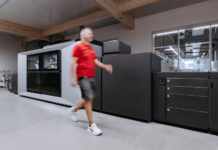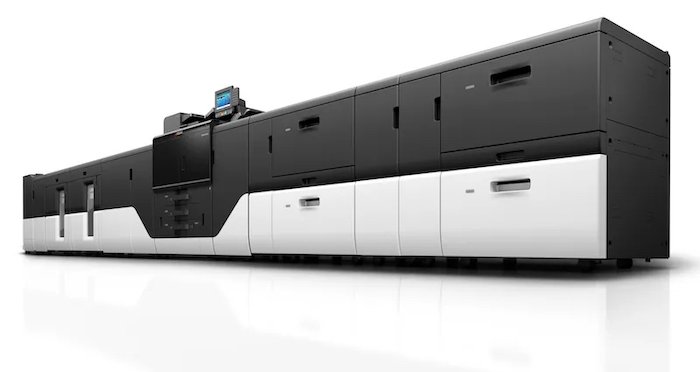
A recent Ricoh press release says that the TASKalfa Pro 15000c, built in collaboration with Kyocera and using its water-based inkjet heads, provides affordability and high-speed productivity. Based on its successful sales in the US for the last several years, the water-based inkjet color production press, based on its collaboration with Kyocera, is now being made available in selected EMEA countries by Ricoh and joins its portfolio.
In Asia, and in India, the TASKalfa Pro 15000c sheetfed inkjet will be sold by Kyocera and its distributors. It is offered by Kyocera India on its website, and it could mean that Kyocera’s distributor TechNova is also selling this. However, thus far, we have no confirmation of any market developments of this product or initial sales.

Actually, this is an integrated printer / copier with a monthly duty cycle of 1 million pages per month. It takes SRA3-sized sheets and can print 75 ppm, which equates to 150 A4 ppm in both colour and black and white. It is capable of duplex printing, though these speeds appear to be for single-sided printing.
As Nessan Cleary wrote six years ago when it was first being introduced, “It uses Kyocera drop-on-demand piezo printheads, with a maximum print resolution of 600 x 600 dpi. It prints CMYK, with three heads per color for a total of 12 heads. It uses water-based pigment inks, which Kyocera claims to also manufacture. The drying is through heaters producing hot air along an extended buffer pass.
“The printer does not use any kind of primer. It will take paper, including plain and inkjet-receptive media, from 52 to 360gsm. Not surprisingly, it’s mostly aimed at the transactional and transpromo markets. It comes with a standard controller, but there is also an optional Fiery FS300 Pro available. It includes a scanner unit that offers resolution from 300 to 600 dpi with speeds from 120 to 70ipm in simplex or 220 to 76ipm duplex.”
The TASKalfa system employs Ricoh input and output media technologies, such as the Large Capacity Tray (LCT) and high-capacity stackers. Developed with transactional printing and mailing houses in mind, the economical system is claimed to deliver cost-effective, high-speed production printing. For a wide range of high-volume print environments, it is being projected as an accessible entry point and backup solution. It may also present new opportunities for structured digital print operations in sectors such as education, government, healthcare, and financial and professional services.
The claimed benefits of the TASKalfa Pro 15000c are that it is eco-friendly because it uses water-based inks and consumes significantly less energy (up to 70% less) than comparable toner-based printers, thus reducing the carbon footprint. It is designed to run on standard power with no specific infrastructure, allowing fairly easy installation across many different types of print environments.
The jointly developed press by Kyocera and Ricoh is said to offer a lower cost per page and strong ROI for high volume printing across a variety of paper sizes and weights up to 360gsm. It is claimed to be scalable with a small initial footprint which can be grown as demand increases.
Productivity and color management can be enhanced with the optional Fiery controller. It is supported by remote servicing options. An optional 4,000-sheet inline finisher enables end-to-end production for folded letters, tri-fold brochures, and booklets. It delivers stapling for up to 100 sheets, booklet folding and stapling for up to 20 sheets, and two- and three-hole punching.
Our take
There is a distinct move toward high-volume web-fed inkjet presses in India with a high variation in quality, reliability, capex and consumable prices. The recent influx of presses is coming mostly from Asian manufacturers in India, Japan, and China. As far as sheetfed machines, the high-volume color inkjets from the established manufacturers have had relatively high capital expenditure for the Indian market in comparison to offset multicolor presses. Even the smaller Kyocera sheetfed inkjets seem expensive in comparison to the Chinese-made machines that use Kyocera inkjet heads.
Nevertheless, there could be a reasonable market play for a high-quality and high-volume water-based sheetfed inkjet press with reliable service and support at an accessible price. Most likely, it would go to experienced transactional or book printers looking for a low-carbon-footprint device that could handle work for competitive products, and also as a backup to their other webfed or sheetfed digital presses. On the other hand, this is a relatively old device, and unless it is aggressively marketed, it may have missed its opportunity by a good five to six years.