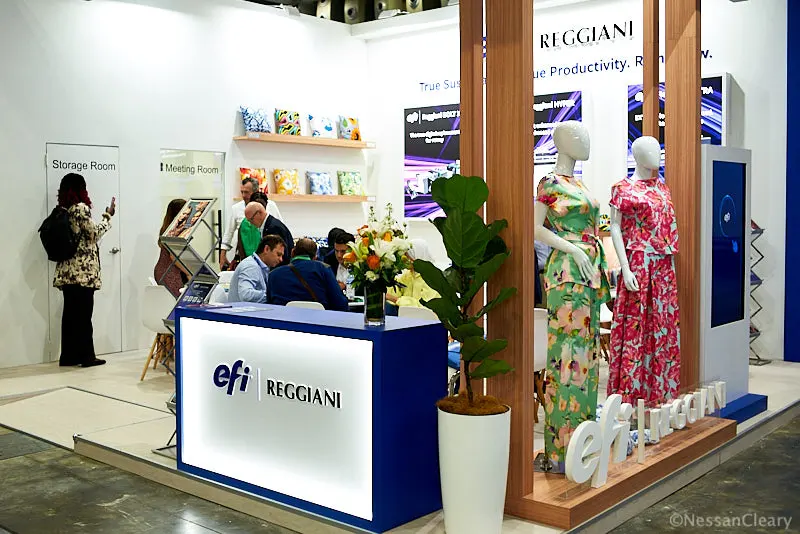
EFI Reggiani has added a new Titan model to its range of Eco Terra pigment textile printers, as well as announcing updates to its Hyper and Extra printers.
For the new Titan, EFI has increased the number of printheads from 16 in the Gold model to 32 so that it can produce up to 600 m/hr using Reggiani’s EcoTerra pigment ink. The heads themselves are Kyocera’s older non-recirculating 600 dpi KJ4B heads, rather than the new Kyocera EX600 heads. Micol Gamba, product marketing director for EFI Reggiani, says that the company may switch to the EX600 heads for the EcoTerra models later when they have more experience with them but that for now these printheads offer proven reliability with pigment ink.

The Titan was prompted by a customer from Brazil who invested in an EcoTerra machine a year ago but found that a rapid growth in volume left him needing more capacity. Gamba explains, “We had something in the pipeline, so he became our beta customer.” She adds that other customers from Latin America and the Gulf are also running tests on it, with more due to visit Reggiani to see it in December. Reggiani anticipates a standard three-month beta test followed by a full commercial launch around March or April of 2026.
Gamba says that the EcoTerra range was designed for customers who don’t have traditional textile production lines, “so they don’t have steaming or washing machines, but they want to deliver products faster and more sustainably.”

She continues, “We had North America and Europe in mind when we developed the EcoTerra product. We see a lot of demand in Latin America, where there is a need to save water, and there is a priority to turn off water-consuming machines. Also, Saudi and Gulf countries, where customers are thinking about setting up brand new textile manufacturing. And there are brands they want to build their own manufacturing capacity.”
EFI also announced improvements to two of its existing printers. The Hyper is Reggiani’s fastest multi-pass printer for the textile market. It uses 72 Kyocera 600dpi printheads, in this case the Katana heads with the full recirculation system down to the nozzle plate – Katana being the development code name for the Ex series with the large monolithic actuator. The Hyper has eight colour channels and can handle a range of inks, including reactive, disperse, and acid, as well as pigment, which explains the need for recirculating heads.
EFI has now managed to improve on this with a new High Quality booster pack that will improve both the print quality and productivity. Essentially, EFI has improved the ink and worked with its InEdit software subsidiary to improve the software for the printer and the profiling for the ink to eliminate any dithering effects, which in turn means it can produce better results with fewer passes. The Hyper is available in two widths, with the 1.5m wide 180 able to produce up to 20mpm while the 3m wide 340 will run at 16mpm.
Better still, the new booster pack will be available to existing customers as a field upgrade. Gamba says, “It’s just ink and software on the printer, so it’s a simple upgrade, but the customers will see an immediate boost in quality.”
Meanwhile, Reggiani’s existing Extra printer has also been improved. This has 48 printheads, in this case also the Kyocera Katana heads with recirculation for a choice of inks, including reactive, acid, and disperse as well as pigment. The hardware remains the same, so it’s still a 12-colour machine, but now it can run two sets of six colours. Gamba says, “The speed stays the same, but customers can do more and reduce the number of passes.
There are currently five of these installed in Europe and a sixth in Pakistan. One customer in Spain is using three of them for home textiles and has now ordered a fourth. Gamba says that the Pakistani customer is mainly producing fashion items for export, adding, “So they look for bright colours for higher quality.”
Elsewhere, Gamba says that EFI is also developing an eco-denim concept that aims to use digital printing to mimic the different shades of denim and faded effects that many brands and customers prize. That would eliminate not only the dyeing of the denim but also all of the washing that’s needed to produce those shades.
She notes, “Denim is probably one of the most polluting products of the textile industry.” Printing is simply a matter of colour matching the precise shade that the brand wants. It’s still a work in progress but Gamba says the results are almost the same as dyeing, and of course, considerably more sustainable as well as being quicker to produce.
You can find further details on EFI Reggiani’s digital textile printers from efi.com.