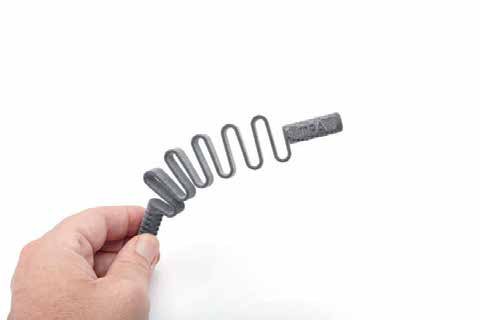
The sixth session of HP’s Beyond the Layers polymer 3D printing webinar series focused on elastomers, specifically TPU (Thermoplastic Polyurethane) and TPA (Thermoplastic Polyamide), and their expanding role within the 3D printing ecosystem.
David Johnson, HP’s application engineer, mentioned that HP supports multiple TPU variants and one TPA material, each serving different performance expectations across industries. While earlier MJF platforms, such as the 4200 series, work with materials such as Lubrizol’s M95A and Evonik’s TPA, the latest 5200 and 5600 series systems are designed for newer formulations, including M88 and HP 3D high-reusability TPU 01. Johnson emphasized that as customers shift to advanced systems, these newer TPUs will become the primary elastomer options for most applications.

A major theme of the session was the shift from traditional definitions of hardness to more advanced, design-driven methods of controlling elastomer behavior. Johnson explained that while customers frequently begin their discussions by asking for a specific durometer, hardness alone is no longer the central parameter for 3D-printed elastomers. With the Multi Jet Fusion process requiring no support structures, elastomer lattices can be produced easily and at scale. This expands the application usage, such as for footwear midsoles, cushioning parts, seating components, orthotics, and protective padding — areas where traditional foams have historically dominated.
TPU 01 for healthcare and footwear
Among the elastomers, Johnson first focused on TPU 01, which he said is a highly adaptable material for healthcare and consumer applications. He presented the work of Tillges, an orthotics clinic in Minneapolis, which is currently the world’s largest user of TPU 01. Tillges produces custom orthotic devices using patient-specific digital foot scans. These devices incorporate variable wall thicknesses, strategically open zones, and carefully tuned geometries to achieve the right balance of support and comfort. Once printed, the orthotics are vapor-smoothed to deliver a refined and consumer-ready finish.
In the footwear domain, the brand Hylos uses TPU to create midsoles that merge aesthetic quality with the structural freedom of MJF. Their shoes demonstrate how TPU can deliver both visual appeal and functional performance, especially when paired with post-processing techniques such as vapor smoothing or dyeing.
Replacing foam with elastomer lattices
The session explored how TPU is enabling manufacturers to replace traditional foam components with sustainable, long-lasting lattice structures. Various brands have already begun re-engineering automotive seat cushions using TPU lattices that offer improved breathability, custom zoning for different body regions, and long-term material resilience. A notable example discussed was a Porsche concept seat that showcased how a single printed lattice can incorporate multiple hardness regions, enhancing ergonomics and reducing material waste.
Industrial durability with TPU
Durability was another key highlight in the session, demonstrated through the work of Forerunner 3D Printing, a long-time user of Lubrizol’s M95A TPU. The company produces end-of-arm tooling inserts used in automotive paint handling systems, where components must withstand millions of cycles without damaging the painted surface. In rigorous testing, the M95A TPU insert operated for over three million cycles without requiring a replacement. Johnson also remarked that the material’s toughness allows for secondary machining, enabling manufacturers to fine-tune tolerances or geometry after printing, which is rare for elastomer materials.
TPA: High performance for athletic footwear
Johnson pointed out TPA for its exceptional rebound characteristics. He explained that while TPU and TPA may seem similar, TPA offers a noticeably livelier response, making it suitable for high-performance athletic use. This was demonstrated through HP’s collaboration with Brooks Running, where TPA was used to develop a 3D-printed midsole. Independent testing found that the TPA midsole achieved energy-return results surpassed only by Nike’s top-tier running shoe, positioning it as one of the highest-performing additive midsoles on the market. The Brooks shoe has since entered commercial production in select sizes, signifying a major step forward for 3D-printed footwear in mainstream performance sports.
The sixth session of HP’s Beyond the Layers webinar series highlighted the adaptability and industrial readiness of elastomer materials in Multi Jet Fusion 3D printing. With TPU and TPA enabling innovation in sectors as diverse as healthcare, automotive, consumer products, and high-performance sports, elastomers are emerging as a vital material class for functional additive manufacturing.