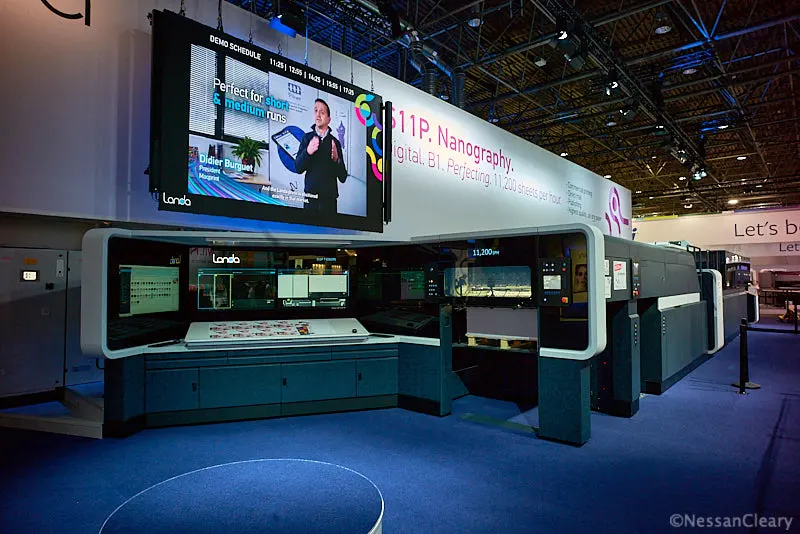
Last weekend, an Israeli bankruptcy court approved a bid for US$ 80 million by the private equity FIMI to take over Landa Digital Printing. The approval was subject to some administrative changes that FIMI has taken care of over the last few days so the deal should clear today, 11 September, leaving FIMI as the sole owner of Landa Digital Printing, including all assets and patents.
I have already written about the Landa Nanography technology and the company’s filing for bankruptcy. Those stories concluded with Landa Digital Print having been given two months to find a buyer before the court sold off the assets to repay its creditors. There was much speculation that a number of printer manufacturers had looked at the books and at the technology itself, but in the end, FIMI was the only company to table a bid. FIMI has said that its intention is to reorganize Landa Digital Print into a profitable business that it can then sell on, hopefully in around three years.

Most of the comments that have circulated since this bid was first announced have suggested that US$ 80 million is nowhere near enough to bail out LDP, which had debts totalling US$ 1.7 billion and was said by FIMI to be burning through an additional US$ 12 million every month. However, what has also emerged in the Landa story is a tale of poor financial control, with the company treating its investors as an unlimited source of funding. A good illustration of this can be seen in the decision, approved by the board of LDP, to commission a local developer, Vitania, to build a new headquarters that the company neither needed nor could afford. The building has been built, though Landa Digital Print had yet to move into it. Fortunately for FIMI, the court has released it from this rental agreement, leaving Vitania with a NIS 220 million (approximately US$ 66 million or Indian Rs 560 crore) headache.
FIMI, which is based in Israel, was founded by Ishay Davidi in 1996. It has an extremely good track record in turning around failing companies across a range of different industries. It doesn’t have any expertise in commercial print, but there are plenty of people in Israel who do understand how to sell digital printing to an international market. The bankruptcy process in Israel mirrors the American Chapter 11 model, which prioritizes helping companies reorganize and survive rather than just disposing of assets to pay off creditors.
Under the terms of the arrangement, FIMI will pay off the outstanding debts to the critical suppliers in full. There may be some debate as to which companies qualify as critical suppliers, as other suppliers will only be paid in part. Some US$ 25 million will be set aside to repay these suppliers plus any money owed to employees, such as for outstanding holiday pay.
Some of the money will also be paid into a pool with a view to eventually paying off the other investors. However, FIMI will not have to begin repayments to those investors until after it has doubled its investment to US$ 160 million. That means that Benny Landa, who personally invested some US$ 200 million of his own money, will be one of the last creditors to be reimbursed.
The rest of the money will be used to fund the company going forward. Benny Landa has no further involvement with the company, other than being acknowledged as the founder and the fact that it bears his name, at least for the time being.

This leaves the big question as to whether or not FIMI really can turn the company around for a mere US$ 80 million? I’ve opted to treat all the sources for this and the previous stories regarding Landa’s difficulties as anonymous, in order to discuss confidential matters freely. (This also has the happy coincidence of making me look smarter than I really am!) Nonetheless, one source disputes that the company ever reported that it would need US$ 300 million to reach profitability. Instead, the company has generated enough revenues to support itself through the bankruptcy period.
The previous creditors told the board that they would stop funding the company on 22 May and although they did offer another month’s funding, the company was living on borrowed time from that date. When the company was finally forced to file for bankruptcy on 29 June, one of the conditions imposed by the court was that there would be no new debts. That means that there had to be enough revenue coming in to cover the ongoing business activities including the staff salaries.
I’ve been told that throughout this recent turmoil, LDP was able to supply customers with inks and other consumables as well as spare parts, so that customers were not left with presses that they could not run. The inks and some additives have a shelf life of 12 months, though this drops to three months once they’ve been mixed, so most distributors would have had enough stock to help with this.
This is also confirmed by Komori, which has enough consumables to support its customers and my understanding is that the day-to-day business between Komori and Landa has continued as normal. Komori is a critical supplier, being responsible for the press chassis and substrate transport, so its invoices should now be paid in full.
Komori also licenses the Nanographic inkjet technology for its own NS40 B1 presses, so it is dependent on Landa to supply consumables. Landa has told me that it sees no difference between the Komori and Landa customers and aims to supply all customers equally. Komori has also clarified that it has installed three NS40s: one to China and two in Japan, at Kyoshin Packaging and Crown Packaging.
One source has told me that the print volumes for the Landa presses continued at the same level as before the bankruptcy. However, it should be noted that some customers, such as Bluetree in the UK, have maximised the volumes they run on their presses, while others have a relatively low volume because they mainly use their press for higher value work. So one challenge going forward will be to ensure that all the presses are run at higher volumes to increase the consumable revenue for LDP.
Despite speculation, I’ve been told that customers are paying for their presses, although my understanding is that there is some variation in the financing arrangements around some presses. Equally, LDP has had to rely on local distributors to carry out any servicing rather than sending staff from Israel because of the financial situation. However, this appears to have worked without any problems and is likely to be adopted as normal procedure in the future.

So FIMI appears to be betting that the kind of back-to-basics business approach that private equity firms generally take might be enough to put LDP onto a firmer financial footing. As one source put it to me, “FIMI can be ruthless but could make the company work.” Ensuring continuity of supplies, regularising the financing of the presses and eliminating unnecessary overheads will all help with this.
Although there is a suggestion that FIMI will continue to employ all the staff at LDP, there’s no obligation to do so. It’s far more likely that the staffing levels will be stripped back to the bare minimum needed to support the existing customers. There is still some work to be done to improve some of the technical aspects of the press. This includes sorting out inconsistencies in the blankets as well as reducing the cost of the inks, and this may mean that some R&D employees are brought back.
Otherwise, the court proceedings have removed any further liabilities on the company and its management and directors, so today’s transaction should close this part of the LDP story and there shouldn’t be any further legal actions relating to the bankruptcy process. Effectively, the court process has wiped the slate clean, leaving the way clear for LDP to start afresh.
Much will undoubtedly be written about Benny Landa’s style of management, and clearly, there have been problems from the way the technology was over-hyped to the way the company was run. But it should also be remembered that Landa delivered not one but two market-leading print technologies. Sure, it took HP to stabilise Indigo, and now FIMI will have to do the same for LDP, but it’s still a significant achievement.
For now, the priority for FIMI will be to cut costs and ensure continuity of support for the existing customers. It’s extremely unlikely that anyone will be ordering new Landa presses any time soon, so the company will have to survive on the revenues from the 50 or so presses that are currently installed. We’re unlikely to hear much more from Landa this year, but if the company can survive till the end of the year, then it may yet weather this storm.
In the meantime, you can find further details from landanano.com and fimi.co.il.
First published by the Printing and Manufacturing Journal on 11th September 2025. Republished by permission.