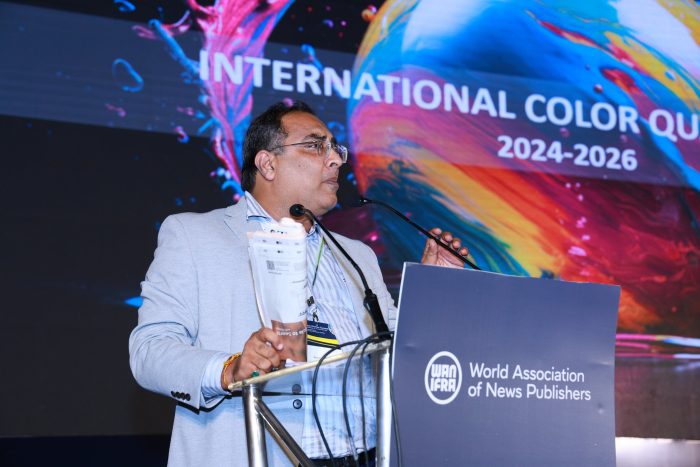
At the Indian Printers Summit hosted by Wan-Ifra in Hyderabad last month, Amit Khurana, CEO of Technova Imaging Systems, stressed that diversification is vital for the newspaper industry’s long-term survival and sustainability.
Khurana called on newspaper companies to move beyond traditional printing and venture into new business opportunities such as packaging and book publishing. By tapping into fast-growing markets and leveraging their established infrastructure, knowledge, and trusted brands, he believes newspapers can secure business profitability while enhancing their environmental sustainability.

“Print has a long, sustainable future,” Khurana said. “But we need to diversify.” He noted that the print industry has traditionally focused on content distribution, but with the rise of middle-class incomes and rapid economic growth in countries such as India, there are promising new avenues for expansion. “Why restrict ourselves? We should be looking at how to reinvent our business models, reimagine our future, and contribute to the environment,” he added.
Khurana highlighted the power of collaboration within the industry, arguing that it could help unlock underutilized capacities and create synergies that benefit both business and environmental goals. “Collaboration is the way to go,” he remarked, pointing to examples in other industries that have partnered to successfully pursue both business growth and sustainability.
Achieving sustainability: a collective effort
Khurana spoke about the importance of embedding sustainability into the very core of business operations. “It has to be top-down,” he said, explaining that sustainability must become part of the operational DNA of every business. He introduced the concept of life cycle analysis, a cradle-to-grave approach that evaluates the environmental impact of each component in the newspaper supply chain.
Khurana used this approach to illustrate how businesses could reduce their carbon footprints by assessing their operations at every stage. From sourcing raw materials such as paper, aluminum, and ink to manufacturing, distribution, and recycling, every step of the process leaves a footprint. “Once we know what our carbon footprint is, we can work towards reducing it,” he said, urging collective action from the industry.
The role of aluminum in the print industry
A key issue discussed during the panel was the role of aluminum in the production of lithographic printing plates. Khurana highlighted aluminum’s significant recyclability, with over 90% of it reused in industries such as utensil manufacturing. He also stressed the importance of maintaining the high quality of aluminum for printing plates, which requires 99.99% purity.
“Aluminium is a recyclable product. Ninety-five percent of the product we supply goes back into recycling,” Khurana said, underlining the material’s role in reducing the newspaper industry’s overall carbon footprint.
A sustainable future for print
In conclusion, Khurana reiterated that the print industry has a sustainable future, but only if it embraces both diversification and sustainability as central business strategies. By doing so, the industry can maintain profitability while contributing to a healthier planet for future generations. “We have the talent, infrastructure, and knowledge,” he said. “Now it’s about expanding our horizons and taking responsibility for our environmental impact.”