Held as a parallel event to the Jaipur Literary Fest, the first Jaipur BookMark was held at the Narain Niwas a few kilometres away.
Well received by publishers, illustrators, writers, agents and other professionals, the three-day event was partnered by Norla Norwegian literature abroad, fiction and non-fiction — and the Norwegian Embassy along with leading book publishers such as DC Books, Sahitya Akademi, National Book Trust and Niyogi Books.

The last BookMark session addressed some of the ‘Bottlenecks in Indian Publishing.
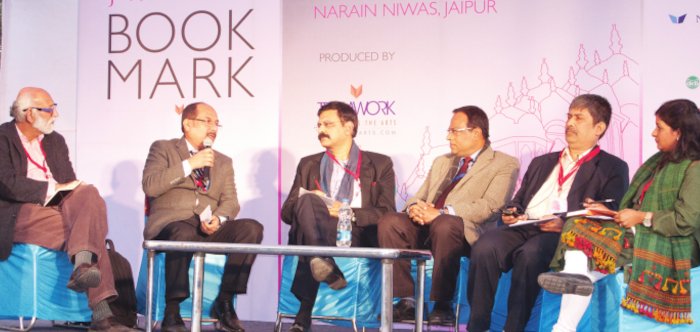
Moderated by Aditi Maheshwari of Vani Prakashan, the panel consisted of MA Sikandar of the National Book Trust, Bikash Niyogi of Niyogi Books, Ajay Shukla of Tata Mcgraw Hill, and Naresh Khanna and Sandip Sen of Indian Printer and Publisher.
The tone was set by Ajay Shukla when he said that although there are reasons to be concerned about the status of the Indian publishing scene, it is still one of the most vibrant and largest in the world with further scope of growth although there are not enough hands-on data to prove it.
He stressed that the economic viability of all stake-holders is fundamental for the industry going forward.
Naresh Khanna said it is unfortunate that the industry is still not able to authoritatively present relevant and concrete data which makes it more difficult to address the overall constraints. The enormity of the issue require a holistic vision based on data and facts that can quantify the bottleneck that the industry faces. He also suggested that compared to India, China has already demonstrated what can be done to economically produce books for universal education with the efficient use of technology.
Although the content creation and publishing and distribution supply chain is perforce more fragmented in a democracy, pronouncements of universal education are wishful thinking without a roadmap built on data.
MA Sikandar also highlighted the mismatch of available industry data and said that there has to be a collective effort from all the quarters to overcome this preliminary constraint. While commercial parameters cannot continued to be overlooked, a sustainable ecosystem, a policy framework is also needed. Sikandar agreed that digital printing has a bigger role to play in the future and that the National Book Trust will aim to evolve with the demands of the changing times.
Bikash Niyogi highlighted the plight of a quality illustrated book publisher in an extremely price sensitive market. Either paper production in the country has to improve in terms of quality and availability or duties need to be reduced especially in a time of currency volatility.
Sandip Sen praised the organizers of the Jaipur Literary Fest for organizing the first BookMark. He enumerated the bottlenecks in Indian publishing — capital, credit structure,
The seemingly over flowing crowd in rapt attention at one of the sessions in JLF 2014.
Photo: IPP distribution infrastructure, deep discounts and margins under pressure. Distribution and warehousing are also expensive bottlenecks of the book trade in India. His request to the big and small publishers in the country was to sit together, discuss and find a working solution for these issues.
The first BookMark has to be commended for asking the right questions and it was an intriguing experience to listen to so many young and engaged industry experts. As Sandip Sen said, being away from the glamour and hubbub of Diggy palace, the BookMark platform will hopefully mature into a full blown local version of the Frankfurt Book Fair in the years to come