Kao Chimigraf has come up with an interesting concept for deinking inkjet inks from flexible films that for now it is calling thermo switch polymer and which will be shown at this summer’s Drupa.
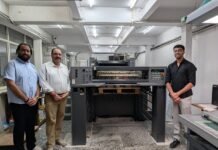
Francois Aguilar, chief commercial officer for Kao Chimigraf, introduced this concept at a press briefing in New Delhi, India. The basic idea is to use a change in water temperature to trigger a chemical reaction that switches the polymer, which could be in the ink, from binding to the substrate to instead repelling from the substrate, allowing the substrate to be easily recycled.
Kao Chimigraf started working on this idea two years ago, initially planning it as a primer that could be used to recycle flexible films. Aguilar says, “Normally, the primer is to add good adhesion to the substrate and better print quality but we wanted to add something extra to this primer technology.” He adds, “But now we can put it directly into the ink so that there’s no need to apply it to the primer.”
Another option is to include it in a barrier coating, which would eliminate the need to laminate a separate film to the print substrate, which should make it easier to recycle the finished product as a mono film. He notes, “It’s an inkjet print but we could put a flexo varnish on the back so that we don’t need a multi-layer material. We are trying to avoid the need for lamination, which is not easy but it’s a possibility to study.”

Aguilar says that the key will be the existing recycling systems. He explains, “Today the recycling of flexible films is done with alkaline water. It’s not easy to do and it’s harmful for human skin so you have to be careful with it. And it’s not good for the environment because this water has to be recycled.”
The thermo switch polymer can be used with normal water though it does have to be tested for the pH value as this differs from region to region. Heating the water to 70°C activates the polymer to switch. Aguilar says that this heating shouldn’t lead to additional energy costs since it’s already necessary to heat the water for recycling some materials such as corrugated cardboard. He continues, “We will make a fluid to add to the water that will agglomerate the ink together so that then it can be filtered out. And then it can become like pure water again.”
“The key thing is that the existing recycling infrastructure companies will have to consider something new and that will take time because you can’t ask these companies to completely change their cleaning systems,” he notes.
Aguilar says it shouldn’t be any more complex than existing systems and that the price should be similar to adding a primer to a substrate.
For now, Kao Chimigraf is working on water-based inkjet inks though Aguilar says that it should be possible to work with UV ink in the future. He says that it shouldn’t change the rheology or any other properties of the ink, though concedes that will depend on the formulation of the ink. It should work with any printhead though it might be more complicated with those heads that include recirculation.
He says, “Our first target was with flexible film but we are looking at paper and corrugated as well.” To this end they are hoping to start with labeling before moving to wider web single pass inkjet presses. Textiles could represent another opportunity though he says that the company does not have enough experience within the textile market to include this area yet. He says the main thing is that the process should work without requiring any further equipment in order to fit into the existing recycling systems.
This thermo switch polymer system will be shown as a concept at this summer’s Drupa show in Düsseldorf, Germany. Aguilar says that Kao Chimigraf is testing it with some flexible film manufacturers but anticipates that it will take at least another year to commercialize it.
However, it is exactly these sorts of concepts, which are often hidden behind all the fuss over the new presses, that make Drupa stand out from all the other print shows. While trade fairs are primarily about selling products, Drupa also includes plenty of projects such as this, helping vendors gauge feedback from potential users to shape their development, as well as to find other partners to work with. Aguilar adds: “We are still working on the concept and we are looking for partners to help us understand the recycling process.
The press briefing in Delhi was organized by Namrata Sharma, who set up her Global Print Konnect agency to help introduce western inkjet professionals to the Indian market. Apart from Kao Chimigraf, the briefing also included Seiko Industrial Instruments, Meteor Inkjet and Trijet plus People and Technology. It was an interesting collection of inkjet specialists, with some good presentations and discussions, but I’ll cover the rest of this event in a separate story over the next few weeks along with a series of reports on the Indian print market.
For now, you can find further information from kaoprint.com.
First published on nessancleary.co.uk on 15 February 2024