At least 66 journalists were killed in the year 2022, at least 40 of them for reasons directly linked to their work. Estimates suggest a record number – 363 – are currently in jail (a 20% increase on 2021), according to Wan-Ifra’s latest World Press Trends Outlook, reports Andrew Heslop.
Physical intimidation remains an effective means to silence the press, particularly in countries where public institutions are weak or under threat and the rule of law is challenged.

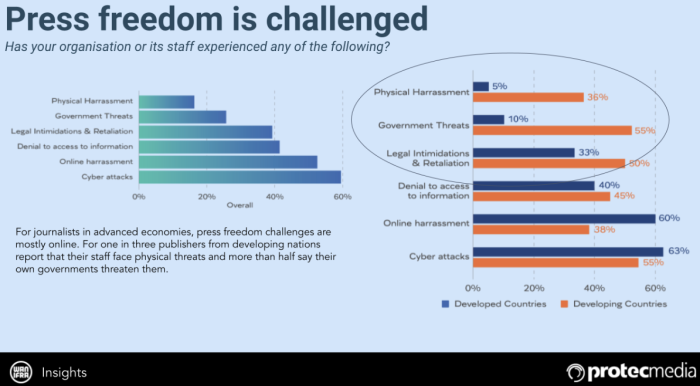
Wan-Ifra’s latest World Press Trends Outlook report features data collected on specific incidents of media freedom violations. In this extract from the full report, adapted for World Press Freedom Day, there is a broad split, echoed in its data, between developed and developing markets and between online and offline attacks.
The report comes ahead of UNESCO World Press Freedom Day celebrations that take place this year on 2 May at the UN Headquarters in New York.
Globally, the rate of physical attacks and murders has risen this year compared to 2021 figures, with the conflict in Ukraine contributing additional casualties – due, in part, to the heightened risks and dangers of war reporting, but also the deliberate targeting of journalists by invading Russian forces. Early PPE shortages, a lack of safety training, and the relative inexperience of many journalists covering the conflict highlight the need for continued investment in this area, and for media organizations (under their duty of care obligations) to better prepare staff for dangerous assignments.
Impunity around attacks and killings also continues to fuel the rising numbers, with lackluster investigations and low prosecution rates for those who commit crimes against journalists in hotspot areas ultimately providing scant deterrence. Globally, approximately 80% of attacks against journalists, including murders, remain unsolved, the report says.
Systemic failings within national justice systems coupled with general financial and resource mobilization issues across many fragile states and emerging democracies contribute to a weak legal environment. Corruption and intimidation of the legal profession in many countries further reduces access to justice and challenges the rule of law, all of which ultimately points to an ongoing lack of genuine political will to tackle assaults on the press in many jurisdictions.
Legal harassment continues to undermine public interest reporting worldwide. Libel and SLAPPs cases drain immense resources and time from even the most well funded news organizations, with the risk of criminal prosecution still a reality across numerous jurisdictions. Even the mere prospect of facing costly and lengthy legal proceedings can be enough to bury a story. National security and anti-terror legislation also continue to be widely applied and misused to target the press, jail journalists, and justify blocking access to information against claims of the wider public interest.
The need for legislative revision remains key in a number of countries still applying outdated, vaguely defined, or broadly applicable laws that do not meet accepted international standards and leave the door open for abuse, particularly in the online sphere. Censorship and the decriminalization of journalism has intensified as the debate around online regulation continues. The risk of laws either inadequate in their provisions, or far too overreaching in their potential application, leave journalists and media organizations increasingly isolated and exposed to the twin caprices of legislative interpretation and political interference.
On the reverse side, the data shows that online harassment against journalists – particularly women journalists – is becoming more prevalent across all regions. In the absence of effective deterrents, greater awareness among media managers and better access to support for victims remains an urgent priority.
Related, and increasingly common since the height of the Covid-19 lockdowns, we are seeing a significant increase in demand to address mental health and well-being issues alongside coping mechanisms for digital burnout and stress related illnesses associated with heavy workloads, heightened performance pressures, and the ‘always online’ culture.
Uncertainty around the future of Twitter led to great alarm, particularly for journalists based in countries hostile to press freedom where the platform has become entrenched as a reliable source of independent news. Concerns more broadly focus on the ability of tech platforms, themselves undergoing significant retrenchments and repositioning, to provide consistent content moderation, ensure safeguarding protections, and police extremism and other forms of online hate speech that inevitably risk leading to increased threats against media professionals.
While the dramatic changes to-date may satisfy the libertarian interpretation of unfettered freedom of speech online, the risk of an unchecked spread of misinformation and disinformation – coupled with the very real-world consequences facing individuals and groups at risk of discrimination – seriously calls into question the safety of journalists engaging across the major platforms. Newsrooms are also grappling with the mainstream arrival of artificial intelligence and its impact on journalism. While undoubtedly presenting significant opportunities, AI has the potential to exacerbate risks already inherent in the relationship between tech and modern journalism.
Underlining all of this, the financial health of media and the long-term sustainability of many organizations remains critical, particularly at this crucial stage of post-pandemic recovery. Independent media, particularly in fragile markets, are susceptible to financial pressures more so than at any previous time, given reduced advertising revenues and increased reliance on either state or donor support with a finite timeline and strings often attached. More than ever, the media must be acutely aware of exposure to soft censorship practices as they seek new investment in attempts to reach a more stable position.
Finally, as long as question marks remain over the viability of independent media titles, a free press will forever be limited in terms of its potential to contribute to critical democratic processes. The proliferation of news deserts and the negative impact these have on access to reliable information can only be reversed with investment in, and prioritization for, public interest media, good journalism, and trustworthy news. Successful continuance of the democratic, rights- and rules-based societal model goes hand-in-hand with the health of the independent media sector. Otherwise the gap between those thriving and those barely surviving will only increase, to the detriment of us all.
(This article by Andrew Heslop was first published on Wan-Ifra)