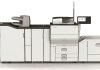
The Indian Printer & Publisher team caught up with some renowned printers at Shah and Nahar Industrial Estate, dubbed as the Mecca of print industry in Mumbai, to understand the current trends and their preference for future investments with respect to digital and conventional offset press.
During our interaction with various converters, it became evident that there is a growing preference offset press as compared to its digital counterpart. Short run is a new trend that has gained traction in the market. In addition, converters specified the need for color consistency, low cost per print and color gamut close to offset print. These, they said, were the key factors they considered before making any decision to install a press.

According to Dhiren Thakkar, director of Nirman Impresse and Mayur Gandhi, business development executive of Leo Prints, the market for commercial print is witnessing a downward trend, but it cannot be counted as a measurement to gauge the progress of digital presses. Digital has a limitation in terms of size, which doesn’t make it the first preference for printers. Additionally, offset prints are cheap as compared to digital prints. When the quantity increases, the print cost comes down in offset but in digital, click charges consume a share of price. The high cost of a digital press job is another factor that can’t be ignored.
No printer can afford to lose a client and they try hard to fulfill every requirement of the customer irrespective the job quantity. Echoing a similar statement, Bhavesh Devda, owner of Skyprint comments, “There is tremendous competition and client demands are soaring too. Digital press is a good option for urgent job requirements but for mass production, one turns to offset. Mass production gives leverage to business. Additionally, small quantity can also be viable with offset.”
Although the Shah and Nahar area is still primarily dominated by offset printers, in recent years many have turned their focus to digital presses as the demand for short-run jobs has increased significantly. Siddharth Wala, partner at Chandana Graphics and a user of both digital and offset presses, believes that the trend in the industrial estate is inclined towards a mix of offset and digital presses. He opines, “Most of the new players may go with digital presses but offset will never become obsolete. No doubt, the quality one gets out of a digital press is as good as offset but often, clients request for offset print if they desire better print quality.”
Ashok Shah of Manifold Graphics, who recently installed digital presses, feels the general tendency is mostly towards offset press. The prime reason to believe it is that offset print is less expensive as compared to digital print and with latest upgrading technologies such as autoplate loader and a few others, offset press significantly reduces sheet wastage and achieves precise print results. “For long, it’s been said that inkjet will be the leading technology in the market, but still there have been recent installations of offset presses in the estate.”
However, efficient workflow for print production was ignored by many, perhaps owing to space constraints or easy availability of prepress and postpress services at other galas. Many printers echoed the same sentiment that offset will be around for a long time and emphasized on having both digital and offset presses in their units.