After a prolonged delay that invited severe criticism from various corners, the Union government of India has reconstituted the Press Council of India (PCI), a statutory and autonomous print media surveillance and rights body – including working journalists in the vacant slots. In its notification on 7 October 2026, the government nominated 13 media professionals, six editors and seven working journalists, from newspapers and news agencies to the council.
The PCI’s main role is to preserve the freedom of the press and maintain and improve the standards of newspapers and news agencies in the country.

Led by Justice Ranjana Prakash Desai (retired), PCI had 14 members, including lawmakers, representatives from the Bar Council of India (BCI), the University Grants Commission (UGC) and the Sahitya Akademi, along with a few newspaper owners. The 29-member 15th council’s term will end on 18 December 2027.
“In exercise of the powers conferred by clause (a) of sub-section (3) and sub-section (5) of section 5 read with sub-section (1) of section 6 of the Press Council Act, 1978 (37 of 1978), the Central Government hereby nominates the following members (editors, namely Pradeep Kumar Jain, Sayed Raza Husain Rizvi, Ankur Dua, Aparna Shukla, Raj Parwana/Narender Singh and Vinod Bajpai, as well as working journalists, namely Vinod Kohli, Geetartha Pathak, Prajnananda Chaudhuri, Kingshuk Pramanik, C K Nayak, Prasanna Kumar Mohanty and Bijoy Kakchingtabam) to the Press Council of India,” read a notification from the Union Information and Broadcasting Ministry.
For months, the quasi-judicial PCI had been functioning without representatives of the working journalists (including editor) category. The PCI was initially set up in 1966 under the Press Council Act 1965 and later re-established in 1979 following the Press Council Act 1978 to ensure the freedom and quality of the mainstream media in the South Asian nation.
Justice RP Desai, who served as the PCI chairman from 17 June 2022 to 16 December 2025, assumed charge once again on 24 April 2026. The retired judge of the Supreme Court was nominated for another term of three years. But the quota for working journalists remained vacant, leaving the 15th council of the PCI incomplete (http://www.presscouncil.nic.in/CurrentMemberPCI.aspx).
Months ago, a member of the Rajya Sabha (the upper house of the Indian Parliament) raised the issue. Sasmit Patra, then a Biju Janata Dal leader from Odisha, had urged the Union government to complete the current PCI so that the media watchdog could perform its duty to safeguard democratic principles and strengthen media accountability.
Patra said the constitution of a full-fledged council after the term of the 14th council (which expired on 5 October 2024) was necessary for a free, fair and responsible press. Earlier, the ministry concerned had informed Parliament that the process of nominating these members (under the category of working journalists) was sub judice before the Delhi High Court.
Besides the chairperson (by convention, a retired Supreme Court judge is usually assigned), the PCI comprises 28 members, of whom 13 represent professional journalists. Another six members represent the management of newspapers (including the owners), with two each taken from big, medium and small newspapers, whereas one member represents the news agencies.
The two houses of Parliament usually send five members; three individuals are nominated from the BCI, UGC and Sahitya Akademi. Individuals representing small newspapers also get space.
Till now, the PCI had functioning members – Dr Sudhanshu Trivedi and Brij Lal (Rajya Sabha lawmakers); Dr Sambit Patra, Naresh Ganpat Mhaske and Kali Charan Munda (Lok Sabha members); Prof Ashwini K. Mohapatra (UGC); Manan Kumar Mishra (BCI); Dr K Sreenivasarao (Sahitya Akademi); and Sudhir Kumar Panda, MV Shreyams Kumar, Gurinder Singh, Arun Kumar Tripathi, Braj Mohan Sharma and Arti Tripathi (who all either own or carry on the business of management in big, medium and small newspapers).
The debate started when some national journo-bodies (including the Indian Journalists Union and the All India Working News Cameramen’s Association) legally opposed a change in the PCI rules to pick members from various press clubs instead of the national forum of working journalists. They argued that press clubs are basically recreational bodies, and their coverage areas normally stick to a particular region, city or town. Many press clubs offer memberships to non-working journalists (for example academicians, writers, film personalities and diplomats) to enhance their influence, and hence their members may not do justice to professional media personnel at various crucial junctures, they felt.
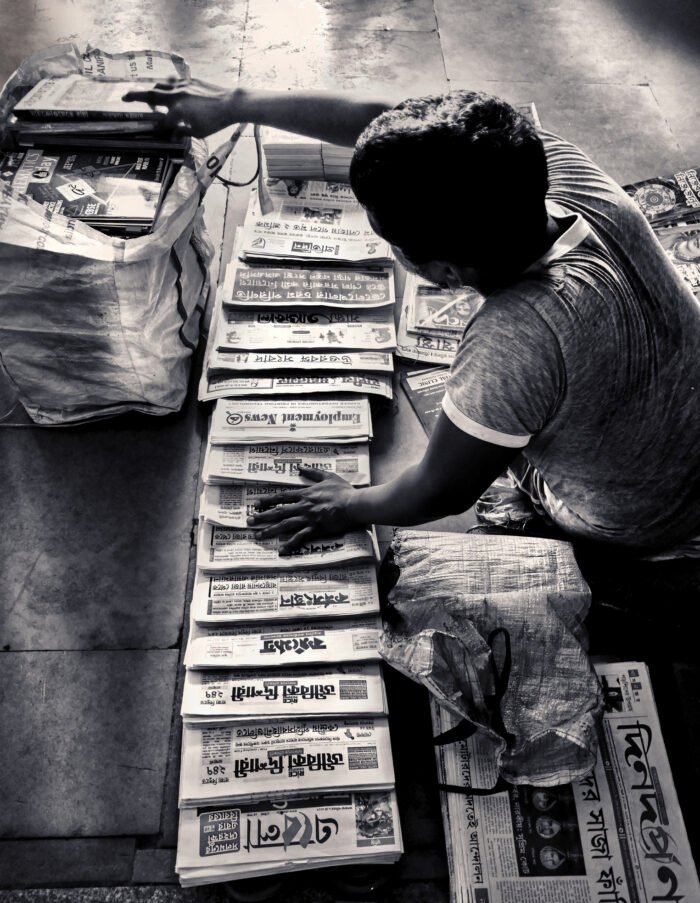
The Indian print media fraternity comprises over 100,000 publications, endorsed by the Registrar of Newspapers for India, in various frequencies and languages of publication. The billion-plus nation also supports nearly 400 satellite news channels along with thousands of portals, WhatsApp channels and other digital media outlets. The revenues collected (from both sales and advertisements) by Indian newspapers continued to shrink after the Covid-19 pandemic, when alternative media outlets started dominating the financial market space. However, many print observers believe that the traditional media will slowly recover from its abrupt loss. Resurgence in readership is expected as digitally fatigued consumers will soon turn back to print media outlets for reliable information.
The PCI has the authority to accept complaints against any newspaper/news agency or editor/working journalist for professional misconduct that deteriorates the standard of journalistic behavior. It has, however, limited power to enforce its guidelines by penalizing print outlets as well as their editors and working journalists for violating the guidelines. Many media professionals are demanding that the PCI be reorganized (renamed the Media Council of India) with television channels, radio and digital platforms brought under its jurisdiction.
As the press council enjoys the authority to make observations if the conduct of any government is found inappropriate with regard to the guaranteed freedom of the press, the journalist fraternity wants an empowered and enhanced council with larger coverage.
(The author is an independent journalist from Assam. The views expressed in the article are personal)