Xaar has released its final financial figures for the year ended 31 December 2025, which broadly show that the company is meeting its targets and has had some success in diversifying the markets its serves.
Thus revenues were up 12% to £60.1 million. The operating profit – after adjustments for currency exchange and the discontinuation of the FFEI life sciences business – was £1.1 million, up from the previous year’s £0.6 million. The profit before tax from continuing operations, with similar adjustments, was £0.8 million.
Gross profit for the year was £23.7 million, up from £19.6 million in 2024, while gross margins improved to 40%, up from 37% in 2024. The basic earnings per share, after adjustments, were 1.1 pence, up from 0.7 pence in 2024 though Xaar is not offering a dividend.
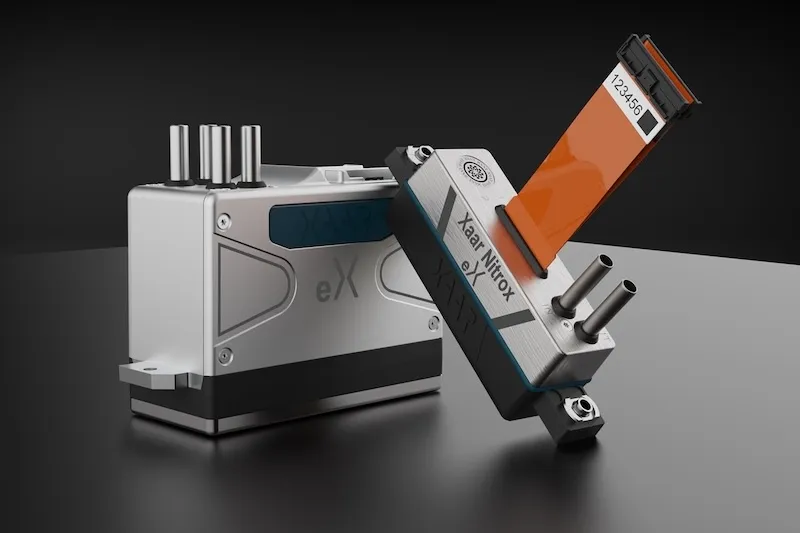
Xaar attributes the improvement in its figures to enhanced manufacturing yields, efficiency improvements and a more favorable product mix. The report notes that the ceramics market, which had been affected by changes in the Chinese domestic property sector, has stabilized. More importantly, Xaar is less dependent on that market, having re-focussed its efforts on the emerging market for higher viscosity fluids to differentiate itself from its competitors.
As with the previous year, Xaar reinvested eight percent of its revenues into R&D for both the printheads business and the Megnajet subsidiary, which is just about within the target range of 8-10 percent. According to the report: “Investment shifted further toward application-led development, OEM integration and enhancements to fluid management and platform reliability.”
Xaar is actively pursuing a number of markets, including 3D printing, notably in wax and desktop 3D, where more functional fluids offer superior printed components. This has led to a commercial breakthrough in the digital manufacture of jewelry. That’s an interesting development, given that Xaar has been involved in 3D printing for many years but mainly at the industrial rather than desktop end.
The company is also looking at automotive coating, where inkjet can give greater design flexibility and significant materials savings. Xaar has already had some success in coatings for electric vehicle batteries, where inkjet can replace Polyethylene Terephthalate wrap. The company has struggled to break into the packaging and textile markets, having previously lacked printheads suitable for jetting water-based inks with high enough resolution, but now sees opportunities where its ability to work with higher viscosity will translate into higher pigment loadings and lower water content for higher speed printing and lower energy costs. Equally, Xaar is also looking to use its capability for high ink laydown to open doors in the labeling sector.
John Mills, Xaar’s chief executive, commented, “Xaar’s differentiated technology can deposit precise volumes of high viscosity inks with pin-point accuracy. This capability brings benefits, increasingly in new applications which are driven by global trends towards digital manufacturing and the need to reduce process waste. Over the last five years, a period during which Xaar’s traditional markets have been troubled, the Group has revitalized product design and developed new products for applications where higher viscosity or higher pigment loading offers differentiation.”
However, as Xaar notes in its report, this sort of application development is complex, requiring cooperation with the companies behind both the fluid to be printed and the printing machine and that several layers of customer accreditation are necessary before commercial adoption. That means long development teams but also creates a significant barrier to entry for competition. And Xaar notes that “critical to the board’s strategy for the group, printheads need to be replaced regularly, leading to annuity revenue streams.”
The result of all this activity is that the core printhead business saw revenues rise by 22% to £43 million. Xaar’s Megnajet subsidiary, which mostly deals with fluid management systems, reported revenues rising by 2%. However, the US subsidiary, Engineered Print Systems, which mainly concentrates on integration projects, saw its revenues fall by 10%. Xaar blames this on disruption in end markets and says it carried out a business review and change of management early in the year. The report notes: “Moving into 2026 the new product and new application pipeline at EPS is healthy and the outlook is stronger.”
Otherwise, Xaar mainly concentrated on improving its technical support and regional focus, particularly in markets where digital print adoption is gaining traction such as corrugated, textiles, wax and Printed Circuit Board conformal coating. Xaar also opened a new ink manufacturing plant in Dongguan in southern China, which will also house a technology partnership center. This should improve support for OEM and integration customers in Asia. Xaar will also assemble some components here but with production linked to its core IP remaining in the UK.
One more interesting point to note from these results is that Xaar plans to meet investment needs from free cash flow and modest borrowing facilities. The company ended the year with net cash of £4.9 million, less than the £8.2 million it had from 2024, but that includes investing £2.0 million in capex and £0.9 million in repurchasing some shares.
Indeed, Xaar appears to be in a relatively strong position. It is free of any long term structural debt and has good liquidity and the flexibility to invest. That said, Xaar has previously disclosed historic overseas tax liabilities, primarily indirect taxes estimated at £2.7 million, which were uncovered during a review of local compliance processes and will be settled over the next two years and is not expected to impact future trading.
Mills concluded, “The timing of revenue from new applications, which generally require several layers of customer qualification, can be uncertain. This complexity, while sometimes challenging, eventually leads to much clearer competitive advantage, along with a valuable annuity revenue for printheads. Early trading in 2026 is in line with expectations. The order book is healthy for this time of year, and the Board believes the Group is well positioned for further progress – both in 2026 and in the longer term.”