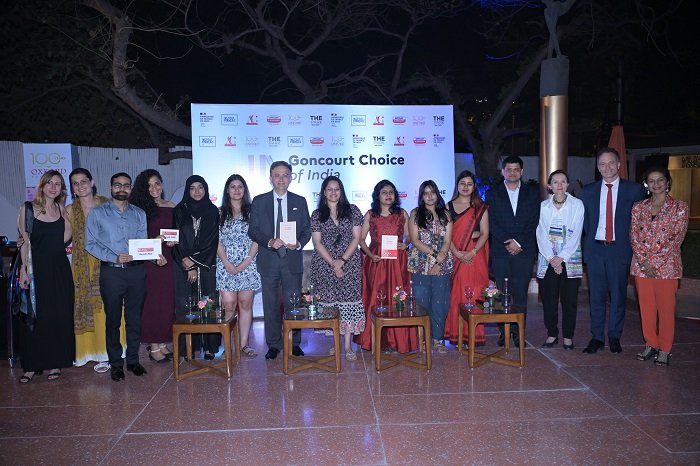
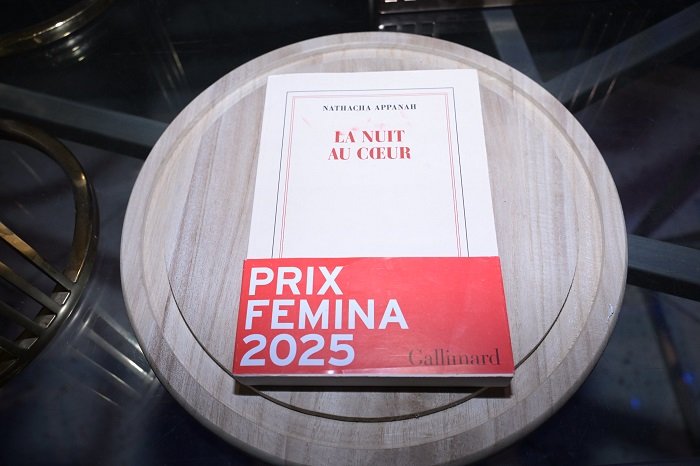
The Goncourt Choice of India 2026 was awarded to the book La Nuit au Coeur (Night in the Heart) by novelist of Indian origin Nathacha Appanah on 17 March at The Park in New Delhi. Nathacha Appanah is a prize-winning French-Mauritian novelist of Indian origin.
In La Nuit au cœur (Night in the Heart, 2025), Nathacha Appanah examines the unbearable enigma of intimate partner femicide, when the dark night takes the place of love, through the intertwined stories of three women who are victims of their partner’s violence. The book won the Prix Femina in France and has become the Goncourt Choice of India.
Born in Mauritius, Appanah is a descendant of Telugu-speaking indentured laborers who immigrated to the island. Her writing often addresses the themes of identity, displacement, and the memory of her Indian heritage in a Mauritian context. Her debut novel, The Rocks of Gold Dust (Les Rochers de Poudre d’Or, 2003) traces the journey of Indian indentured laborers to Mauritius, and Washed-Out Memory (La Mémoire délavée, 2023) recounts the story of her grandparents, descendants of such laborers who arrived in Mauritius in the 19th century.
Selection process
Students of French from across India participated in the International Goncourt Prize program for the fifth consecutive year. The program, run by the Académie Goncourt, is taken to more than 40 countries by the French cultural network.
The Indian jury was composed of students from eight Indian universities — The English and Foreign Languages University (EFLU), Pondicherry University, Savitribai Phule Pune University, University of Delhi, Jawaharlal Nehru University, University of Rajasthan, Banaras Hindu University, and University of Punjab, as well as students from the network of Alliances françaises in India.
Over the course of four months, the jurors read and discussed with their teachers and classmates the four books shortlisted for the Goncourt Prize in the original French: Nathacha Appanah’s La Nuit au Cœur (Night in the Heart), Gallimard; Emmanuel Carrère’s Kolkhoze (Kolkhoze), P.O.L; Caroline Lamarche’s Le Bel Obscur (The Beautiful Darkness), Seuil; and Laurent Mauvignier’s La Maison Vide (The Empty House), Minuit. A series of online sessions was held for the jury to familiarize them with the literary prize, literary criticism, and the publication journey behind the four titles.
This edition was particularly special as it was patronized by Moroccan writer Tahar Ben Jelloun, who is a member of the Prix Goncourt jury and winner of the Prix Goncourt in 1987. His involvement was especially cherished in India, where several of his works have been translated into Tamil.
The presidents of each of the nine juries met at the Embassy of France in Delhi on the morning of 17 March, where they debated their choices before sharing a special time over lunch hosted by the Ambassador of France to India, Thierry Mathou, following the ritual established by the Goncourt Academy more than a century ago.
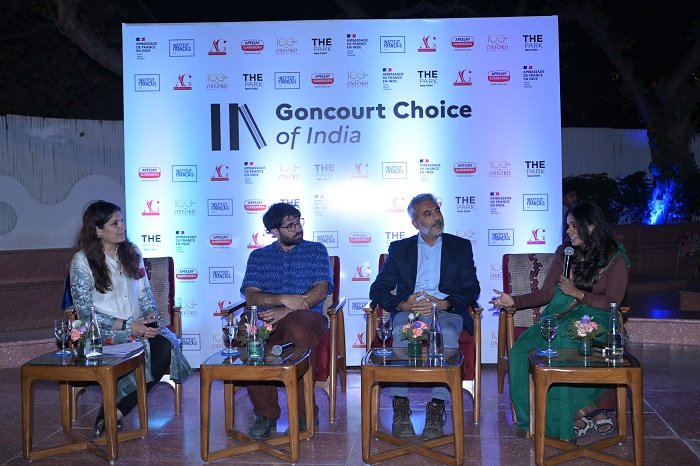
In the evening, jury members, bibliophiles, publishers, and authors from Delhi gathered at The Park Hotel for a literary soirée. Ahead of the announcement, attendees were treated to a conversation between Meena Kandasamy, Prayaag Akbar, and Gautam Bhatia, moderated by Amrita Tripathi, on the theme, ‘In literature, are we always writing about ourselves?’
The theme reflects a growing trend in contemporary literature, particularly in France, where recent selections increasingly foreground intimate, personal narratives. Notably, the latest shortlist for the Prix Goncourt featured several works that intertwine family histories with broader historical events, underscoring the enduring interplay between private experience and history and prompting reflection on the inherently autobiographical nature of writing.
The Goncourt Choice of India
The Prix Goncourt was instituted in 1862 by brothers Edmond and Jules de Goncourt. Initially conceived as a lifetime stipend for emerging authors, it evolved to become one of France’s most prestigious literary awards.
The Goncourt Choice of India, supported by Apeejay Surrendra Group director Priti Paul through the Apeejay Trust, aims to foster cultural exchanges and strengthen ties between Indian readers and French authors. Under a new partnership with the Apeejay Trust, the program is set to expand through a series of additional initiatives.
Alongside the university-led literary prize and seminars, a translation competition will be launched soon. Translators will be invited to submit a translation from an excerpt of the winning title. Excerpts can be submitted in any of the languages covered by the publication assistance program—English, Hindi, Tamil, Bengali, Malayalam, Kannada and Marathi. The winning translator will be awarded a publication contract supported by the Institut Français India and Apeejay, further deepening Indo-French literary exchanges.
The winner receives a symbolic 10-euro cheque but sells hundreds of thousands of copies, making it one of the most influential prizes in the Francophone world.