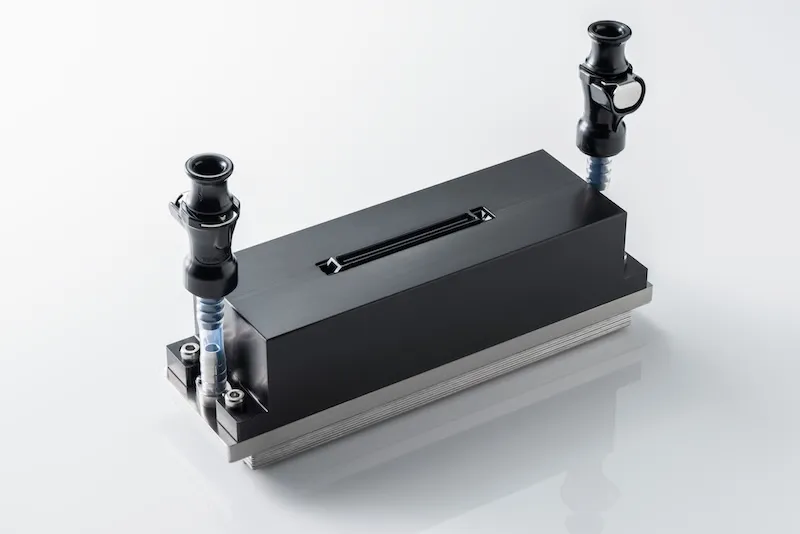
Kyocera has announced a new printhead, still in the prototype stage and without a name, but aimed at the emerging market for high-viscosity inks and fluids.
This capability could open up the operating range of inkjet inks, for example, for printing to packaging or textiles without the need for pretreatment, or it could allow for more functional inks, such as for printed circuit boards. Moreover, this capability can go beyond ink to other applications, such as material jetting for additive manufacturing or for jetting automotive paints.

These kinds of fluids are extremely challenging, and most current printheads are designed to handle low viscosity inks, typically around 3-11 mPa/s, where the fluid flows easily but with more limited functionality. To get around this, most printer manufacturers heat the ink as it enters the printhead, which lowers the viscosity, improving the flowability so that it jets more easily. But this is a workaround and is limited by how much heat you can safely have in a printing system, and the operating temperature of the ink itself.
Kyocera has now adapted one of its existing KJ4-series printheads to address two of the major challenges in jetting more viscous fluids. The most obvious of these is that such fluids have different flow characteristics, which means that the fluids don’t easily flow through the head from the fluid inlet to the nozzle chambers. So Kyocera has had to redesign the fluid channels within the printhead to account for this.
Another requirement is that these fluids require more oomph* to force the fluids out of the nozzles. The KJ4-series heads use a monolithic actuator made from a single, very thin ceramic sheet laced with piezo crystals. This sits above the ink chambers, and applying an electrical signal causes the actuator to change shape, pushing the ink out of the chambers. So for this head, Kyocera has had to redesign the actuator to enhance the jetting force.
The result is a printhead that can jet fluids with viscosity up to 80 mPa/s at room temperature. In practice, heating those fluids will allow the head to handle much higher viscosity fluids. The head has 1,584 nozzles and an effective print width of 111.69mm. Resolution is limited to 360 x 360dpi, but with a large drop volume of 280 pL.
It’s not currently possible to have high viscosity, with high resolution and high speed; two out of these three, maybe. That also explains why most vendors are talking about fluids for industrial applications, such as automotive paint, where 360dpi is considered high resolution, rather than inks for graphic arts applications.
This new head is a prototype and doesn’t even have a finished mount yet as it’s meant for use in a test rig or a robotic arm. This fits with Kyocera’s normal practice of announcing prototypes to attract customers willing to work on further development for their applications. This will allow Kyocera to fine-tune its design around real-world requirements before finalising a printhead design for commercial release. This process can take several years.
Kyocera has claimed this as an industry first, which is not entirely accurate, as Xaar has been addressing the high-viscosity printhead market for several years now. What is true is that there is now a growing interest in the possibilities behind high viscosity fluids so we can expect to see more printhead manufacturers developing suitable heads.
In the meantime, you can find more information on Kyocera’s current printhead portfolio and its actuators from kyocera.com.
(*not a technical term)