IHC Samanvay 2026 Celebrating Indian Languages, presented at the India Habitat Centre, concluded on Sunday after three days of sustained dialogue, performance, and reflection that foregrounded the relationship between India’s natural landscapes and its literary, cultural, and artistic traditions. The festival, this year, placed nature at the centre of inquiry, examining how mountains, rivers, deserts, forests, and coastlines have shaped languages, belief systems, creative expression, and community life across the subcontinent.
Bringing together writers, scholars, conservationists, filmmakers, musicians, and performers, IHC Samanvay 2026 unfolded as a multidisciplinary exploration of ecology as lived experience and cultural memory.

Sharing his thoughts at the conclusion of the festival, Prof (Dr) K G Suresh, director, India Habitat Centre, said, “As IHC Samanvay comes to a close, the deliberations and artistic expressions across these days reaffirm the profound interdependence between India’s linguistic traditions, cultural practices, and the ecological contexts in which they have evolved. This edition has consciously foregrounded ecology as both cultural memory and lived knowledge, reminding us that environmental responsibility is inseparable from intellectual and ethical inquiry. Through IHC Samanvay, India Habitat Centre seeks to sustain a reflective cultural space where ideas are examined with care, traditions are engaged with care, and dialogue contributes meaningfully to a more mindful and sustainable future.”
Sharing her closing remarks, Vidyun Singh, creative head – Programmes, Habitat World, India Habitat Centre, said, “It has been a most satisfying Samanvay. Brilliant authors, speakers, and moderators were bookended by a fiery and rousing opening keynote address by environmentalist Sunita Narain and a closing session with the pioneering,award winning environmental film maker Mike Pandey sharing his experiences. It was an awesome three days that covered the length and breadth of this blessed land, and underscored the importance of nurturing and conserving biodiversity—not just of our land, but of our planet Earth.”
“Our hope is that the conversations we began here will carry forward beyond Samanvay, informing our homes, our work, and everyday choices.” Singh further added.
Day 2 | Saturday, February 7, 2026
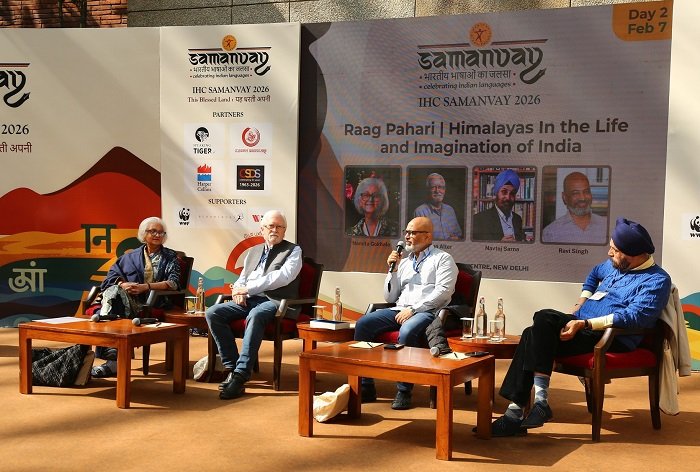
The second day of the festival opened with an in-depth conversation titled Raag Pahari – Himalayas in the Life and Imagination of India. author and festival co-director Namita Gokhale, award-winning writer and environmental chronicler Stephen Alter, and former diplomat, author, and translator Navtej Sarna, moderated by Ravi Singh, publisher at Speaking Tiger Books, examined the Himalayas as a space that has continuously inspired spiritual seeking, literary imagination, and historical movement. Drawing from mythology, travel writing, personal experience, and recorded history, the speakers reflected on why these mountains have remained a site of pilgrimage, resilience, exile, and return. The discussion addressed the paradox of the Himalayas as both nurturing and unforgiving, shaping not only individual lives but entire cultural and philosophical traditions.
This was followed by Sanjeevani Dharti – The Healing Earth, a session focused on the curative and regenerative knowledge embedded in India’s landscapes. Mamang Dai, poet, novelist, and journalist from Arunachal Pradesh; Dr Sunita Reddy, anthropologist and researcher on traditional healing practices; and Dr Hemalatha N Potti, Ayurveda clinician, academic, and researcher, in a conversation moderated by Prof Pushpesh Pant, author, scholar, and public intellectual, explored indigenous healing systems, medicinal plants, and regional practices rooted in forests and biodiversity. The session included screenings of short films by Mike Pandey, environmental filmmaker, on medicinal plants, underscoring the urgency of preserving traditional ecological knowledge that has sustained communities for generations.
After lunch, the focus shifted to rivers, beginning with Bin Paani Sab Soon – Streams of Life. Joshil, Malayalam writer and assistant forest conservator; Milan Moudgill, photographer and graphic designer; Abhay Mishra, Hindi writer and journalist; and Vaishali Shroff, author, scriptwriter, and columnist, moderated by Dr Medha Bisht, academic and policy researcher, discussed rivers as ecological lifelines as well as cultural witnesses. The conversation addressed displacement, environmental degradation, memory, and the symbolic role of rivers in regional literature and lived realities.
The thematic journey continued with Behta Paani Nirmala – Songs of the River, a multi-art presentation celebrating rivers through poetry, music, and dance. Dr Madan Gopal Singh, scholar, composer, singer, and lyricist, presented A Myriad of Rivers in My Courtyard, weaving song and scholarship. Jayaprabha Menon, Mohiniyattam danseuse and choreographer, performed an abhinaya inspired by the rhythm and flow of rivers. The session concluded with Mayukh Hazarika, singer-songwriter and nephew of Dr Bhupen Hazarika, reading excerpts from Bistirno Parore, one of the legendary composer’s most iconic songs, reflecting on the Brahmaputra as both a silent witness and a powerful metaphor for social change.
The evening sessions turned towards the Desert with Registaan Main Jeevan Ki Laya – The Many Rhythms of Desert Life. Ilse Köhler-Rollefson, writer and researcher known for her work on camel pastoralist communities; Abhishek Srivastava, journalist and translator; and Dr Shubha Chaudhuri, ethnomusicologist and co-author of Bards, Ballads and Boundaries, moderated by Giriraj Kiradoo, writer, editor, and cultural activist, explored desert ecologies, pastoral communities, oral traditions, and musical heritage. The discussion highlighted how desert cultures have evolved sophisticated systems of survival, storytelling, and artistic expression in challenging environments.
A short poetry recital titled Devdar Aur Dev Vann by Amar Nath, poet and environmentalist, added a reflective dimension, invoking reverence for forests as sacred and sustaining spaces.
The day concluded with a performance by the Barmer Boys, a Manganiyar trio comprising Bhura Khan, Magada Khan, and Sawai Khan, whose renditions of Rajasthani folk and Sufi music brought alive centuries-old musical traditions rooted in the Thar Desert.
Day 3 | Sunday, February 8, 2026
The final day opened with Aranya – Listening to the Indian Forest, an illustrated talk by Vivek Menon, conservationist, author, and wildlife photographer. Introducing the session, Ravi Singh, publisher at Speaking Tiger Books, contextualised forests as both ecological systems and cultural archives. Menon spoke about listening to forests as living entities, emphasising conservation as a practice of attentiveness, coexistence, and responsibility.
This was followed by Dev Vann – Sacred Groves, where Mamang Dai, poet and novelist; Prof Rekha M Shangpliang, scholar from North-Eastern Hill University; and Dr Neekee Chaturvedi, author and cultural historian of the Bishnoi community, moderated by Prof Yogesh V Gokhale, ecologist and co-author of Sacred Groves in India, examined sacred groves across regions and communities. The discussion highlighted how faith, tradition, and community stewardship have historically protected biodiversity. Drawing from the North-East, the conversation also reflected on the Khasi community of Meghalaya, whose living root bridges—nurtured over generations—stand as a powerful example of ecological knowledge embedded in culture. These bio-engineered pathways not only preserve vital forest routes and water systems, but also demonstrate how indigenous practices sustain connectivity between landscapes, communities, and species without disrupting fragile ecosystems.
The afternoon featured book launches that echoed the festival’s core concerns. Paro Anand, children’s author, launched A Girl, A Tiger and a Very Strange Story, a narrative exploring coexistence and empathy. Umesh Pant, writer and journalist, presented Chhani Kharikon Mein, engaging with regional memory and language. Anumeha Yadav, journalist and author, launched Our Rice Tastes of Spring, which examined agricultural diversity, food systems, and the urgent need to preserve indigenous rice varieties threatened by modern farming practices.
The focus then shifted to Coastlines, with a session examining India’s interconnectedness through historic sea routes that shaped trade, migration, and cultural exchange. Delivered by William Dalrymple, the presentation explored India’s maritime influence and the gradual eclipsing of the Silk Route, highlighting how oceanic networks became the primary conduits for cultural, commercial, and intellectual exchange across regions. This was followed by Marine Conservation, featuring Dr Anant Pande, head of Oceans and Coasts Conservation at WWF-India, and Murali Manoharakrishna, lead for Marine Species at WWF-India, who addressed the fragility of marine ecosystems and the need for sustainable coastal practices. The speakers highlighted the fragility of marine ecosystems and underscored the urgent need for sustainable coastal practices. They emphasized the importance of creating coastal corridors to ensure connectivity between marine habitats, enabling species to move, feed, and breed naturally. The conversation also drew attention to the Dugong and Seagrass Conservation Project, illustrating how the protection of seagrass meadows is critical not only for the survival of the endangered dugong but also for maintaining healthy coastal ecosystems and supporting livelihoods dependent on the sea. The session was moderated by conservation biologist and author Neha Sinha.
The concluding session, Dhrishya Dastavez – Visual Documents of Our Environment, was an immersive audio-visual conversation with environmental filmmaker Mike Pandey and photographer and visual storyteller Milan Moudgill, moderated by conservation biologist and author Neha Sinha. Moudgill presented a powerful photographic journey of Mount Kailasha, capturing its awe-inspiring landscapes while foregrounding its spiritual, cultural, and ecological significance, and reflecting on the responsibility of visual storytellers in documenting fragile and sacred geographies. Marking fifty years of Mike Pandey’s journey as an environmental activist and filmmaker, the session also saw him share his long-standing wish to make a film on the power and intelligence of insects, drawing attention to their critical yet overlooked role in sustaining ecosystems, while emphasising the urgent need for Indian environmental stories to be told to the global community, and reaffirming the transformative role of visual storytelling in environmental advocacy.
IHC Samanvay 2026 concluded with a special tribute celebrating the 100th birth centenary of Dr Bhupen Hazarika, presented through a performance by Mayukh Hazarika. Through song, personal reflections, and lesser-known stories, the performance offered insight into the musical philosophy and humanism of the Bard of the Brahmaputra.
Through conversations, performances, films, and books, IHC Samanvay 2026 reaffirmed the role of language and culture in deepening our understanding of the natural world. The festival closed with an emphasis on listening to landscapes, preserving knowledge systems, and recognizing ecology as central to India’s cultural and linguistic inheritance.