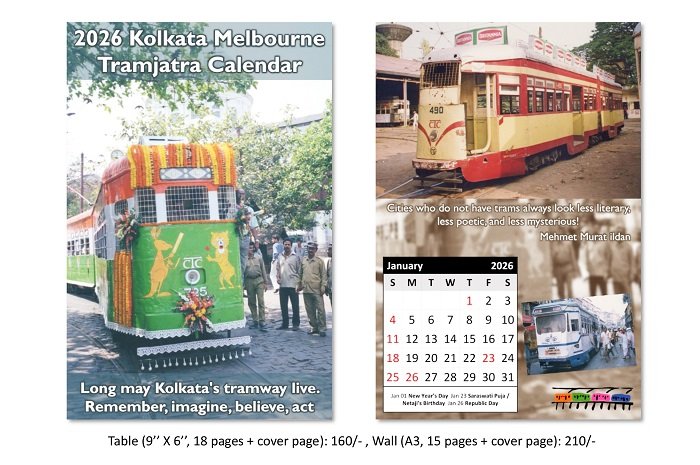
The Tramjatra collective, a collaboration between Melbourne and Kolkata tram enthusiasts, has unveiled the 2026 ‘Tram Conductor’s Camera’ calendar, a tribute to Kolkata’s tramways and the Nonapukur Workshops that have designed and built them for generations.
Following the success of last year’s edition, the 2026 calendar is available in both wall and table formats. It features vivid photographs taken by Roberto D’Andrea, Melbourne–Kolkata Tramjatra co-founder, activist, and former Melbourne tram conductor.
D’Andrea, who has spent decades documenting Kolkata’s trams through his lens, says in his introduction, “We are in a pre-election environment and Kolkata’s tramways are on the brink of extinction. Our calendar aims to educate, inform, and inspire people to act. We need to question politicians about tram policies and push for their revival.”
Reflecting on his long association with the Nonapukur Tram Workshops, D’Andrea adds, “The skilled workforce and colorful tramcars built here are part of Kolkata’s heritage. Without Nonapukur, there can be no tramways. We must preserve this institution before it’s lost forever. Think tram—for culture, clean air, and a healthier city.”
The calendar’s design, created by Anurag Mitra, a data science professional and Tramjatra activist, offers a behind-the-scenes look at the craftsmanship of Nonapukur. Each month pairs a striking tram photograph with a literary quote celebrating Kolkata’s deep connection to its trams.
“We hope all tram enthusiasts of the city, who are not a small group by any means will appreciate our endeavour that celebrates this enduring symbol of the city, something that sets apart Calcutta from the other Indian cities while at the same time ensures it has something in common with cities across the globe, from Melbourne to San Francisco, from Milan to Lisbon,” Mitra.
Co-founder and filmmaker Mahadeb Shi, who also serves as general secretary of the Calcutta Tram Users’ Association (CTUA), said the initiative serves as “a quiet, subtle critique of the government’s current stance on trams.” He added, “We seek to draw attention to the tram’s struggle for survival at a time when the city risks losing a 152-year-old living legacy.”
“In addition to colorful photographs of trams, each page of the calendar features a quote by a renowned writer, expressing Kolkata’s deep association with trams and their vibrancy. The goal is to rekindle love for trams and reach out to all sections of society—including the citizens of Kolkata, politicians, and lawmakers,” Mahadeb Shi said.
The calendar also underscores the tram’s role in promoting sustainable transport. An electrical engineer with the Indian Railways and member of CTUA noted, “With Kolkata’s air quality index frequently above 300, it’s critical to shift away from fossil fuels. Trams offer a clean, sustainable electric transport system powered by overhead wires—not polluting batteries.”
With elections approaching, Tramjatra plans to distribute the calendar to key political leaders to highlight the urgent need for policy action.
As D’Andrea puts it, “Vote 1 for trams—because saving Kolkata’s trams means saving a part of its soul.”