Lucknow’s Amber is now a well-known name in packaging printing and conversion. But when it began its journey around two decades ago, the story was different – that of a new venture trying to find a foothold. Komori India has played a key role in Amber Packagers’ success story.
Narrating the journey, Wafa Abbas, managing director of Amber Group, says, “We at the Amber Group are two companies—one is Amber Press and the other is Amber Packagers (India). It all started gradually after my graduation in 1998.” Abbas says he was born and brought up in a middle-class family with no connection to any business. “So, many around me objected to my idea of starting a business. But my passion and determination finally brought me to this stage today.”

First print order
“At a fashion show in Delhi around the year 2000, I met an IAS officer, who was the chief guest at the event. After that, I started meeting him regularly. Being unemployed, I had no work, and even covering weekly expenses was difficult for me. The officer gave me a visiting card to print and said, ‘Wafa, get this printed somewhere. It will at least cover the petrol expense of your motorcycle.’ I got it done at a friend’s printing company at Rs 350 or Rs 250, out of which I saved Rs 100, and it covered my petrol expense for a week then. I felt it was good and should pursue it. This is where and how my business journey started, with small orders,” recounts Abbas.
In the year 2002, Amber Group incorporated Amber Press as a commercial division specializing in offset printing. Recognizing the growing demand for premium packaging boxes, the group launched Amber Print Pack in 2018 for packaging boxes. In 2021, the group expanded its business to engage in manufacturing non-woven fabric products such as bags. In the following year, all the activities of Amber Print Pack were shifted to the newly unveiled Amber Packagers (India)—a move to introduce the group’s fully-automated packaging plant equipped with a line of highly-advanced Komori presses.
Major technological transition
From 2002 to 2015, Amber Group used to run only a set of pre-owned machines. “Our major technological transition took place in 2015 when a Komori sales team contacted us. From the team, Sahil Ajmani, who is still with the company, convinced us to buy its machines. I’d always like to thank him for his mutual support and all-time amiable co-operation,” Abbas says, adding, “In fact, our decision to invest in the first machine of Rs 2 crore was a big challenge. We had to build up our mindset for it, but we successfully did it.”
Abbas continues, “The first brand new Komori machine we bought in 2015, a Lithrone GL37, is still running efficiently. With the machine, we printed as much in 24 hours, what other six pre-owned machines collectively produced. This is a tension-free machine. Plug and play—you just load the job and forget about it, as Lithrone GL37 can handle the rest flawlessly. If it stops, a phone call brings team Komori to resolve anything within 24 hours.”
Growth & expansion
With the brand new Lithrone GL37 in 2015, Amber Group significantly grew its business. “After the all-new Komori machine, our growth graph shot up rapidly because we tremendously increased our production capacity and print quality. We could maintain the strictest delivery deadlines for finished products as per our customers’ demands and desire,” Abbas says.
Amber Group’s production plant initially occupied a small area of around 10,000 square feet, a combination of three floors with each having an area of 3,000 square feet. “As we grew from one level to another, we had set up a new campus of about 80,000 square feet of constructed area at Kakori, around 20 km from Lucknow city. After that, we bought our second brand-new Komori machine in 2018, another Lithrone G37, a substitute for the 28 x 40 size unit (commonly used for book printing). This is the best machine for book printing for us as it saves plates, time, power, and takes up less space. It offers the same trouble-free experience as our first brand new Komori installed in 2015,” Abbas says.
Latest acquisitions
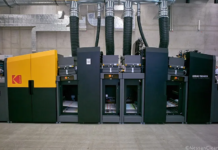
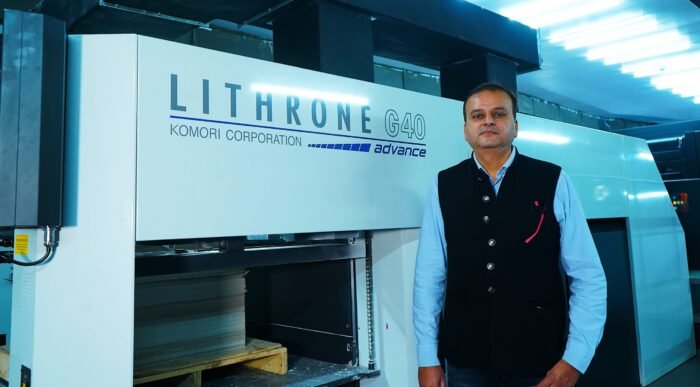
Satisfied with the Komori technology, Amber Group in 2019 bought its third Lithrone G37. “With our constant expansions of both infrastructures and machine portfolios, we gradually grew in the packaging sector. In 2023, we made a deal with Komori India for a brand new 6-color machine with a coater—Lithrone GL40 Advance, which was installed in the subsequent year,” Abbas, says, adding, “Today, we run four Komori machines, delivering everything to our customers 100% time.”
Sustainability
“Here the question is: What are we giving to our future generation? Is it a polluted country or a city or a clean one? I feel running a raft of Komori machines has benefited us and we are contributing to society. These Lithrone presses do not use alcohol, making them eco-friendly. Secondly, the power consumption of every Komori machine we run is comparatively lower than other machines in their classes. For these reasons, I believe we are contributing to the global move toward eco-friendly and sustainable printing and packaging conversion,” Abbas says.
As a CSR initiative, the Amber Group has formed the Amber Foundation Trust. “We put a portion of our income into our trust, through which we have done a lot of social work over the last three years. So far, we have conducted over 2,500 cataract operations and distributed spectacles to 25,000 people. Today, the lives of these 30,000-35,000 people have been bettered under the Amber umbrella,” Abbas says. Collector Bitiya (collector daughter) is yet another social responsibility campaign of the Amber Group for helping girls who wish to prepare for the civil services examinations.