In the first half of 2025, the climate facing journalists darkened to levels not seen in decades, reflecting a coordinated escalation of violence, intimidation, and censorship.
The fabric of societies is being torn apart by what in many cases are deliberate and calculated campaigns to undermine facts, the bedrock of our shared reality.
There is no need to prove things are untrue; you only need to relentlessly smear, sow doubt and float conspiracies. Often social media algorithms will do the rest.
For Agence France-Presse, an international news agency with a reporting team spread across the globe, the figures are stark: we had 25 serious incidents involving journalists working for us in the first six months of this year. That is more than occurred in the whole of 2024.
But these incidents of assaults, arrests, expulsions or journalists fleeing for their lives only hint at the full scale of the global assault on the public’s right to information.
The geographical spread of violence and intimidation is widening. The situation is aggravated by the rise of authoritarian practices and populist rhetoric that openly targets the press.
Law enforcement’s growing impunity – emboldened by prevailing political messages – has made physical assaults on journalists commonplace.
This is not a phenomenon isolated to so-called unstable regimes; it is surfacing in established democracies and countries with long traditions of press freedom, pointing to a dangerous shift in global norms.
Journalists have traditionally identified themselves at protests and public events, believing this identity carried some form of protection and legitimacy.
But we increasingly see these identifiers as targets.
Over the past year journalists working for us have been targeted in different and violent ways at protests in countries as varied as Turkey, Argentina and the United States.
All of them were clearly identified as press. All of them are convinced they were targeted because they were journalists.
In significant swathes of the world, journalism is effectively disappearing. The intimidation and threats have become unmanageable. We have seen journalists working for us being forced to flee from across the Sahel area of West Africa and also in areas of Central America such as Nicaragua and El Salvador.
In parts of Eastern and Central Europe our fact-checkers face regular death threats and campaigns to intimidate and silence.
The message often comes from the top. The presidency in Argentina posted on social media last year: “We Do Not Hate Journalists Enough”. In total the Argentine Journalism Forum recorded 179 assaults on media workers in 2024.
And then there is Gaza.
The Committee to Protect Journalists (CPJ) says nearly 200 journalists in Gaza have been killed over the past two years.
It points to over 20 incidents where it believes individuals were deliberately targeted.
Some of the journalists who work for AFP in Gaza refuse to wear their protective flak jackets because they fear it will make them a target. They also say people are scared to be near them because they think journalists are targets.
And yet perhaps what is most notable is how few governments in the many countries that have thrived on press freedom are prepared to raise their heads above the parapet to stand up for facts, truth and press freedom.
Many brave and dedicated journalists feel horribly alone at this point.
This assault on journalism and campaign to undermine facts comes as the management of our digital lives is increasingly transferring to powerful Generative Artificial Intelligence tools.
We can all see the astonishing capacities these tools have for knowledge building and human advancement, but we are also already seeing how they can be used to pollute our information ecosystem with vast amounts of false and made-up content.
This feels like an inflection point.
People talk casually about living in a post-truth world. Journalism is imperfect, it will not always get it right. But the honest aspiration to gather information and seek the truth is fundamental to the healthy functioning of our societies.
Now, more than ever, we need to stand up for facts.
There can be no alternative.
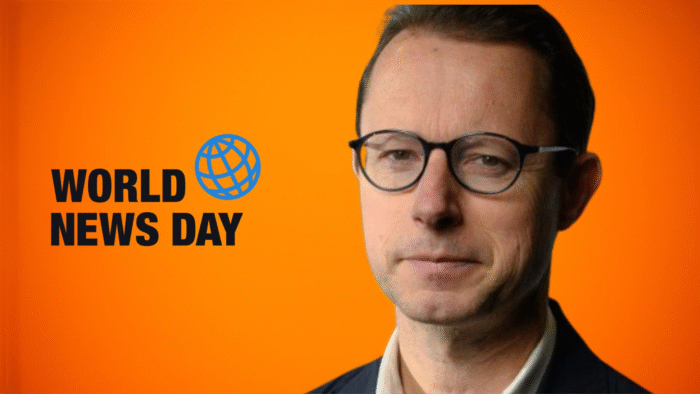
Phil Chetwynd is the Global News Director for Agence France-Presse (AFP).
This article was commissioned as part of World News Day – a global campaign to highlight the value of journalism. It is organised by Wan-Ifra’s World Editors Forum, Project Kontinuum and The Canadian Journalism Foundation.
First published by Wan-Ifra on 27 September 2025