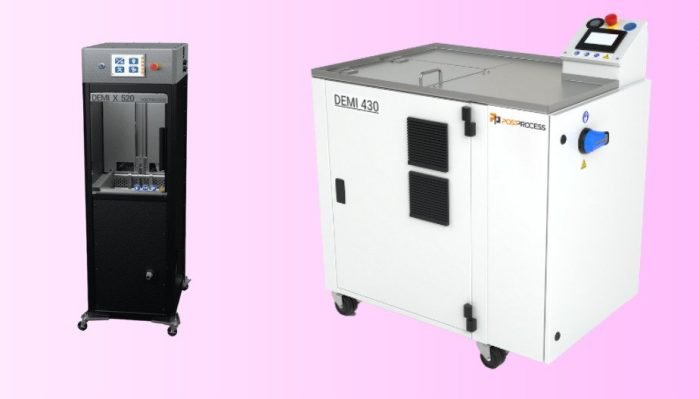
The world of additive manufacturing has evolved significantly in recent years, with innovations in materials, speed, and precision. However, even with these advancements, post-processing remains a critical step in delivering high-quality, customer-ready parts. According to 3D Monotech, a 3D printing solutions manufacturer, there are a few key things every manufacturer and 3D printing professional should know about post-processing.
Automation is no longer optional
Traditional post-processing methods, such as manual labor, are still in use today by many manufacturers. This approach cannot deliver customer-ready parts at scale – it’s time-consuming, inconsistent, expensive, and leads to high breakage rates.

The need for automation in post-processing has become essential. Automated solutions help streamline tasks like support removal, resin or powder removal, and surface finishing, saving time, reducing human error, and increasing throughput. The future of efficient, scalable production relies on automation – and it’s here to stay.
Sustainability is a growing focus
In 2025, sustainability isn’t just a buzzword – it’s a requirement. The manufacturers are adopting environmentally friendly practices, from minimizing waste to using recycled materials. Technologies are evolving to reduce the amount of consumables required in post-processing, and more efficient systems are being developed. For manufacturers looking to be competitive and eco-conscious, focusing on sustainable post-processing solutions is essential.
At post process Technologies, 3D Monotech’s software-driven automated technology enhances workflow efficiencies, reducing energy and chemical usage. The detergents outperform traditional methods, lasting up to 10x longer and producing 10x less waste.
Enhanced safety measures are crucial
Across industries such as aerospace, automotive, dental and healthcare, safety during the post-printing step has become a top priority. A major safety concern involves the use of Isopropyl Alcohol (IPA) in these processes. IPA can pose significant health risks if not handled properly and is extremely flammable.
There has become a need to minimize human exposure to IPA through automated cleaning stations and safety protocols to ensure safer working conditions. Adopting these advanced systems not only protects workers but also ensures compliance with safety standards across industries.
Speed and throughput are key
After 3D printing, the post-printing step has traditionally become a bottleneck in large-scale workflows. However, the demand for faster production cycles means post-processing technology must keep up with 3D printing technology. If 3D printing is already automated, why not automate the next step?
Advances in high-throughput depowdering, cleaning, and finishing technologies are allowing manufacturers to speed up production without sacrificing quality. The push for faster, more scalable solutions is driving innovation to reduce cycle times, enabling quicker delivery to market.
Quality control is a must
As additive manufacturing evolves, the demand for consistent, high-quality parts has never been greater. This means post-processing companies will need to provide solutions that offer better quality control. Advances in AI-driven quality checks and automated inspection technologies are allowing manufacturers to ensure that parts meet exact specifications every time. As quality assurance becomes even more critical in industries like healthcare and aerospace, these innovations will become non-negotiable.
Conclusion
Post-processing is no longer an afterthought in 3D printing – it’s a critical part of the production process that directly impacts the quality, cost, and efficiency of the final product. Embracing automation, sustainability, safety, and cutting-edge technologies will be essential for staying competitive and meeting the growing demands of the industry.