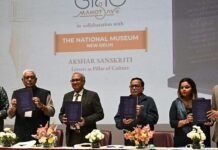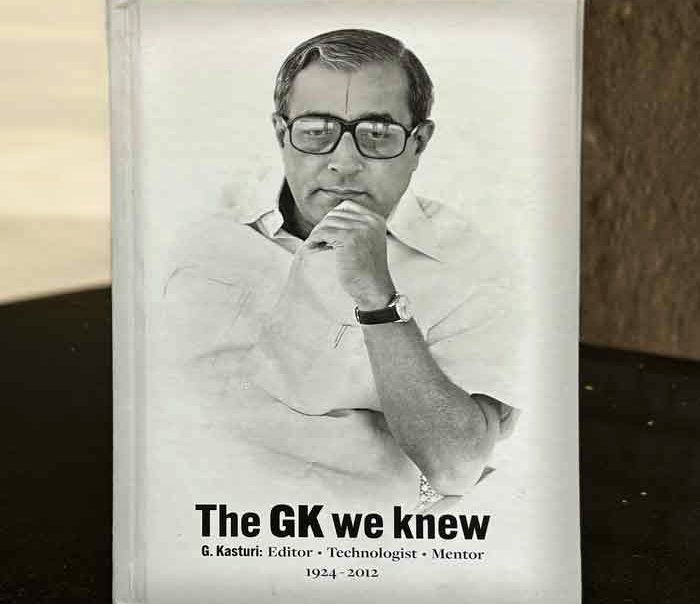
The volume’s subtitle published this month, on the 100th anniversary of G Kasturi’s birth and released on 17 December 2024, is G Kasturi: Editor, Technologist, Mentor. I mention the subtitle because he was many other things, larger than life not only to his family and our industry but also to our country’s development. As we already know, and what is written in this book by his knowledgeable colleagues, friends, and associates, is that Kasturi was the patriarch of a family that owned the most important newspaper of our times.
Editor and managing director of an enterprise whose role and credibility in the work of the nation’s development he understood, but handled with poise and modesty. He eschewed the self-importance of newspaper barons who hanker for self-aggrandizement and public positions.

This volume has many articles about his curiosity and ability to understand and adopt the latest technologies, and these may have helped him make his greatest contribution, which was to embody the role of a dignified publisher. He insisted that his views would only be known through the editorials and columns of his newspaper. The volume contains several letters in which he stated just this – in reply, to those who beseeched him for his views on political and economic subjects.
For me, the real subject of this volume and its articles is modernity. How do we mediate our country’s development and progress and its social, political, and physical environment – with our spiritual and cultural traditions? In many ways, Kasturi was fortunate to inherit an important newspaper, where he started working after his MA in economics in 1944 and became joint editor in 1959.
C Rangarajan, former advisor to the prime and former governor of the Reserve Bank of India in his contribution to this volume, writes – “First and foremost, he was a keen observer of political and economic events. Under his leadership, The Hindu stood by the three principles of objectivity, clarity, and authenticity … To be an editor of a newspaper is not an easy task. There are multiple objectives for any responsible newspaper. Its role in shaping and molding public opinion must be balanced against its primary role as an objective and unbiased instrument of information supplier. Activism in a cause is justifiable. But journalistic activism, just like judicial activism, must be tempered by self-imposed limits. These limits are essential in order to be effective.” Rangarajan ends by noting, “The reputation of Kasturi as an editor rested on the delicate balance he was able to achieve in terms of the multiple objectives.”
It turns out that as one goes through this commemorative volume, which is thus far only published for private distribution by the family, it’s impossible to skip through. One first reads the recollections written by industry friends such Narendra Paruchuri, Kiran Priyagi, and Pranav Parikh and then the ones by some of the wonders that Kasturi surrounded himself, including D Krishnan the photographer, and the technologists, K Krishnan, K Panchanathan and RP Lakshmivenkataraman. Finally one comes to the front of the book – to many leading economists, journalists, and family members. There are tributes by sportsmen also.
By and large, the collection documents an unusual life lived in the era of a newly independent democratic nation. It is rich with recollections of his vision of growing the newspaper and the publishing house and his leadership in adopting and adapting technology. But the real lesson for us is how Kasturi understood the role of the newspaper in India and in nation-building. He took on the latest scientific ideas and technology as a leveler and as instruments that could build the essential tools of information, knowledge, and science.
We could learn from this man’s life, and rejoice that he existed and that some of us were privileged to know him. Better still, we could learn a little bit about humanity with a small h, about endless curiosity, and doing with a firm but gentle hand.