The Valencian Community produces 65% of the shoes in Spain, which represents about 70 million pairs per year. It is estimated that the waste generated by footwear factories in leather scraps alone amounts to 3,500 tons per year. Although there are different recycling techniques, their application for complex waste, such as footwear, is not easy for assorted reasons, including the presence of substances such as adhesives and inks. This waste cannot be recycled and the resulting recycled material is of low quality if it is.
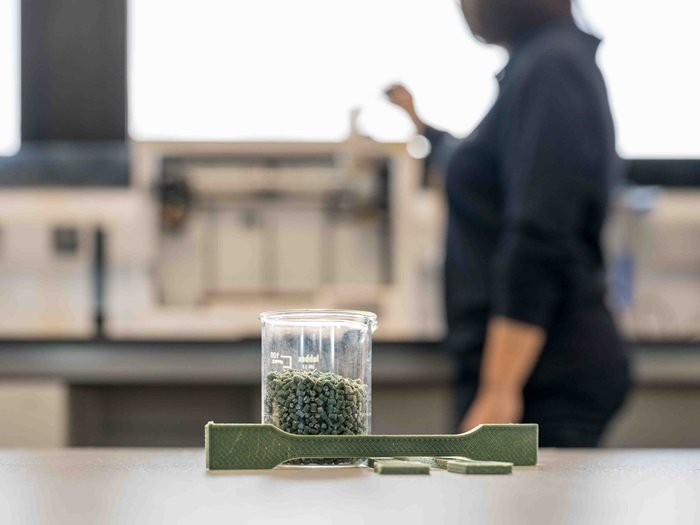
To solve this issue, AIMPLAS, the Plastics Technology Centre, Pikolinos, Evatalking and the Footwear Technology Centre of La Rioja (CTCR) are working on the ECOFAP Project to develop a new 3D printing material based on recycled natural leather so it can be used in different components for fashion, textiles and footwear. Specifically, the project is focused on recovering tanned leather waste from the footwear industry to create new materials for making soles and heels using FDM 3D printing.

This research project is framed within the concept of the circular economy because it allows waste from the footwear industry to be recovered and reused for the development of new products, thus reducing the industry’s environmental impact and carbon footprint.
3D printing applied to shoe manufacture is one of the technologies with the greatest growth potential within the footwear industry, a market characterized by customization. In addition, the commitment to recycling and reuse is becoming increasingly important in the industry.
ECOFAP aims to solve the problem of recycling leather scraps in the manufacture of footwear, given that the waste produced in a shoe factory is usually sent to landfill. However, almost all of it could be recycled and used for applications in other industries at a great savings on resources and almost no environmental impact.
New technology to obtain micronized leather
The challenge faced by the ECOFAP consortium is to reduce the particle size of the leather scraps to 10 microns to allow for post-processing as a secondary raw material. The goal is to combine different percentages of micronized leather with various polymers whose mechanical properties make them suitable for footwear for working with leather so they can be used as a filament for 3D printing. The reduction of particle size to less than 10 microns is a demanding task due to the difficulty of crushing a material made up of elastic fibres (collagen).
This project is funded by the Ministry of Science, Innovation and Universities and Next Generation funds of the European Union. Project CPP2021-008773 funded by MICIU/AEI/10.13039/501100011033 and the European Union NextGenerationEU/PRTR.