Similar to the past ten years, FBF 2016 has been able to attract a total of 277,000 visitors. The number of professional trade visitors, however, has been in constant decline: 142,000 this year or hardly 52 percent of the total, against 65 percent in previous years. Exhibitor numbers have been shrinking slightly but surely over the same period as well. Moreover, the 7,100 exhibitors at this year’s fair took less space and were more diversified than ever, as rights traders of books, movies, multimedia, music, games, software, merchandising, art objects, virtual reality and 3D applications, and more.
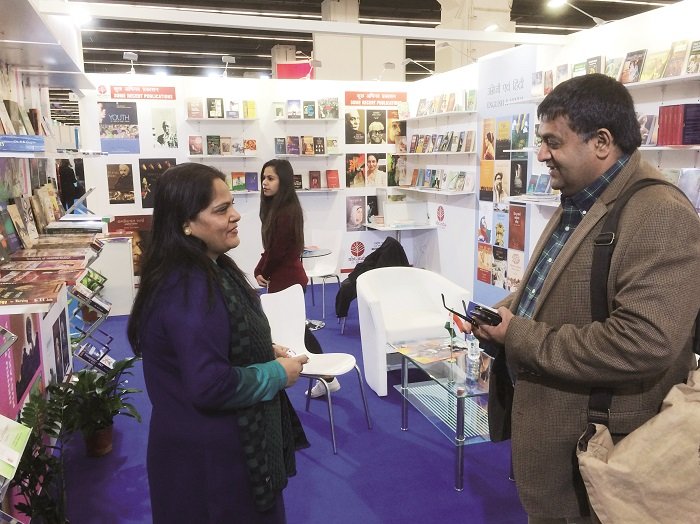
The Indian exhibitor scene, which recorded a serious dip last year, was back to its usual overall strength, with 50 publishers, four agents and distributors, three printers (International Print-O-Pac, Replika, and Thompson) and 13 digital service providers. Most of these were scattered over Halls 4 and 5, while the NBT’s “Collective Stand” was left to represent merely itself, since the Indian government stopped subsidizing publishers’ fair presence last year. One publisher, Bingsha Shatabdi from Kolkata, benefitted from the fair’s own Fellowship Programme. Gradually increasing in numbers, the other exhibitors from Asia-Pacific included 95 from mainland China, 50 from Korea, 42 from Indonesia, 36 from Japan, 36 from Australia, 25 from Malaysia, 22 from Taiwan, 21 from the Philippines, 21 from Singapore, 17 from Thailand, 15 from New Zealand, 7 from Hong Kong and 1 each from Afghanistan, Nepal, Pakistan, Sri Lanka and Vietnam.

Almost every year, the Nobel Prize for Literature is announced a short period in advance of the Frankfurt Book Fair (FBF), leaving publishers and agents little time to react and mostly creating an extremely hectic situation for those concerned. The buzz at FBF around the prize has hardly ever been as controversary and exasperating as this year’s nomination of songwriter Bob Dylan for, in the words of the Swedish Academy’s Nobel Prize Committee, “having created new poetic expressions within the great American song tradition.” Or, as the arguably more authoritative music magazine Rolling Stone put it, “for inventing ways to make songs do what they hadn’t done before”. At any rate, his biographies and collections of songs could be found all over the fair in almost every imaginable language.
A new initiative, the 2,000 sq. m large Arts+ area for exhibitors with digital cultural content, covered around 50 booths representing museums, galleries, architects, designers, artwork publishers and art dealers, and provided a conference and meeting place for businesses involved in the creative industries. Its marketed purpose as a continuous part of the FBF is “to exploit the potential of digitization for the creative economy and develop new business ideas”. Holger Volland, FBF’s vice president for business development, concluded that “the Arts+ had a significant European dimension, with numerous partners like Europeana and the EU Commission’s Directorate General for Culture. We want to strengthen this dimension still further and promote a European network for innovation in the creative industries.”
The 460 tables of the Literary Agents and Scouts Centre were fully booked, with over fifty percent of the 700 agents coming from the English-speaking world including the US, UK, India and Australia. The FBF Business Club, established three years ago as an international working and networking space, was used by more than 3,400 visitors. Over the five exhibition days, it hosted 45 events with some 150 invited book industry experts. On another note, the fair’s programme in support of small publishers from Africa, Asia and Latin America, LitProm, appears to be dying a slow death, with budget cuts from both FBF and the German Ministry of Foreign Affairs. Its magazine, mainly a networking and sponsoring tool, was shut down just before the start of the fair.
A conference was held on the publishing markets of Brazil, the Philippines, Poland, Spain, the United Arab Emirates, UK and this year’s Guests of Honour, Flanders and the Netherlands, next to workshops and reading sessions on rights management, e-book and selfpublishing developments, and such topics as the implications of Brexit for the UK’s and European book industry.
Business as usual, it seems. Politically, however, things were not seen or discussed as rosy at this fair, not even by its director Jürgen Boos, who sent out this message on the last day of the fair: “We note with great concern that the freedoms of opinion and of publication are acutely threatened in many European and non-European countries. This topic affects our industry all around the world, and the large wave of solidarity which became visible at the Buchmesse (for Can Dündar, Asli Erdogan and Raif Badawi) makes an impression around the world.”
Frankfurt’s next Book Fair will be held from 11 to 15 October, 2017. France’s book industry will be the focal theme. Subsequent Guests of Honour up to 2020 will be the book industries of Georgia, Norway and Canada.