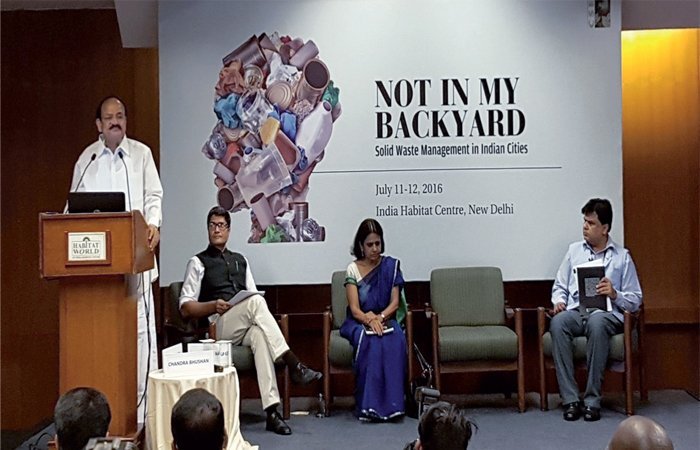
The Union urban development minister, Venkaiah Naidu, gave away the prestigious Clean City Awards to three southern cities, Alappuzha, Panaji and Mysuru at an event organized by CSE (Centre for Science and Environment) on 11 and 12 July 2016. The awards were for the citizens and officials of these cities’ efforts in waste management that attempts to totally obviate the need for landfill. Dry garbage is sorted by the residents themselves and collected and sorted again with great care, recycled in various channels while wet waste is composted. The minister also launched the book Not in my Backyard, authored by the CSE director general, Sunita Narain and Swati Singh Sambyal. In his address to the gathering, the minister said that the book could not have come at a better time as India is at a critical point of its development where mountains of waste require serious management.
Open pit trash dump-yard
Urban India is notorious for filth, sloth and various forms of trash that lie strewn along its streets, roads and drains for days if not weeks. The municipal bodies in most cities are too lax and ill-equipped to do anything about this waste accumulating on the streets. If not addressed on a war-footing, such filth can easily result in disease epidemics, of which, there are many instances that can be referred to, the Surat Plague being one.

CSE’s Sunita Narain, referring to a 2007 CAG Report on waste management, observed that a mere 11% of the municipalities had any waste processing capabilities. She also noted that waste segregation, without which processing of waste is simply not possible, is partially present in just 10% of the municipalities while about 60% of the sampled municipalities simply didn’t collect any waste at all.
Clean cities – how do they do it?
At the book launch, Narain admitted The Union urban development minister, Venkaiah Naidu, addressing the gathering after releasing the book, Not in my Backyard, authored by the CSE director general, Sunita Narain that the CSE team was caught unawares by the lack of available data about the amount of waste that is generated across municipalities in the country. This is an alarming situation for a country like India with a population density of close to 300 people in every square kilometre. India adds the equivalent of the population of Australia every year which means garbage output will keep increasing exponentially every year.
Unless effective and sustainable steps are taken immediately, this situation could spiral out of control. CSE therefore decided to approach the problem in its own way and set out to fi nd the cleanest city in the country. Sunita Narain said that once her team gets to know about the cleanest city they would also know what makes it so. This would offer vital clues on a functional and workable mechanism that can be replicated across other cities.
Availability of technology for waste management is not a problem according to Narain. The problem is more structural than anything else – on the one hand, households and institutions are not in the loop and on the other, the financial and institutional (human) capacity of the municipalities have totally collapsed. At the state level, Kerala offers the best example where people segregate and compost the organic waste they generate while informal recyclers collect and sell the compost. It is now becoming apparent that the best way to deal with waste is to treat it at source.
CSE is a not-for-profit organization, based in Delhi and renowned globally for its leading role in bringing up the issue of waste management in the national discourse. The organization’s strong research credentials with regard to the environmental and ecological impact of growing population and fast-paced development has resulted in many interesting initiatives over the years. The odd-even campaign in Delhi was CSE’s suggestion to the Delhi government, although it had cautioned that this was at best, a temporary move to bring down pollution.