The opening keynote by Torry Pedersen, CEO and editorin-chief of Verdens Gang (VG), Norway, at Digital Media India 2016, the 5th annual digital media conference organized by the World Association of Newspapers and News Publishers (Wan-Ifra) on 22 and 23 February at Delhi’s Aerocity near the airport, implied that the digital media business needs to be protected from legacy culture. This is the strategy that VG followed in Norway, and it became the central message of the event right through to the panel discussion with ‘online only disruptors’ that ended the conference.
However, at the last panel discussion of the conference a single dissenter seemed totally disenchanted with the lack of resources that most ‘purely digital’ news players are able to garner and seemed worried that running after digital by strong news organizations will destroy their traditional strong investment in news gathering and publishing.

In his keynote, Pedersen spoke of how VG transitioned by thinking ‘digital first’ and recruiting the right people to cope with the dynamics of transformation. He said that transformation requires new criteria for success, and this set the tone for the two-day conference. Rajan Anandan, vice president and managing director of Google South East Asia and India, followed Pedersen and said that 65% of internet users in India access the web via mobile. He also rather optimistically said that the total number of internet users in the country is estimated or expected to reach 500 million by 2017.
A panel of leading Indian news publishers, spoke about “increasing engagement in mobile, online video and native advertising” as the common digital priorities for the year. Monetizing content was an overriding theme with break-out sessions on social media growth; online video; digital and native advertising; and, ad blockers. Key takeaways from the conference include – journalism is not disrupted by digitization, and it has only made it better than before and power has shifted to the hands of the mobile and connected audience. Globally ad-blockers have emerged as a major obstacle to ad revenues with losses at 10% of revenues while in India the losses are still somewhat minimal at around US$ 4 million.
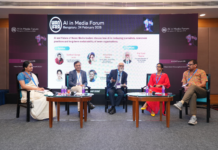
The conference, which drew 170 delegates, the highest number in the past five years and a growth of 35% from the previous edition, from more than 10 countries, concluded on the afternoon of 23 February with a roundtable discussion on “Can digital pure players disrupt the news media industry in India?” Gautham Pai, managing director of the Manipal Group was the moderator with panelists Ritu Kapur, co-founder, The Quint, Siddharth Varadarajan, founding editor, thewire.in and Sruthijith KK, editor-in-chief, Huffington Post India. There was mostly agreement that traditional media and digital pure players will coexist and while Kapur and Sruthijith were mostly upbeat about being able to make a go of pure digital media, Varadarajan was forthright about his fears. Firstly that print media may run after digital and destroy its own newsgathering and editorial capabilities; and, secondly, that online news is already a broken model. “There is no way that online revenues will match print,” Varadarajan said. He suggested that a very serious problem can arise in the content and news industry if aggregation, recycling and clever digital distribution replace some of the basic tenets of news gathering, selection, editing and publishing.
Understandably, many of the digital technology and platform providers are naturally upbeat about the futurology of Indian internet and cell phone numbers. Nevertheless, one astute newspaper industry observer at the conference remarked that the situation is actually quite chaotic and the confusion is reminiscent of the bewildering technology choices that confronted the industry 25 years ago.