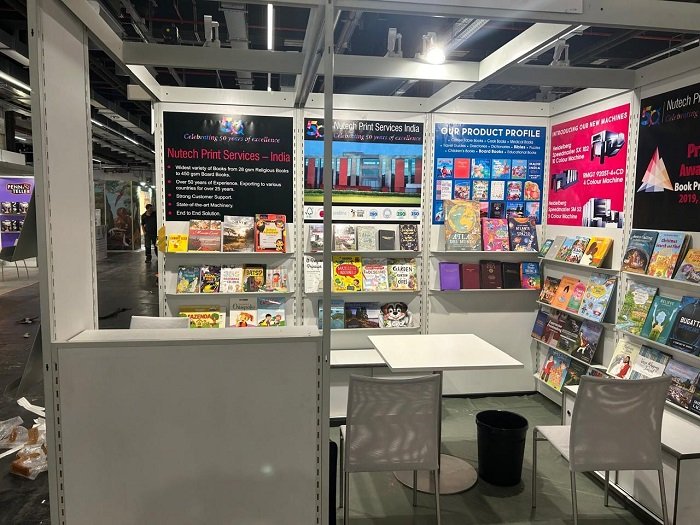
Ahead of the 78th Frankfurter Buchmesse (Frankfurt Book Fair), set to take place from 7 to 11 October 2026 at the Messe Frankfurt exhibition center in Germany, Indian Printer and Publisher met Ravi Shroff of Faridabad-based Nutech Print Services to discuss their plans for the upcoming edition of the event that draws book lovers, publishers and printers from across the world.
According to Shroff, the basic objective of visiting the fair is to meet existing customers. “I think it’s still the Mecca of publishing…almost every publisher from around the world likes to attend the Frankfurt Book Fair, even if they don’t attend the other similar events.”

“Instead of traveling to multiple countries, we can meet customers from across the world at one place. The idea is to expand our market share. Before the book fair, we reach out to our prospects and customers, fix a time to meet them, and showcase our work at the stand.”
Nutech has one of the largest portfolios in terms of the range of books – from Bibles printed on 28 gsm paper to board books as high as 400 gsm paperboard. Shroff says a customer needs to feel and open a product to see the quality. “The biggest advantage for us is that customers can come to the stand, see the books and study the products.”
Diversifying print supply chains
When asked about global publishers looking to diversify their print supply chains away from a single-source reliance. Shroff replied in the affirmative.
“India has not been able to live up to the promise or expectations of customers. We have challenges at many different levels and get little government support, unlike other countries. A small country like Vietnam has more exports compared to India. That’s largely because of their government’s policies and support. We are now finding that more and more customers do not favor printing in India.”
According to Shroff, one of the largest publishers in the world was looking at India as part of their plus one strategy. They worked with India from 2022 to 2024 and after that they decided India was not able to meet the challenges or their requirements and moved on to another Southeast Asian country.
“The basic shift in the publishing segment as a whole, whether international or local, is reduced print runs. Customers prefer multiple print runs of the same product around the year if it’s doing well, instead of one large print. We have seen this in multiple markets. Our equipment has changed over the last 3-4 years to help us better meet this demand. At the Frankfurt Book Fair, we educate our customers about our new equipment and how we can meet this new challenge,” Shroff explained.
Challenges arising from the US-Israel war on Iran
Transit time is a major factor for all export customers and with the ongoing Iran war, things on the shipping side are very difficult at the moment, Shroff said. “Prices have gone up by 2-3 times along with the shipping times. Nutech offers an end to end solution, up to delivery of the books to the warehouse. We have strong partnerships with logistics companies in different parts of the world to ensure that when a book reaches the destination port, they can deliver it to our customers as quickly and as seamlessly as possible.”
He said Nutech has developed strong partnerships over the last 20 odd years and tends to work with the same partners as long as they can deliver. “We don’t want to cause any discomfort to our customers because of shipping or other challenges.”
Sustainability, Shroff said, is a concern for European publishers. “Over the last 3-4 years, we have been working on reducing our carbon footprint and have taken steps in this direction. We have been an FSC company for a long time – we ensure that the paper we use is from a renewable source. We installed a solar plant a couple of years ago to reduce dependence on the coal-based and carbon-emitting grid.”
On varying shipping climates and heavy handling, he explained, “When a container sits on the top of the ship, the temperature difference can be high. In the day, the temperature within the container can go up to 60-65 degrees and fall drastically at night. The glues that we use on the books can withstand these kinds of temperature fluctuations.”
“We make sure the books are packed properly. The carton and pallet qualities are of utmost importance. Edge protectors have to be put in place to make sure there is no damage at any stage of handling. So, when the customer gets the shipment, it’s in the same pristine condition as when it left the factory,” he concluded.