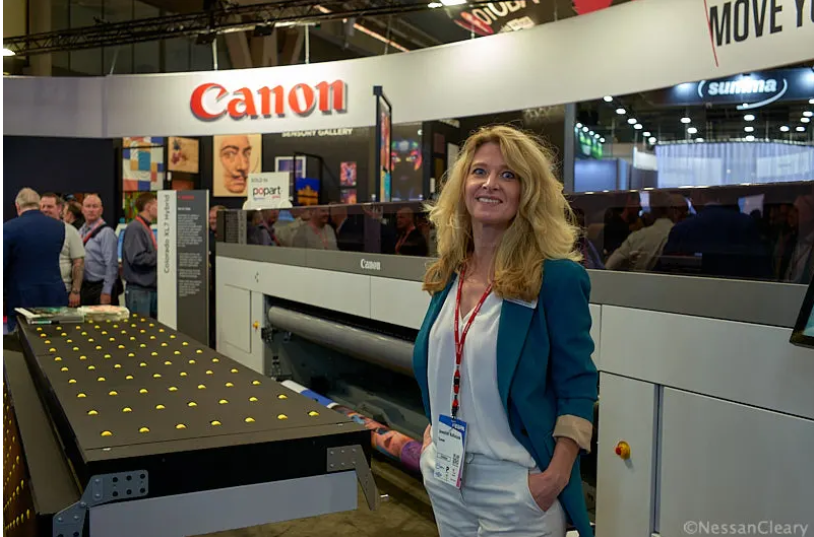
Canon has shown off its new wide-format Colorado printer, the Colorado XL, which builds on the existing M-series with a new 3.4m wide hybrid design. This was announced last September, but the recent Fespa show in Barcelona marks its European debut.
The XL was developed to fill the 3.2m gap in Canon’s portfolio, with Jennifer Kolloczek, senior marketing and innovation director for Canon Europe, saying, “We had quite some requests for it. So we could have just made a wider Colorado but a hybrid made more sense.” She added, “A lot of the time that we put into it was to enhance production and support the operator better.”

As with other printers of this size, the extra width allows for printing two 1.6m rolls side by side, with Kolloczek adding that the decision to use 3.4m rather than the more standard 3.2m was to give the operator “extra wiggle room.” The standard spindle can be swapped out for a split spindle that allows for different types of media to be run side by side; the only stipulation is that both rolls have to be printed with the same print mode.
The XL is sold in two variants as either a roll-to-roll or hybrid model complete with tables for rigid media. It has a modular design so users can change from one to the other as needed. Users can expect production speeds of around 106 sqm/hr, which drops to 70 sqm/hr for Quality mode.
Canon has developed a new vacuum belt system that it calls Tri-Drive because it uses three rollers that help load the media and keep it running smoothly under tension without any wrinkles forming. Kolloczek adds, “So it always keeps the tension on the media for higher speeds.” The XL will take standard roll-fed media and most rigid boards, but not plexiglass or wood.
It uses Canon’s own piezo printheads, which is part of a development that dates to the former Océ. Each of these heads has 4,544 nozzles with a print resolution of 1800 dpi. They include PAINT, or Piezo Acoustic Integrated Nozzle Technology, which provides feedback on blocked nozzles and can automatically map around such blockages and compensate with nozzles on either side. The heads contain micro motors so that they can be automatically moved to compensate for issues with the media. There are two heads for the CMYK colors with a third added for the optional white ink.
These heads were developed for use with Canon’s UVgel ink, and it is this ink that sets the Colorado series apart from the other roll-fed printers on the market. The XL uses a new 860 generation of the UVgel, which has been reformulated to improve adhesion on rigid media, though it still retains the flexibility needed for roll-fed media.
The ink has a much higher viscosity than other UV inks, with each drop forming a dome shape, helped by a very slight delay in curing to allow for a small degree of dot gain. The ink is pinned first, with a full cure coming after all the colors have been laid down. Varying the intensity and timing of the curing allows for either a matte or gloss finish.
As with the existing M-series, there’s an FLXfinish option that allows both matte and gloss finishes on the same print, essentially allowing for a spot varnish effect. It can be quite effective, but this does slow down the printer to around 26 sqm per hour. It gives a slightly textured finish, but it’s not the same as the tactile effects that can be produced on a true UV flatbed, such as Canon’s Arizona series.
Kolloczek says Canon is aiming the Colorado series at retail and interior decor as well as some packaging. She notes, “We do see some customers use the Colorado M-series for packaging.” She continues, “But it’s really about a lot more than just the technology. We are trying to focus on applications and areas where the market continues to grow. It’s really not about traditional signage anymore.” To this end Canon showed a range of different prints on its stand at Fespa, including stained glass window effects, noise-dampening panels and corrugated boxes.
Canon has already sold two XL machines, with the first going to Madrir in Paris and the machine from the show staying in Barcelona with PopArt. You can find further details from canon-europe.com.