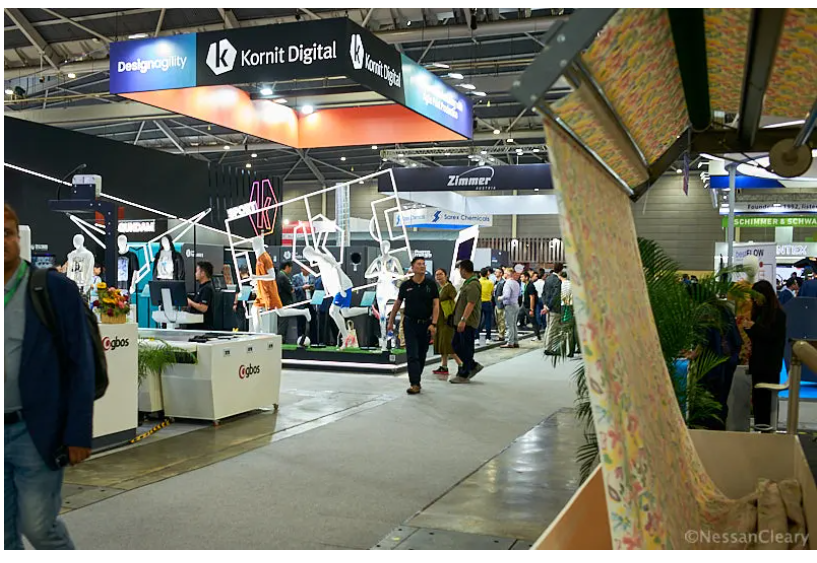
Kornit Digital has acquired PrintFactory, which develops cloud-based workflow, color management and production automation software. At the same time, Kornit has also announced a new Direct-to-Garment printer, the Atlas Matrix, which can handle both cotton and polyester.
The PrintFactory acquisition is to strengthen Kornit’s order taking, production workflows and fulfilment. Kornit is hoping that this, in turn, will help it compete more effectively against screen printing by making it easier for apparel producers to mix digital and analogue workflows.

It is true that PrintFactory is widely used worldwide and that it also brings with it a community of more than 10,000 active users, which Kornit says includes several of its largest customers. However, PrintFactory is not entirely focused on textile production as it mainly serves small to medium-sized wide format users from right across the display graphics market. The strength of the PrintFactory offering is that it offers drivers for over 3,500 different models of printing and cutting devices, which allows its customers to build a single workflow to run equipment from multiple vendors. This is backed up by excellent capability in colour management and multi-site workflows.
The plan apparently is to leave PrintFactory operating from its headquarters in the Netherlands and for PrintFactory to continue to develop its workflow platform across all markets, including those outside textile and apparel printing. That really depends on how much of the development team is diverted to help build Kornit’s workflow. Kornit’s vision is to use PrintFactory to help it’s customers create large-scale on-demand apparel production networks. Kornit sees it as the missing production workflow link between its existing KornitX web-to-print ordering and fulfilment software, and the Kornit hardware technology that is its printers and ink.
Naturally, neither side wanted to disclose the terms of the acquisition beyond saying that it is expected to close in the second quarter of 2026. Kornit says that it does not expect this acquisition to have a material impact on its near-term revenue or earnings.
Ronen Samuel, Chief Executive Officer of Kornit Digital, said of this acquisition: “It is about building the digital infrastructure the fashion industry needs to move from analog production to agile, on-demand manufacturing. By connecting demand generation, production workflow, and manufacturing through one integrated platform, we are accelerating the industry’s transition to a new production model.”
Kornit says the acquisition also marks a strategic shift as it seeks to adopt a consultative, solution-oriented engagement with customers across the production value chain, which would move it up the value chain from mainly dealing with individual textile production companies to larger brand owners. According to Kornit, the global screen-printing market currently represents approximately 14 billion impressions annually, with nearly 6 billion impressions in run lengths below 1,000 units. Roughly 30% of this volume includes polyester and blended materials, which are widely used in sportswear and athleisure.
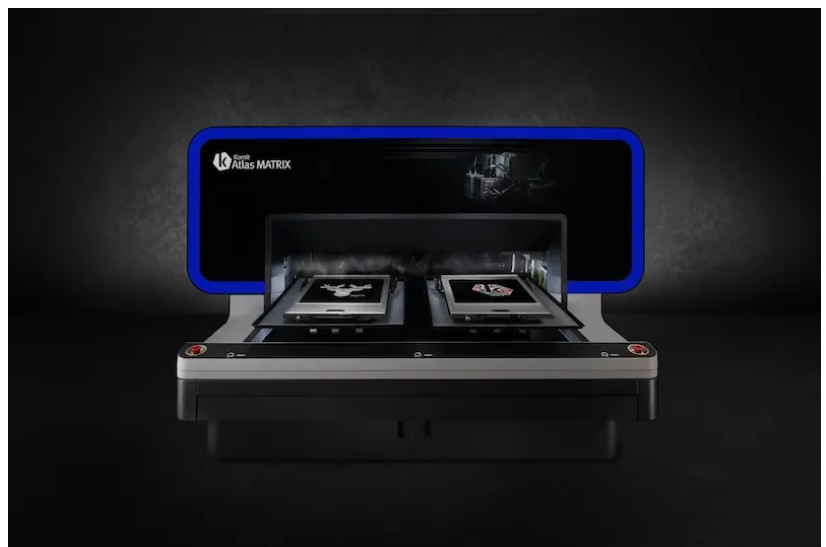
This brings us neatly to the new Atlas Matrix DtG printer, which Kornit hopes will give it greater market share in polyester, which dominates the sportswear market. The printer is built on Kornit’s existing Atlas platform so that some of those installed printers, including the Max Plus and Max Poly can be upgraded to the new Matrix specification. The advantage of the Matrix is that, as well as natural fabrics such as cotton, it can also print on dyed polyester.
This is mainly down to a new Karbon Shield coating, which Kornit describes as a ‘protection layer’. This is said to prevent dye migration on most fabrics, including deep-dyed and sublimated polyester fabrics. Kornit claims that its use leads to consistent, vibrant, and durable results and that it maintains a soft hand feel that meets most retail standards. It can be used for printing direct-to-garments and there’s also a Karbon Transfer variant for transfers to film.
The Karbon Shield/ transfer seems to be centred around DigiBlocker, which is described as a digital ink blocker. That’s because most polyester that’s used to produce blank garments will already be dyed to ensure a consistent base. However, that dye can migrate and show through the digital inks, particularly where heat is applied to fix the digital inks. The DigiBlocker takes care of this and provides a base for the inks to key to on top of the polyester.
That in turn means that there’s no need for the dedicated polyester inkset that Kornit previously used for DtG polyester. Instead, the Atlas Matrix uses the NeoPigment Eco-Rapid inkset, which is the same textile pigment ink that it uses in its other Atlas series printers. However, the Matrix does get new versions of the Q.fix fixation fluid and the Intensifier that’s used to enhance the hand feel. Consequently, the new printer has 10 inkjet channels in total, only seven of which are used for the colours, including CMYK plus white, red and green. Kornit is also planning an option to allow customers to replace the red and green channels with two neons – pink and yellow – that are more common in sportswear. The other three channels are for jetting the DigiBlocker, the Q.fix 2 and the Intensifier 2.
The printheads are the same Dimatix Starfire 1024 Twinflex that Kornit uses in the rest of its Atlas series printers, which give print resolution up to 1200 dpi. The Matrix can print the same 150 impressions per hour on cotton as the Atlas Plus, but this speed drops to 98 per hour for polyester. These speeds assume a 330 x 330mm image in the standard print mode with ten seconds handling time for loading and unloading.
Ronen Samuel, Chief Executive Officer of Kornit Digital, explained: “Screen printing can deliver strong results on polyester, but requires long setup times, multiple process steps, and additional costs to control dye migration and maintain consistency. Digital solutions, including earlier generations such as Atlas Max Poly, did meaningfully expand the boundaries of what’s possible, yet performance on polyester depended on fabric type, process tuning, and operational complexity. Atlas Matrix removes these limitations entirely, opens a massive market opportunity, and firmly positions digital as the new standard for apparel production.”
The Atlas Matrix can be ordered now, with deliveries scheduled to start early May. It comes with a PrintFactory RIP. You can find further details on kornit.com.