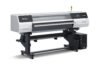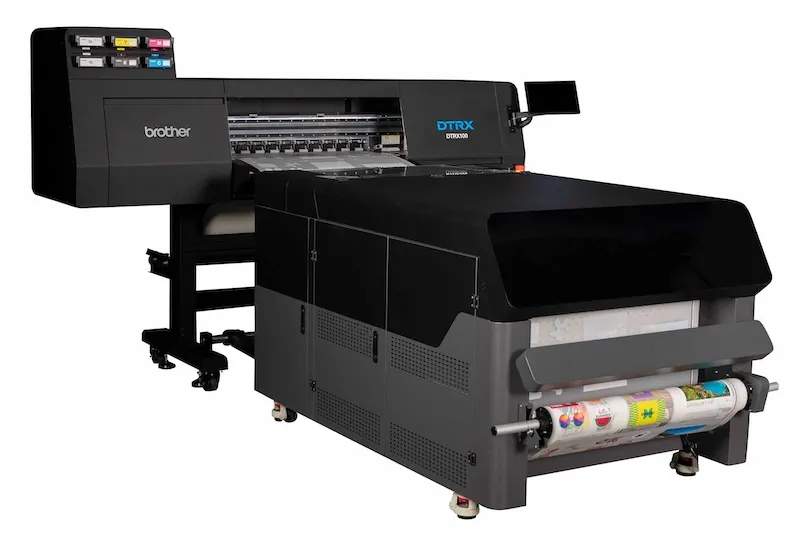
Brother has apparently launched the DTRX dedicated direct-to-film solution that it showed as a prototype at last year’s Fespa show. Well, sort of. Maybe.
Up to now, Brother has mainly adapted its existing DtG printers to take film and added a powder shaker to create a complete solution. But the DTRX has been designed from the ground up for the DtF market, and comes as a complete solution with the powder shaker, which should make for a smoother operator experience.

The printer itself, the DTRX100, will take media up to 800mm wide, but with a print width of 780mm. In my original report on the prototype that I saw at Fespa, I noted that it looks similar to Brother’s WF1 Latex printer. However, Brother refuted this and claims to have built the DTRX itself, with its own printheads, ink, and powder, whereas the WF1 was built in collaboration with Roland DG.
The DTRX uses four Brother piezo electric printheads, with two for CMYK and two for the white ink. Most of the Brother printheads start from a common squarish architecture but with different variants depending on the ink and application. So the heads for the DTRX follow the same approach and use 24 rows of 70 nozzles, giving a total of 1,680 nozzles. I believe that the print width for these heads is roughly 1.4 inches. The two heads used for the colour heads have four channels, while the white heads have a single channel. There is recirculation for the white ink channels from the ink lines down to the head manifold.
The printhead design appears to use a single piezo-electric actuator that is 40 microns thick and which sits directly above the ink chambers. Applying a voltage to the piezo elements causes flexing in the actuator for the individual chambers, which forces the ink out of those nozzles. In addition, there is a wet wiper system to automatically wipe the nozzles on the printheads to reduce the degree of manual cleaning that is often needed with DtF printers.
The printer is capable of up to 600 x 1200 dpi resolution, though it’s not clear how many passes this would require or what sort of productivity could be expected at that resolution. The original specification sheet that Brother published last year claimed a speed of 19.52 square meters an hour, but this has now dropped to 15 square meters an hour for the production mode, according to the latest specifications.
The ink, which is a standard water-based DtF ink developed by Brother, is supplied in 700ml pouches. The powder shaker unit is said to have a large powder reservoir and uses infrared for curing. The whole solution is run from a 10-inch touch screen on the side of the printer.
Curiously, Brother’s press release includes the statement, “The Brother DTRX is built for real-world production. It is designed to perform reliably day after day on the production floor. With the DTRX, customers benefit from Brother’s proven engineering, global support network, and production-ready technology they can rely on.”
Normally, such statements are written by somebody in the marketing department, and then a senior executive takes ownership, and the statement is presented as a quote from that person. In this case, the statement is just attributed to Brother. And this neatly illustrates the difficulty that Brother will have in its stated aim to expand into the industrial printing market. Most vendors are proud of their innovation and want to shout about this.
But not Brother. Instead, the overriding sentiment that comes across every time I try to talk to Brother is one of fear. Nobody ever wants to talk about the products they are trying to sell for fear of upsetting someone further up the food chain. So instead, Brother is reduced to issuing bland marketing statements. That might work in the consumer market and may even be acceptable in the DtF sector, but is unlikely to play well in the industrial print business, where customers tend to expect a named individual to take responsibility for the products they are selling.
As it is, it’s difficult to tell what stage Brother is at with the DTRX, which seems like a strange way to approach a very crowded market. A prototype was shown at last year’s Fespa show in May, with the promise it would be commercially available by September 2025. This was pushed back to January, followed by a statement that it would be available from February. However, there are still no details on availability or pricing. No doubt it will appear at some point, and I’ll update this story if anyone from Brother wants to add any more information. In the meantime, you can find further information from brother.info.