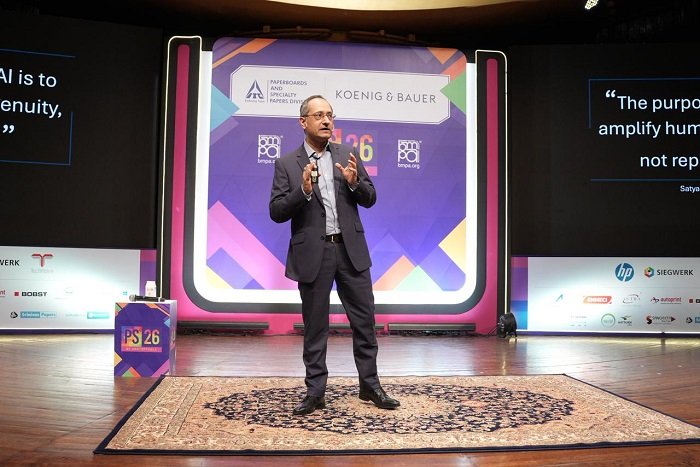
At the Print Summit 2026 organized by the Bombay Master Printers’ Association (BMPA) at Mumbai’s NCPA on 4 February, Gaurav Kataria, vice president – digital (manufacturing) and CDIO at ITC’s Paperboard and Specialty Papers Division, highlighted how artificial intelligence is impacting industries worldwide, including print and packaging.
A BITS Pilani graduate and Harvard Business School alumnus, Kataria described AI as an omnipresent force that is transforming variety of industries such as finance, travel, healthcare, education, manufacturing, and consumer services. Talking about concerns about automation replacing jobs, he said that AI is more likely to augment human capability rather than replace it.

Citing Google Maps as an example, Kataria explained how AI systems fuse real-time data, prediction, and simulation to guide users efficiently. He linked these capabilities to the concept of a “digital twin,” where virtual replicas of physical systems help monitor performance and predict issues before they occur.
He illustrated this with aerospace examples, where aircraft and engines equipped with thousands of sensors enable ground teams to predict maintenance needs before landing, ensuring uptime and operational efficiency. Similar predictive systems are used in motorsports, healthcare monitoring, and defense operations, where digital tools can identify problems early and trigger timely intervention.
Kataria also highlighted how AI is revolutionizing advertising and marketing production. Creative development that once took months can now be accelerated using AI-generated storyboards, virtual actors, and localized adaptations, allowing brands to produce targeted campaigns quickly and cost-effectively.
Turning to print and packaging, he cited global examples where AI-driven inspection, predictive production planning, and automated color optimization have significantly improved quality, reduced waste, and accelerated turnaround times. AI-powered inspection systems have improved defect detection and increased production speeds, predictive ERP systems have reduced overtime and improved delivery performance, and automated color engines have minimized rework while speeding up campaign production.
Closing his talk, Kataria emphasized the importance of staying customer-focused while adopting technology, arguing that businesses embracing data and AI-driven decision-making will gain sustainable competitive advantage in the evolving print and packaging landscape.