Katsura India, the joint venture for rubber roller production between the Delhi-based Provin Group and Katsura Japan, has been in production for the first three quarters of this financial year. It hosted an open house on 29 March at its new roller manufacturing plant in Faridabad, when it was already in production and supplying initial batches of rubber rollers to some of the leading offset and flexo printers in South India.
The company restores rubber rollers from presses in the field to brand-new health using imported NBR and EPDM compounds and techniques with strict adherence to the processes and standards of Katsura Japan. The EPDM rollers are for UV and varnish units. The initial focus was on the leading multicolor offset printers, whose rubber rollers need to be replaced periodically and are generally sent for re-rubberizing or remanufacturing.
The feedback from the first group of printers was excellent, and since then, representatives of all the global offset press manufacturers have visited the plant. They are impressed by the quality of the process and the testing routines for closely specified rollers. Leading newspapers have also evaluated the plant and found it to be most technically sound and quality-conscious in the country for its web offset machines.
Katsura India has experienced strong demand in the first three quarters of its first year of operation. The performance of the rollers has impressed its customers, including the leading Indian offset and label printers across the country, and the word has spread that there is an authentic and fair-priced re-rubberizing facility in the country that understands each roller’s specs and requirements.
The company has been compelled to increase its capacity by adding equipment within the first six months of operation and has also entered new segments of re-rubberizing industrial rollers. It has gradually increased production in order to maintain the high quality of its deliverables. Additional equipment is expected to be installed before the financial year ends on 31 March 2026.
Rubber roller remanufacturing processes to Japanese standards
As Akshay Kaushal, executive director of sales at the Indian joint-venture partner Provin Technos (which sells and services RMGT, Miyakoshi, and Spande offset, flexo, and digital presses, said at the open house in March, the Indian market previously offered either high-quality rollers at premium prices or low-cost alternatives with compromised quality. “That is what gave us the idea of starting a Japanese roller plant in India.” Kaushal himself underwent a two-month training program in Japan to gain in-depth knowledge of Katsura’s rubber roller manufacturing process.
Explaining the complete roller re-manufacturing process, from initial cleaning to the final polishing and inspection, Kaushal said that, unlike many other roller factories that may leave traces of the previous rubber compound, Katsura India uses sandblasting or chemical cleaning to ensure the steel spindle is entirely free of residue. This ensures optimal rubber adhesion in the next manufacturing phase.
The mixing of rubber compounds in a contamination-free cleanroom is a critical step. The plant uses Nitrile Butadiene Rubber (NBR), a synthetic rubber copolymer known for its excellent resistance to oils, fuels, and chemicals. NBR is particularly suitable for oil-based, and the Ethylene Propylene Diene Monomer (EPDM) compound is for UV offset inks – both comprising the initial and primary target market for Katsura India’s rollers. The company maintains the specifications and the capability to remanufacture the rubber rollers of all the global offset press manufacturers.
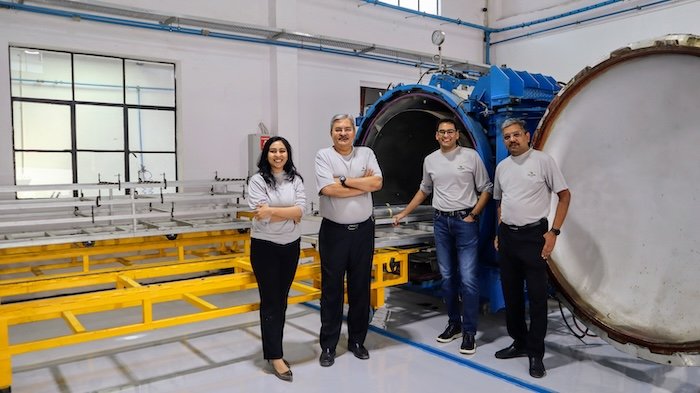
The appropriate rubber compound is processed and applied to the readied roller cores and then vulcanized. “Once we have around 80 to 100 rollers, they are placed in the curing oven for 8 to 9 hours under high air pressure,” Kaushal explained. This curing process is essential for vulcanizing the rubber, ensuring its durability and elasticity.
Following the curing stage, the rollers are transferred to the grinding and polishing section. Specialized machines grind the rollers to the required dimensions and other specifications, which include surface texture and hardness. Every roller has an identifier, and each step of the process is measured and recorded for future reference. The final stage involves quality checks. Once the rollers meet Katsura’s standards, they are cleaned, packed with protective material, labeled, and dispatched to customers.
Maintaining a clean and contamination-free environment is the top priority at Katsura India. Each section of the plant is enclosed and dust-proof, with strict access controls. Employees handling the rubber compounds and rollers wear protective gear and follow safety and quality protocols in compliance with Japanese manufacturing standards.
“We ensure that the rollers we supply to our customers across India are of the highest quality. Our processes strictly adhere to Japanese standards without any deviations,” Kaushal affirmed. Initial feedback from customers has been excellent, with printers acknowledging that the rollers match the quality and characteristics of rollers originally supplied by the OEMs with their new presses.
One can only add that the joint venture has been well-planned and established and timely. It has met early success with excellent demand from various print segments and has also been able to scale up and serve some of the industrial segments.