The Beyond the Layers webinar series has been designed to provide professionals with a structured understanding of HP’s MJF platform and its applications in production. The first three sessions explored advanced use cases in fields ranging from orthotics to automotive, explained the core components of Jet Fusion printers, and outlined their scalability for production.
The fourth session shifted focus to materials, beginning with the advantages of PA-12 (Polyamide 12), HP’s most widely adopted polymer.

Emily Levin, 3D print application engineer at HP, explained in the webinar that PA-12 strikes a balance between strength, recyclability, cost, and scalability. These properties make it the starting point for most customers evaluating additive manufacturing for production.
According to Levin, HP’s MJF technology distinguishes itself through isotropic part strength, dimensional accuracy, and repeatability — key factors that enable manufacturers to utilize 3D printing for end-use components rather than just prototyping. Within this framework, PA-12 offers a combination of high tensile strength, good elongation, impact resistance, and ease of processing.
“PA-12 is very recyclable,” Levin explained, noting the standard 80-20 refresh rate, where 80% of reused material is combined with 20% fresh powder for each build. This balance helps reduce costs and environmental impact while maintaining consistent quality. Parts printed with PA-12 on HP’s 5600 series approach the mechanical performance of injection-molded components, while offering the added benefits of complex geometries, quick iterations, and customization.
HP has also ensured PA-12 integrates seamlessly with the MJF process, producing parts with consistent isotropy and dimensional control. Thin walls, intricate lattice structures, and other advanced geometries are achievable with high precision, opening the door to applications that would be expensive with traditional manufacturing.
Levin demonstrated how PA-12 enables the production of topology-optimized parts—designs generated by algorithms to minimize weight and material use while preserving performance.
One example was an aluminium component from an HP latex printer that, through computational redesign and additive manufacturing, achieved a 93% weight reduction, 50% cost reduction, and a 95-fold lower carbon footprint. “PA-12’s reliability in thin walls and lattice structures allowed the optimized part to meet performance demands at a fraction of the mass of the original.”
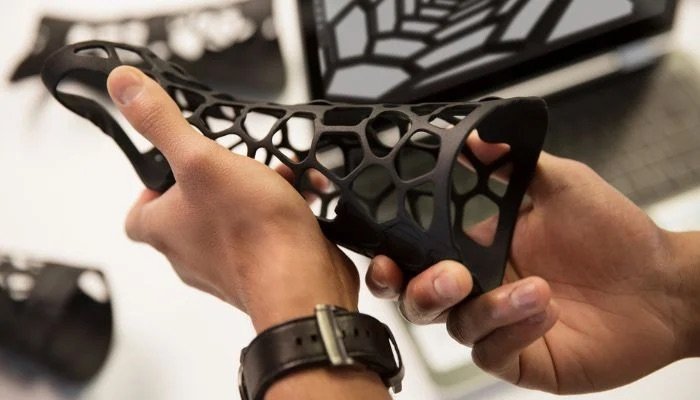
In medical applications, computational design has been applied to orthotics, such as ankle-foot devices. The result: lighter, stiffer components that improve patient outcomes while remaining durable and scalable for production.
HP’s MJF technology with PA-12 is seeing widespread adoption across industries, including automotive, robotics, medical, and aerospace. Each sector leverages different strengths of the material.
Levin highlighted examples such as Blue Flite’s production drones, where entire bodies, wings, and landing gear are printed in PA-12, and Sodecia’s robotic end-of-arm tools that integrate PA-12 parts to reduce weight while improving safety and performance.
In the concluding part of the session, she noted that while PA-12 is the most balanced material in HP’s portfolio, other options such as PA-11, polypropylene, and elastomers are available for applications requiring specific properties such as higher impact resistance or chemical stability. The upcoming webinar sessions will explore these variants in detail, including PA-12 blends with glass beads for added stiffness.