Press freedom in India figures prominently in the Reuters Institute Digital News Report 2025, which mentions how innovative collaborations among digital news platforms have been offering a fresh alternative to mainstream media narratives in the country. The report led by Nic Newman describes how, across the world, traditional news media is struggling to connect with people with declining engagement, low trust, and stagnating digital subscriptions.
This year’s survey also highlights the emerging challenge from AI platforms and chatbots. As Big Tech integrates AI summaries and other news-related features, publishers worry that these could further reduce traffic flows to websites and apps.

As traditional or institutional media struggles to stay afloat, the report mentions the rapid rise of independent news sources. “An accelerating shift towards consumption via social media and video platforms is diminishing the influence of ‘institutional journalism’ and supercharging a fragmented alternative media environment containing an array of podcasters, YouTubers, and TikTokers,” the report says.
Newman mentions in strong terms how populist politicians are bypassing traditional journalism to favor friendly partisan media, personalities, and influencers who rarely pose difficult questions. It specifically mentions the US under Donald Trump and parts of Asia, Latin America, and Eastern Europe.
Alternative ecosystems, however, also offer opportunities, especially in countries where press freedom is under threat, to bring fresh perspectives and challenge repressive governments.
The India factor
Talking of press freedom, the Reuters report mentions how in February, Tamil news outlet Vikatan Plus’ website was blocked over a cartoon critical of the prime minister as well as the alleged murder of independent journalist Mukesh Chandrakar in Chhattisgarh for exposing corruption in road contracts. It may be noted that in the RSF World Press Freedom Index, India scored 151 out of 180.
Small and independent investigative newsrooms continue to face financial-cum-regulatory challenges, such as The Reporters’ Collective, whose non-profit status was canceled by tax authorities early this year. These instances continue to raise concerns over larger problems of press freedom and journalists’ safety in the country,” the report says.
In the India section, Anjana Krishnan mentions how the country’s fragmented and diverse news space was dominated by extensive political coverage, where the “collaborative effort of digital news platforms such as The Wire, Scroll.in, NewsLaundry, Caravan, and The News Minute – known for their adversarial and independent stance on critical issues” – stood out.
The Reuters report refers to veteran journalists such as Ravish Kumar, who made a shift from traditional newsrooms to start their video-based news channels where they have more freedom to express their views, as well as influencers such as Dhruv Rathee, who commands around 28 million subscribers on YouTube.
At the same time, legacy print brands and commercial and public broadcasters such as NDTV, Times of India, Hindustan Times, and Dainik Bhaskar still enjoy high viewership – mainly among English-speaking survey respondents, as do digital-only news platforms in English such as The Print and bilingual languages such as NewsClick.
Changing sources for news
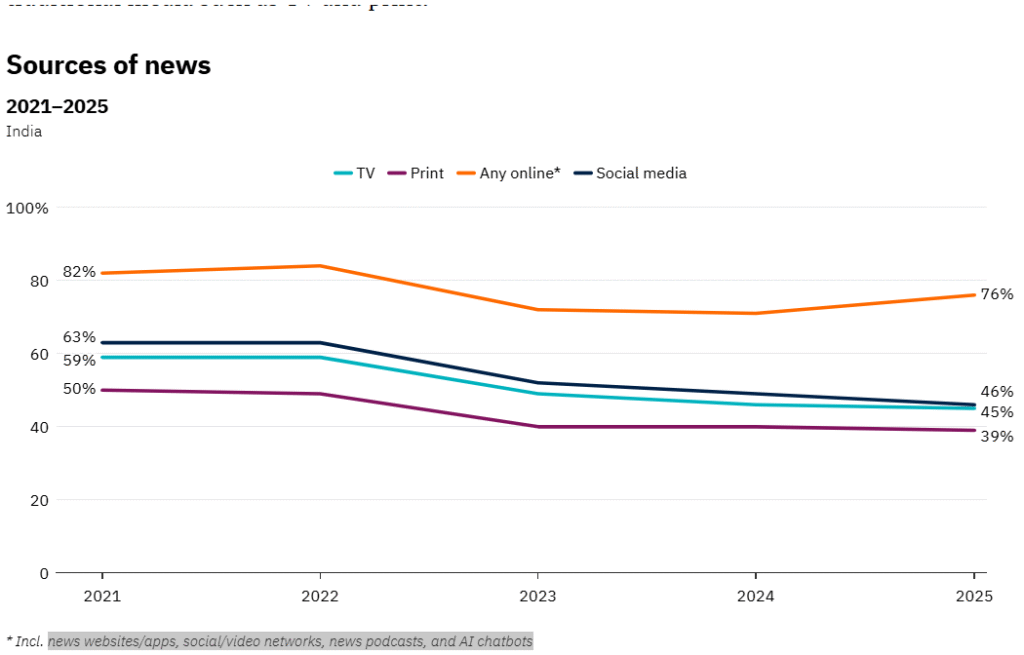
In India, 76% respondents source their news from any online source – news websites and apps, social and video networks, news podcasts, and AI chatbots – in 2025, down from 82% in 2021, the year after the Covid-19 pandemic struck, but up from 71% in 2024.
Next comes social media, from where 46% source their news, down from 2021 (63%). Television is third with 45% depending on it in 2025, down from 59% in 2021. Fifty-seven percent use smartphones, 76% computers, and 47% use tablets to read news.
Print media, which includes magazines and newspapers, has been hit hard over the years amid the digital onslaught, with only 39% using the age-old traditional medium in 2025. In 2021, 50% depended on print, which came down to 49% in 2022 and stayed at 40% in 2023 and 2024.
Trust in news has risen from 2021 (38%) to 43% in 2025. When it comes to brand trust, legacy print titles and public broadcasters scored better. “However, brands extremely critical or extremely uncritical of those in positions of power, tend to have lower trust scores in a polarized environment,” it said.
In an age where privately run organizations rule the roost, it was interesting to note that the government-run All India Radio and DD India fare quite well in the trust factor with 65% and 64% scores, respectively. Trust in regional or local newspapers is also quite high at 62%.
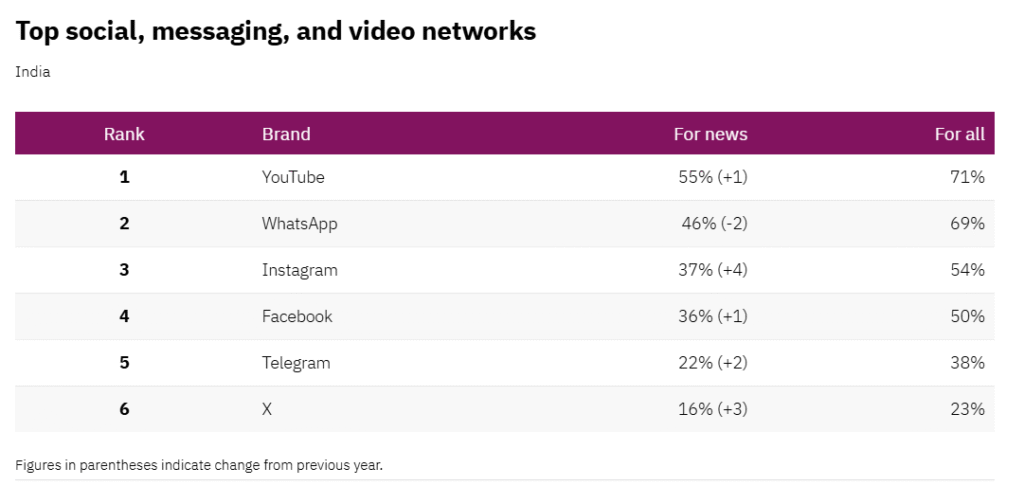
kinds of information.
Among the top social, messaging, and video networks, YouTube tops with 55% using it for news and 71% for all kinds of information. Interestingly, names such as Ravish Kumar, Dhruv Rathee, and many others have a better fan following on YouTube than many traditional news sources. The other news sources are WhatsApp 46%, Instagram 37%, Facebook (36%), Telegram (22%) and X (formerly Twitter) 16%.
The fourteenth edition of the Reuters Digital News Report, based on data from six continents and 48 markets, was led by Nic Newman with Amy Ross Arguedas, Craig T. Robertson, Rasmus Kleis Nielsen, and Richard Fletcher. Anjana Krishnan, research associate at the Asian College of Journalism, Chennai, contributed to the India section of the Reuters report.