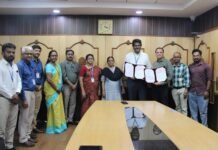
Raju says that higher education is not about the most exclusive college campus or expensive and air conditioned buildings and computerized class rooms – it is about the quality of teachers.
In the current method of eval- uation and approval of a medical or en- gineering college, the quality of the teachers is not assessed, whereas land, building and the number of chairs and tables are all counted and considered essential. There is a need to evaluate teachers and their performance along with the performance of their students and to create a quality bench mark that is available in all developed and devel- oping nations of the world.

In too many places, even ‘educational hubs’, indus- trialists and property dealers have in- vested heavily in schools and colleges because they consider it a safe invest- ment that gives regular fixed income just like a property on rent.
Teachers in India are no longer poorly paid. Amartya Sen quotes a re- cent survey in his latest book, An Uncertain Glory: India and its Contradictions, that reveals that an Indian pri- mary school teacher earns five times more than the average Indian while in some of the poorer states like Bihar and Uttar Pradesh, teachers earn fifteen times as much an average citizen. Quite deservedly, teachers in higher educa- tion in India are much better paid than the average citizen.
Thus, the problem is not anymore of low salaries but that of poor teaching efficiencies across the board, according to Sen.
Political appointees versus an inte- grated education policy
The problem according to Raju, lies with the goal setting from the top. The vice chancellor of a university is often a political appointee. Though chosen from a field of academics, he or she is often given specific goals by political masters that include the deployment of funds and possibly siphoning these out of the system. “
They are simply not fo- cussed on education but on the busines sside of investment in building and in- frastructure. I have invested over Rs. 1,800 crore in the dozens of schools and colleges I have built in the last forty years, but for me the quality of teachers and students will always be a priority,” says Raju.
In his opinion, higher education should be a central subject under a sin- gle ministry to ensure a coherent and single syllabus for students. With three types of universities operating in India – central government universities, state government universities and deemed universities under the University Grants Commission of the government, each have their own standards and courses.
So a doctor with a professional degree from Andhra Pradesh has a different ed- ucation than a doctor in Madhya Pradesh. Raju says, “If our college wants to teach a good course from any uni- versity it cannot, as it can choose cours- es only from the university to which it is affiliated. There is a need to have an in- tegrated policy for education.