In response to the recently published results of the 2022 Program for International Student Assessment (PISA) by the OECD, European printing industry association Intergraf released a statement calling for a balanced approach to education, emphasizing the importance of retaining print materials in the learning process.
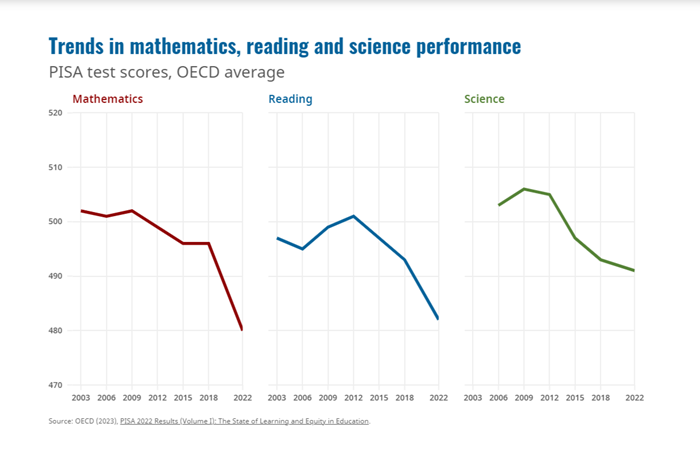
The PISA 2022 results show a significant decline in student performance in reading, falling by 10 points in OECD (Organisation for Economic Co-operation and Development) countries. PISA measures 15-year-olds’ ability to use their reading, mathematics and science knowledge and skills to meet real-life challenges.

This is a substantial drop, equivalent to half a year’s worth of learning in reading. This decline is unprecedented in the history of PISA, as the OECD average score has never changed by more than five points in reading between consecutive assessments. While the Covid-19 pandemic appears to be a factor contributing to this decline, trend analysis reveals pre-pandemic declines in reading performance, thus indicating a long-term problem.
According to PISA 2022, Singapore, Ireland, Japan, Korea, Chinese Taipei and Estonia score best at reading, while several European countries, including Slovenia, the Netherlands, Slovakia, Malta, Serbia, Iceland, Greece, Romania and Cyprus, perform statistically significantly below the OECD average.
Most European countries hover around the OECD average, with the UK, Finland, Denmark, Poland, Czech Republic, Sweden, Switzerland, and Italy performing above average. However, unprecedented drops in performance occurred in Norway, the Netherlands, Poland, Finland, Slovenia, Germany, Spain, Sweden, Greece, France, and Iceland. On average, 26% of students across OECD countries are classified as low performers in reading.
Past data shows that 68% of students in OECD countries exhibit limited or no digital navigation skills (PISA 2018), whereas the freshly released assessment points out that moderate digital device use is associated with higher academic performance, while excessive use or misuse correlates with lower academic scores. Additionally, it is interesting to note that 45% of students experience anxiety without their digital devices, impacting life satisfaction and stress resistance. Notably, spending more than seven hours per day on digital devices for learning activities is associated with lower math scores (no information given on the effects on reading).
During the most recent Social Dialogue meeting of the graphical industry, hosted by the European Commission in Brussels, Professor Anne Mangen from the Reading Centre at the University of Stavanger highlighted a robust correlation between reading long, linear texts in print and better reading skills.
Moreover, she discussed the adverse effects of screens on reading comprehension, particularly when dealing with informational texts. These findings are supported by the results of 54 experiments (link to research) involving over 170,000 participants, consistently showing a significant advantage for paper-based reading, particularly with informational texts.
Research suggests (Delgado et al. 2018; PISA 2022) that digital environments are less conducive to fostering deep comprehension whereas paper-based reading offers a more substantial advantage in situations demanding increased mental effort, such as reading under time pressure or tackling complex texts. Additionally, screen reading tends to prompt fast and shallow processing, while reading in print better supports in-depth reading, especially for longer and more complex texts. Thus, research points to negative correlations between extensive digital reading and overall reading skills. Intergraf calls for a broader consideration of the impact of digital devices on comprehension and skill development.
Considering concerns about declining basic literacy skills linked to excessive digitalization in education, Intergraf strongly supports Sweden’s recent initiative to shift its education focus from digital devices to printed textbooks. Despite Swedish students still outperforming the European average in reading, a decline observed between 2016 and 2021 has prompted a reassessment of educational methods. Sweden has earmarked approximately SEK 650 million (over EUR 55 million) for printed schoolbooks in 2023 and SEK 500 million (EUR 42.5 million) in 2024, aiming to provide one book per student per subject in primary schools.
Literacy continues to be one of the most important pillars of today’s society. Ensuring that young people can read well and understand the world around them is a prerequisite for their participation in our democratic societies.
Considering the unprecedented drop in literacy for reading, math and science and to future-proof European education systems, Intergraf strongly recommends a thoughtful approach and research-based decision-making when deciding on digital or print in education. It is crucial to strike a balance between print and digital materials, considering the strengths and weaknesses of each.
As print offers distinct advantages in terms of concentration, comprehension, retention, and the development of deep reading skills, it is essential to recognize print books as an integral and enduring component of education in schools.